

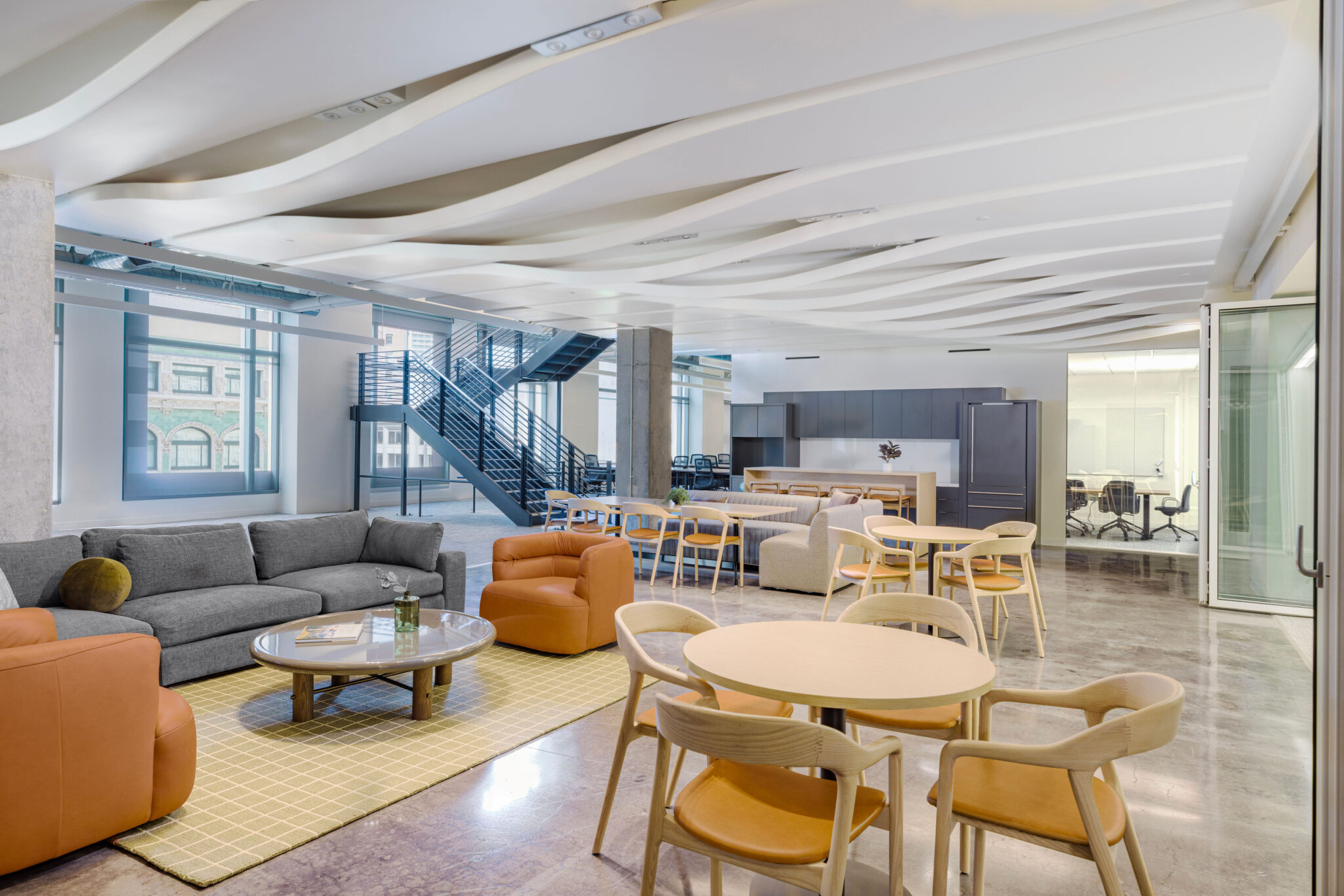
An office fit-out turns an existing commercial space into a workplace configured for a specific organization. The work may include partitions, ceilings, finishes, millwork, lighting, power, data, plumbing, HVAC modifications, fire-life-safety coordination, furniture and specialty systems—but the actual scope depends on the starting condition, lease and approved documents.
This guide helps owners and tenants compare fit-out conditions, plan the delivery process and prepare a decision-ready brief. Terms such as shell and core, Category A, Category A+ and Category B are not standardized specifications in the United States. Define every inclusion in the lease, work letter and drawings.
Planning a Bay Area office project? Review our office and corporate construction and commercial interior build-out capabilities for the commercial service context behind this guide.
What Is an Office Fit-Out?
An office fit-out adapts a leased or owned space to the tenant’s operational program. It begins with a documented delivery condition and ends with the contracted turnover scope. Fit-out, build-out and tenant improvement often overlap in everyday use; the agreement should clarify whether they refer to the same work on a particular project.
Fit-out vs. renovation
A fit-out commonly describes completing or customizing a space for occupancy. A renovation commonly describes altering an existing finished office. A project can involve both—for example, demolishing part of a second-generation office and fitting out a new layout. Use our office renovation checklist when work will occur in an existing or occupied workplace.
Office Fit-Out Categories: Verify the Scope, Not the Label

Shell and core
This generally refers to the primary building structure, enclosure and selected base-building systems, with the tenant interior substantially unfinished. Confirm slab, walls, electrical service, HVAC, plumbing, fire protection, accessibility and utility connection points rather than assuming they are included or adequate.
Category A
Category A is often used for a neutral landlord-delivered interior with selected ceilings, lighting, finishes or building-services distribution. It may not include the tenant’s final layout, rooms, technology or furniture. The exact market definition varies.
Category A+
Category A+ often describes a more complete or market-ready condition between Category A and a tenant-specific fit-out. It may include meeting rooms, furniture or other reusable components. Confirm ownership, quality, quantities, warranties and whether elements can be reconfigured.
Category B
Category B commonly refers to the tenant-specific workplace: final rooms, finishes, branding, millwork, furniture, technology and specialized operational needs. It still does not define a universal quality level or system scope.
For white-box, gray-shell and warm-shell terminology, use the white-box construction guide. In every case, the written component scope controls.
Office Fit-Out Planning Process
1. Define the workplace program
Document headcount, work modes, privacy, meeting, support, storage, reception, accessibility, technology, security and equipment needs. Separate current requirements from optional future capacity.
2. Verify the property and delivery condition
Review available drawings, surveys, landlord criteria and existing systems. Confirm dimensions, structure, power, HVAC, plumbing, fire-life-safety interfaces, accessibility route, loading, elevators, roof access and after-hours rules. Existing equipment should be evaluated rather than assumed usable.
3. Align the lease and responsibility matrix
Identify landlord work, tenant work, approvals, allowance eligibility, utility obligations, restoration requirements and turnover dates. Commercial real-estate and legal advisers should address lease interpretation; the project team should translate the agreed scope into design and construction documents.
4. Test-fit before committing
A test fit can determine whether the program reasonably fits the space and whether major systems or code considerations may affect feasibility. It is not a permit set or guarantee of agency approval.
5. Coordinate design and engineering
The appropriate design professionals develop the documents for the project scope and jurisdiction. Coordinate architecture with mechanical, electrical, plumbing, fire-life-safety, structural, acoustic, lighting, technology, security and furniture requirements as applicable.
6. Establish the budget and schedule basis
Avoid relying on a universal office-fit-out price per square foot. Existing conditions, location, size, quality, building access, system capacity, phasing, design, permits and procurement can materially change cost. Use a documented commercial construction estimate and project schedule with the same scope assumptions.
Office fit-out cost drivers to document
| Cost driver | Questions the estimate should answer |
|---|---|
| Starting condition | What can remain, what requires investigation, and what demolition or remediation is included? |
| Program and quality | Which rooms, finishes, millwork, equipment and performance requirements define the scope? |
| Building systems | Is existing HVAC, electrical, plumbing and fire-life-safety capacity available and suitable for the design? |
| Property logistics | How do access, elevators, loading, work hours, occupied areas, shutdowns and protection affect the work? |
| Design and approvals | Which professional services, landlord reviews, permits, testing and inspections belong in the total project budget? |
| Procurement and timing | Which selections, long-lead products, escalation assumptions and required-by dates control the forecast? |
The table identifies inputs, not prices. A useful comparison states the drawing revision, inclusions, allowances, exclusions and owner costs behind each number.
How to Use 2026 Office Fit-Out Cost Benchmarks
Published cost guides can help an owner test whether an early capital plan is in the right order of magnitude, but they are not interchangeable estimates. Cushman & Wakefield’s 2026 Americas guide reports an average fit-out construction cost of $149 per square foot across its surveyed markets and identifies San Francisco, San Jose and Seattle among the highest-cost markets. Its supporting methodology separates construction cost from categories such as technology, audio-visual systems, security, furniture and soft costs. JLL’s 2026 global research reports a $205-per-square-foot benchmark for a medium-quality corporate fit-out across 68 cities. The figures answer different questions because market mix, quality level and included costs differ.
| Before using a benchmark | What to verify |
|---|---|
| Geography and pricing date | Confirm the city, currency, escalation date and whether local labor, seismic, access and permitting conditions are reflected. |
| Starting condition | Identify demolition, retained work, shell condition and base-building deficiencies rather than assuming a neutral starting point. |
| Included project costs | Separate construction, design and consulting, permits, technology, security, furniture, moving, contingency and other owner costs. |
| Quality and operating program | Match the benchmark to the actual room mix, finishes, acoustics, equipment, privacy, workplace technology and performance criteria. |
In preconstruction, we do not apply a published rate to a lease as though it were a quote. We reconcile the project program, documented existing conditions, drawing revision, landlord requirements, inclusions, exclusions and required-by date, then build a project-specific estimate. This is especially important in the Bay Area, where access, existing systems and approval requirements can materially alter an otherwise similar scope.
7. Plan procurement and construction logistics
Identify long-lead equipment, owner selections, submittal deadlines, freight access, working hours, shutdowns, noise restrictions, temporary protection and neighboring tenants. If the office or building remains occupied, define separation, egress, housekeeping and communication procedures before work begins.
8. Verify turnover and move readiness
Plan inspections, testing, commissioning, punch-list work, training, manuals, warranties, keys, access control, furniture, technology, moving and occupancy documentation. “Construction complete” and “ready for business operations” may be different milestones.
San Francisco Office Fit-Out Readiness: What We Verify Before Construction
A signed lease establishes commercial obligations, but it does not by itself establish a permit-ready or buildable construction scope. For a San Francisco office fit-out, the project team should connect the lease and operating program to the property’s legal use, existing conditions, coordinated design, agency path, trade work and turnover requirements.
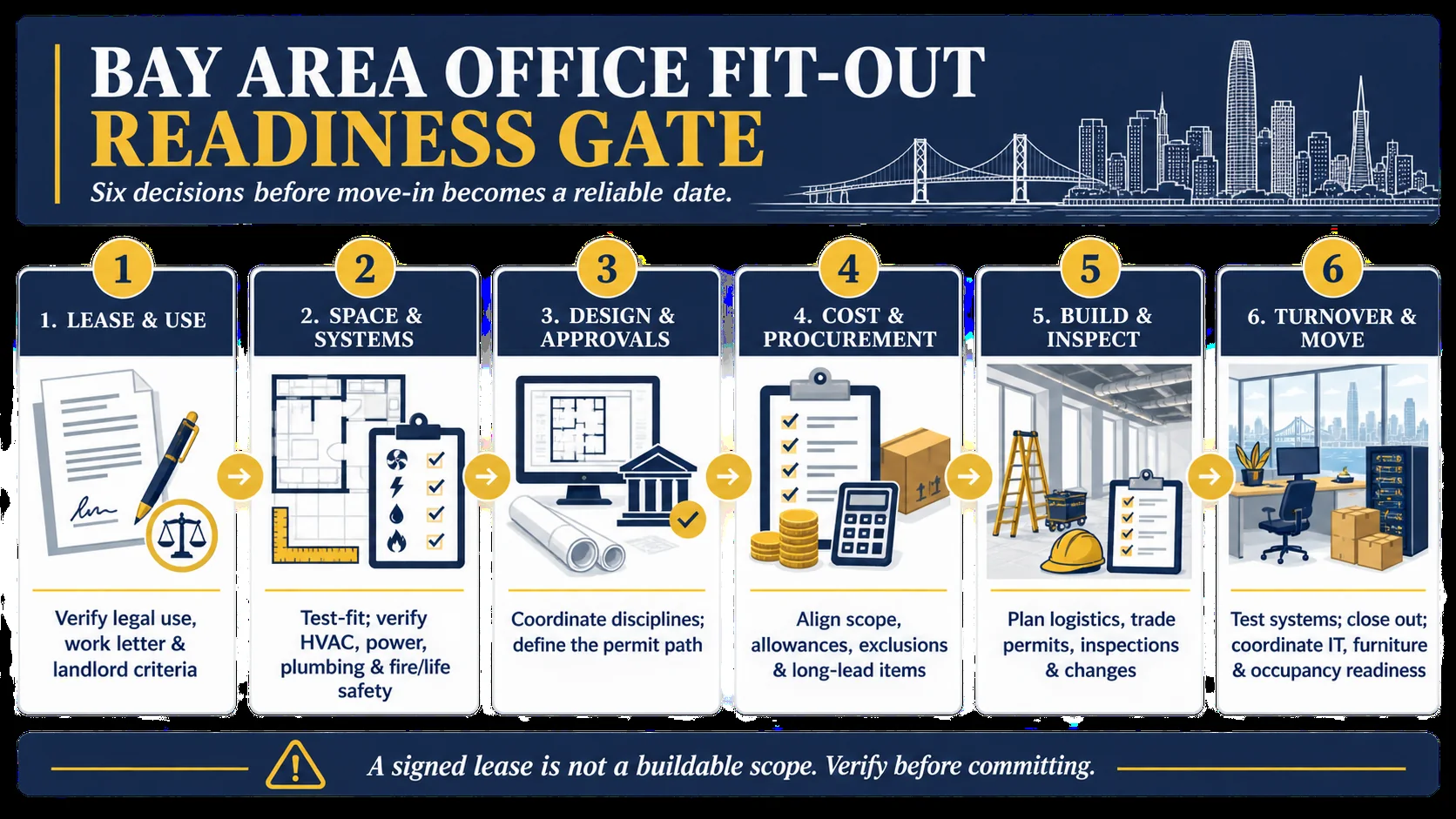
- Confirm use, occupancy and property information. Verify the current and proposed use, suite area, occupant load and known property constraints with the appropriate advisers and design professionals.
- Reconcile the lease and landlord criteria. Document the work letter, allowance eligibility, approval steps, restoration obligations, insurance requirements, building rules and responsibility matrix.
- Investigate the space and base-building systems. Confirm dimensions, accessible routes and the available capacity and condition of HVAC, electrical, plumbing and fire-life-safety systems. Record what remains unverified.
- Coordinate the application package and reviews. San Francisco’s Department of Building Inspection explains that an application begins with a completeness check and may be reviewed by multiple City departments. The required route depends on the project. Use current SF.gov permit guidance rather than assuming a universal review duration.
- Connect building and trade permits to the field plan. Coordinate the approved documents, applicable electrical and plumbing/mechanical permits, inspections, shutdowns and landlord access requirements. The City’s inspection guidance treats building and trade inspections as distinct workflows.
- Define final completion and operational readiness separately. Plan testing, inspections, punch-list work, closeout documents, furniture, technology, security, moving and staff readiness. Final construction work and the tenant’s ability to operate are related but different milestones.
Accessibility must also be evaluated from the actual alteration scope. The U.S. Access Board’s alteration guidance explains that work affecting a primary-function area can trigger accessible-path-of-travel requirements, subject to the applicable regulations and project conditions. Qualified professionals should determine how federal, state and local requirements apply to the specific space.
What an Office Fit-Out Contractor Scope May Include
- Preconstruction, constructability and logistics planning.
- Demolition and temporary protection.
- Partitions, doors, ceilings, finishes and millwork.
- Trade coordination for power, lighting, data pathways, plumbing and HVAC.
- Fire-life-safety and accessibility work within the contracted scope.
- Submittals, procurement, schedule and field coordination.
- Testing, inspections, punch list and closeout support.
Responsibilities vary by delivery method and agreement. A general contractor should not be assumed to provide architectural, engineering, legal, landlord or authority services unless specifically contracted and qualified.
Owner Office Fit-Out Checklist
- Is the starting condition documented component by component?
- Do the program and test fit reflect actual operations and equipment?
- Are landlord, tenant, designer, contractor and vendor responsibilities assigned?
- Are system capacity and existing-condition assumptions identified?
- Do the estimate and schedule use the same drawings, scope and phasing?
- Are owner selections and long-lead releases tied to required-by dates?
- Are access, shutdown, noise and occupied-building restrictions included?
- Are permits and approvals treated as project-specific rather than guaranteed?
- Are furniture, technology, security and moving coordinated with construction?
- Are turnover requirements defined before work begins?
Common Office Fit-Out Mistakes and the Control That Prevents Them
| Common mistake | Why it creates risk | Practical control |
|---|---|---|
| Signing before completing a test fit | The program may not fit the available area, circulation or system constraints. | Test the actual headcount, rooms, equipment, privacy and support needs before relying on the space. |
| Using a fit-out label as the scope | “Category A,” “A+” or “white box” can mean different things to different parties. | Define every component in the lease, work letter, drawings and responsibility matrix. |
| Comparing bids built from different assumptions | A lower total may omit logistics, systems, permits, testing or owner costs included elsewhere. | Issue the same documents and require visible inclusions, exclusions, allowances and alternates. |
| Checking building systems too late | Capacity or condition problems can force redesign, added scope or schedule changes. | Investigate existing HVAC, power, plumbing and fire-life-safety interfaces during feasibility and design. |
| Leaving landlord and agency approvals outside the schedule | The construction start may depend on decisions that are not controlled by field labor. | Show submittal, review, response and approval activities as real schedule milestones. |
| Delaying owner selections and long-lead releases | Late decisions can disrupt procurement and sequencing. | Create a selection schedule tied to design decisions, submittals and required-on-site dates. |
| Treating IT, AV, security and furniture as separate move-day tasks | Pathways, power, clearances and installation sequences may conflict with construction. | Coordinate owner vendors with the design and construction schedule before rough-in and closeout. |
| Equating construction completion with move readiness | Inspections, testing, keys, training, technology and furniture may still be incomplete. | Maintain separate construction, closeout and operational-readiness milestones. |
Download the Bay Area Office Fit-Out Owner Readiness Worksheet (PDF) to record the decisions that should be resolved before construction and move-in planning are treated as reliable.
What to Include in an Office Fit-Out Contractor Brief
Before requesting a proposal, assemble the best current information available. Mark missing items as open decisions rather than allowing bidders to make different silent assumptions.
- Property address, suite, area and documented delivery condition.
- Lease work letter, landlord criteria and responsibility matrix.
- Workplace program, test fit and current drawing package.
- Required rooms, equipment, finishes, technology and owner-furnished items.
- Known system capacities, surveys, investigations and existing-condition records.
- Target milestones, move constraints, working hours, loading and access rules.
- Approval, permit, insurance, testing and closeout requirements known at the time.
- Alternates, allowances and unresolved decisions that should be priced transparently.
How to Evaluate an Office Fit-Out Contractor
Compare teams against the actual project rather than “best contractor” marketing. Review relevant commercial-office work, proposed personnel, licensing and insurance applicable to the scope, preconstruction approach, occupied-space planning, schedule method, estimate transparency, exclusions, communication and closeout process. Verify claims through comparable project records and references.
Review the contractor’s role alongside the design team and landlord. The lowest initial number is not comparable if it omits logistics, system coordination, testing or closeout required by another proposal.
Relevant Constructive Solutions Office Project Evidence
The following portfolio records provide first-party examples of comparable commercial interior delivery. They do not establish a universal scope, cost or outcome for another project.
- 799 Market Street, 6th and 7th Floors — a two-floor San Francisco market-ready/spec buildout delivered by Constructive Solutions as design-build contractor.
- Tidewater Capital Tenant Improvement — a Bay Area commercial tenant improvement whose documented scope included demolition, finishes, building systems, glazing, millwork, appliances and lighting.
Office Fit-Out FAQs
How much does an office fit-out cost?
There is no dependable universal rate. Develop a project-specific estimate based on the delivery condition, program, systems, design, location, logistics, schedule and quality. Separate allowances, exclusions, owner costs and contingency.
How long does an office fit-out take?
Duration depends on design readiness, approvals, procurement, size, complexity, access and phasing. Use a milestone schedule that includes owner and landlord decisions, permits, submittals, fabrication, construction, inspections and move-in dependencies.
Are Category A and Category B defined by code?
They are commercial real-estate and fit-out labels, not universal code classifications. Define the actual components in the lease, work letter and drawings.
Can an office remain occupied during a fit-out?
Sometimes, but feasibility depends on scope, separation, egress, building systems, noise, dust, shutdowns and operational tolerance. Develop a project-specific phasing and protection plan.
Does a sustainable material guarantee certification or energy savings?
No. Certification and building performance depend on the applicable program, complete design, installation, operations and verification. Establish project-specific goals with qualified professionals.
Move From a Real-Estate Label to a Buildable Scope
Constructive Solutions, Inc. serves commercial clients in San Francisco and the Bay Area. Review our office construction, commercial interior build-out, preconstruction and portfolio resources, or contact the team about a defined project.
Constructive Solutions, Inc. is a full-service commercial construction company serving San Francisco and Bay Area.
Whatever your vision, we have the resources, experience, and insight to make your concept a reality, and a space where your business can flourish.
Call Us Now for Estimate






Leave a Reply