

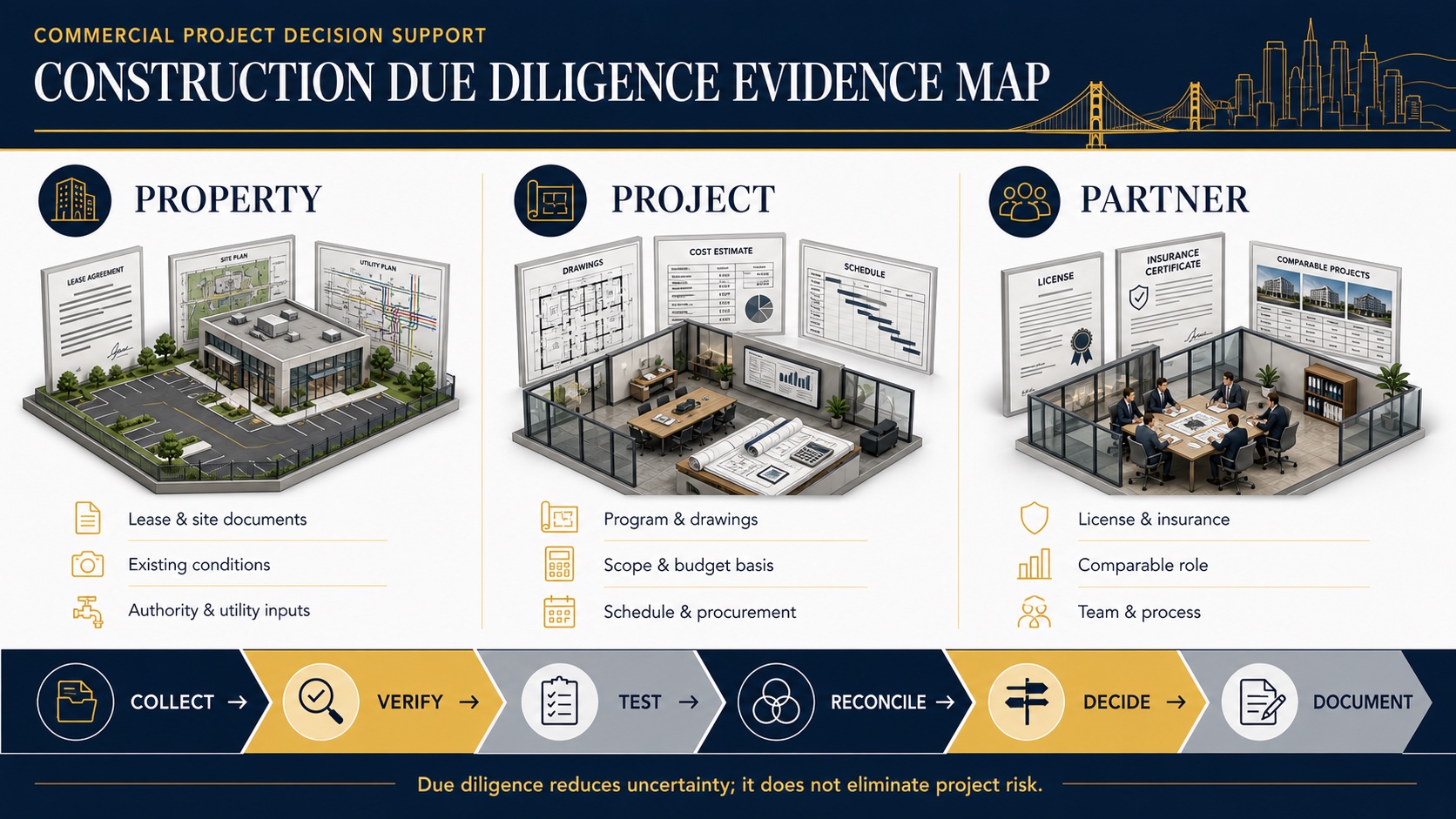
Construction due diligence is the disciplined review of property, project and delivery-partner evidence before an owner commits to a commercial construction decision. It tests what is known, what is assumed, what remains unresolved, and which specialist should verify each issue. The objective is a better-defined decision basis—not a promise that every condition, approval, cost or schedule outcome can be predicted.
A construction due diligence company or preconstruction team may coordinate parts of this review, but it does not replace architects, engineers, environmental consultants, surveyors, attorneys, insurance advisers, authorities or the owner’s own decision-making. Define the scope and responsible party for every diligence item.
Three evidence tracks: property, project and partner
A useful review keeps three tracks separate. Property diligence asks what the site and building permit. Project diligence tests whether the proposed program, documents, budget and schedule share a coherent basis. Partner diligence verifies who will perform the work, under what responsibility, and with what relevant evidence.
| Evidence track | Questions to answer | Possible reviewers |
|---|---|---|
| Property | What do the lease, surveys, reports, utilities, building rules and observed conditions indicate? What has not been tested? | Owner, attorney, broker, architect, engineers, environmental and other specialists |
| Project | Is the use and program sufficiently defined? Do drawings, scope, budget and schedule use the same assumptions? | Owner, design team, contractor or construction manager, cost and scheduling advisers |
| Partner | Are the entity, credentials, role, relevant projects, people, capacity and commercial terms verified? | Owner, counsel, broker, lender and qualified construction reviewers |
Property diligence: understand the place before pricing the work
Commercial construction begins within physical and contractual constraints. Gather available leases and work letters, title or survey information where relevant, as-built drawings, prior reports, landlord criteria, building-system data, utility information, hazardous-material information, and records of prior alterations. Then distinguish documents from verified field conditions.
Existing conditions and access
- What is visible, concealed, inaccessible or based only on an old drawing?
- Do structural, mechanical, electrical, plumbing and fire/life-safety systems have capacity for the intended use?
- What destructive investigation or specialist testing may be appropriate?
- How will loading, elevators, staging, security, deliveries, work hours and shutdowns affect the plan?
- Will adjacent tenants or ongoing operations require phasing, temporary protection or off-hours work?
Discovery should be proportionate to the decision. A visual walkthrough can identify questions; it generally cannot verify concealed assemblies or certify a system’s capacity. Record limitations explicitly.
Authority and utility inputs
Identify the relevant planning, building, fire, health, accessibility, utility and other review paths with qualified professionals. A preliminary conversation or past project does not guarantee approval. Track the use classification, permit assumptions, submittal responsibilities, utility interfaces and unresolved authority questions that form the current budget and schedule basis.
Project diligence: reconcile program, documents, cost and time
A feasibility decision is unreliable when the area program says one thing, the drawings show another, the estimate excludes key work, and the milestone plan assumes immediate procurement. Reconcile the information at the same date and design stage.
| Review item | Document the basis | Flag for decision |
|---|---|---|
| Program and design | Use, area, occupancy assumptions, equipment, finishes, performance and design deliverables | Conflicts, missing criteria and items still awaiting owner approval |
| Scope and estimate | Document set, quantities, trade coverage, allowances, exclusions, fees and contingency treatment | Scope gaps, duplicated coverage and unknown-condition exposure |
| Schedule | Design, decisions, reviews, procurement, construction, inspections and turnover assumptions | Unvalidated milestones, shutdowns, long-lead items and third-party dependencies |
| Risk register | Issue, evidence, owner, next test, decision date and possible response | Items that could change go/no-go, lease, design, procurement or contract decisions |
Partner diligence: verify the proposed role and team
Check the exact contracting entity, current credentials, required insurance, relevant completed work, proposed people, references, current workload, delivery systems and commercial terms. California owners can independently check license information through the Contractors State License Board.
Comparable experience should match the candidate’s proposed role. A company may have participated in a large project without managing the scope you now need. Ask for project facts, the names and roles of proposed personnel, and references connected to work with similar systems and constraints. Our guide on how to choose a commercial general contractor provides a more detailed selection scorecard.
A six-step construction due-diligence process
- Collect: create a document index and identify missing inputs rather than treating an incomplete folder as complete.
- Verify: confirm source, date, revision, responsible professional and whether each fact reflects current field conditions.
- Test: use site walks, measurements, targeted investigation, specialist review or scenario analysis appropriate to the decision.
- Reconcile: align program, drawings, estimate, schedule and responsibility matrix using the same assumptions.
- Decide: identify accept, mitigate, transfer, investigate further, redesign or stop options for material issues.
- Document: record the decision, evidence, owner, remaining uncertainty and how it is addressed in the lease, design or contract.
Use a decision register, not a generic checklist alone
A checklist helps coverage, but a live decision register creates accountability. For every material issue, record the evidence reviewed, open question, responsible party, next action, due date, impact if unresolved and final disposition. Link each conclusion to its source document. This prevents an old assumption from quietly becoming a project fact.
Suggested confidence labels
- Verified: supported by current documentation or appropriate professional/field verification.
- Probable: supported by credible information but still subject to a defined confirmation.
- Assumed: used temporarily for planning, with an owner and deadline for validation.
- Unknown: insufficient evidence; potential impact and next investigation are identified.
How preconstruction supports due diligence
Contractor preconstruction input can test constructability, trade coverage, site logistics, phasing, budget basis, schedule logic and procurement assumptions. It works best alongside the owner and design team, with clear boundaries around professional design, legal, environmental and authority matters. Learn more about Constructive Solutions’ commercial preconstruction services.
Project records can also demonstrate how broad scopes come together. Constructive Solutions’ 2765 16th Street core-and-shell project documents design-build work involving abatement, demolition, concrete and saw cutting, structural steel, waterproofing, roofing, electrical and plumbing. That published scope illustrates why property, project and trade evidence must be coordinated; it does not predict conditions or results elsewhere.
Frequently asked questions
What is construction due diligence?
It is a project-specific investigation and reconciliation of information relevant to a construction decision. It can include property records and conditions, project scope and feasibility inputs, cost and schedule bases, and delivery-partner evidence.
Who should perform construction due diligence?
No single participant covers every discipline. The owner typically assembles the appropriate team, which may include legal, design, engineering, environmental, construction, insurance and other specialists. Each scope and reliance limitation should be clear.
When should diligence begin?
Begin before an irreversible commitment and update it as information changes. Lease, acquisition, design, procurement and construction decisions may each require a different depth of review.
Can due diligence eliminate construction risk?
No. It can identify, test, allocate or help manage uncertainty, but concealed conditions, authority decisions, market changes and other factors can remain. The deliverable should state limitations and residual risks.
Is a contractor’s estimate a feasibility study?
Not by itself. An estimate reflects the documents and assumptions supplied at a particular time. A defensible decision also considers scope completeness, design and authority inputs, existing conditions, schedule, procurement and commercial terms.
Plan the next diligence step
If you are evaluating a Bay Area commercial property or project, assemble the available records, decision date and known unknowns before the first working session. Review Constructive Solutions’ commercial construction services and project portfolio, then contact the team to discuss whether contractor preconstruction input fits the decision.
Constructive Solutions, Inc. is a full-service commercial construction company serving San Francisco and Bay Area.
Whatever your vision, we have the resources, experience, and insight to make your concept a reality, and a space where your business can flourish.
Call Us Now for Estimate








Leave a Reply