


A general contractor is often the operational backbone of every successful construction build, ensuring every aspect works together efficiently from start to finish. Whether you’re constructing a commercial building or renovating an existing property, hiring the right general contractor can save time, reduce costly mistakes, and improve overall project quality.
In this guide, you’ll learn what a general contractor does, why their role is essential, and the key factors to consider before hiring one for your project.
What Is a General Contractor in Construction?

A general contractor (GC) is a construction professional or company responsible for managing and overseeing a building project from start to finish. Serving as the primary point of contact, the general contractor coordinates with the property owner, architects, engineers, subcontractors, and suppliers to ensure a smooth and efficient construction process.
As per the latest available data, the United States had more than 745,000 general contracting businesses employing over 7.6 million people across the construction industry.
The main responsibility of a general contractor is to deliver the project on time, within budget, and according to building codes and contract specifications. They oversee daily on-site construction work, supervise subcontractors, manage schedules and budgets, secure permits, and ensure the project complies with local building and safety regulations.
In commercial construction, a general contractor works on a wide range of projects, such as:
- Office buildings
- Retail centers
- Restaurants
- Hotels
- Warehouses
- Industrial properties
- Healthcare facilities
- Tenant improvement projects
General contractors handle every stage of the project, from pre-construction planning and active construction management to post-construction closeout. Qualities such as strong leadership, project management skills, communication, and problem-solving skills are essential for success in this role.
Whether it is a residential renovation or a large commercial development, the general contractor keeps all moving parts of the building project working together efficiently.
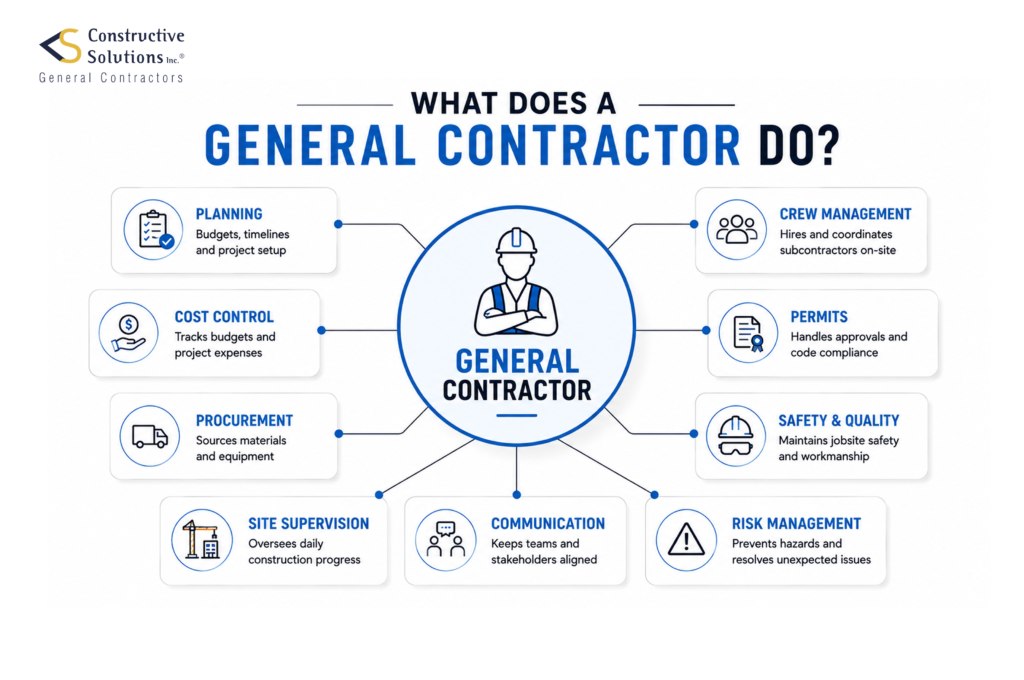
What Does a General Contractor Do? Roles and Responsibilities
To successfully manage a construction project, a general contractor takes on several key roles and responsibilities throughout each stage of the process. Let’s understand each of them in detail.
Budgeting and Cost Control
One of the main responsibilities of a general contractor is budgeting and managing costs, starting from detailed estimating and bidding in the pre-construction phase. They analyze blueprints, calculate labor, material, equipment, and overhead costs, and submit an accurate bid to the owner with 5-10% contingency allowances.
Throughout construction, general contractors track real-time expenses using project management software, manage supplier negotiations, and monitor resource allocation to prevent budget overruns. In design-build projects, this control is even tighter, as design decisions are aligned early with cost realities.
Example: During a warehouse build, a redesign to support heavier equipment required thicker slabs, triggering a formal change order. In the same period, a sudden concrete price hike pushed the contractor to apply escalation clauses outlined in the contract to adjust costs and protect margins.
Research shows that construction projects globally experience average cost overruns of nearly 28%.
Subcontractor Hiring and Coordination
Research from the Associated Builders and Contractors (ABC) shows that 80% to 90% of construction work on many projects is completed by subcontractors.
The general contractor is responsible for vetting licensed trades like excavators, electricians, plumbers, landscapers, roofers, masons, and painters, checking their insurance coverage, and negotiating clear contracts to reduce risk. They coordinate schedules to avoid delays or “trade stacking” where too many crews overlap and slow work down.
General contractors also monitor the performance of subcontractors on-site and ensure work meets building codes and specifications. If any issue arises, for example, HVAC technicians installing ductwork before electrical wiring is properly routed, it can cause rework and wasted time, something an experienced GC prevents through active scheduling and supervision.
Permitting and Code Compliance
Ensuring compliance with local zoning laws and building codes is a key pre-construction role of a general contractor. They manage the full permit lifecycle, including preparing documentation from project plans, submitting applications to local building departments, and addressing revisions to secure approvals.
Depending on the project scope and jurisdiction, they may obtain approval for:
- Building permit
- Demolition permit
- ADA compliance
- Fire safety or sprinkler permits
- Trade-specific permits (MEP, HVAC)
- Signage permit
- Environmental and other related permits
During execution, the contractor oversees site activities, schedules mandatory inspections, and performs quality checks to prevent violations, delays, or rework. Given their legal accountability, even small lapses can impact timelines or trigger penalties.
They also manage final inspections and obtain the Certificate of Occupancy for commercial use. Acting as the liaison with local authorities, the contractor ensures the project is compliant, approved, and on schedule.
Procurement of Materials and Equipment
To procure the right materials and equipment for the construction project, a general contractor sources reliable suppliers from their established network and negotiates discounted pricing.
General contractors ensure all resources meet project specifications, including:
- Construction materials such as concrete, steel, fixtures, and appliances
- Heavy equipment like cranes, excavators, and bulldozers
- Prefabricated systems
They carefully time orders and manage delivery logistics so everything arrives on site when needed, avoiding delays.
If any items fall short of expectations, the contractor promptly replaces them when necessary. Overall, all vendor decisions are aligned with client requirements and in close coordination with subcontractors.
Safety Management and Risk Control
By holding the prime contract, the general contractor carries full accountability for job site safety. Their role is to enforce OSHA standards, ensure all workers follow PPE and compliance protocols and that every subcontractor adheres to site-specific safety plans.
Risk control also involves vetting subcontractors for proper licensing and insurance, reducing legal liability and ensuring reliable performance. General contractors also manage builder’s risk insurance and workers’ compensation coverage to protect against events like fire, theft, or injuries.
They also anticipate safety risks before they escalate, whether it’s fall hazards, equipment conflicts, or unsafe sequencing to avoid on-site incidents or project shut-downs. Modern construction firms now use AI and predictive analytics for safety monitoring.

Quality Control and Contract Compliance
One of the key responsibilities of a general contractor is to deliver work exactly as defined in the contract documents. They regularly review drawings, specs, and submittals to maintain consistent workmanship with code compliance before and during execution.
Quality control also includes coordinating regular inspections, addressing defects through standardized punch lists, and holding subcontractors accountable for deficiencies. Compliance with contract terms is equally critical. Everything must meet the agreed general conditions and project specifications to avoid disputes or rework.
The Construction Industry Institute (CII) found that rework costs on average consume 5% to 12% of total construction costs.
Small deviations early can snowball into major issues, so regular checks and documentation are key to protecting both project outcomes and margins.
Site Supervision and Field Operations
Overseeing daily construction work is what a general contractor does to ensure the project runs efficiently on the ground. This includes supervising day-to-day jobsite activities and ensuring all tasks follow the project schedule and specifications. General contractors monitor labor, equipment usage, and on-time material deliveries while maintaining efficient site logistics such as access points, staging areas, and temporary utilities to minimize congestion and delays.
They rely on regular inspections, daily reports, and progress meetings to track performance and document on-site activities. They enforce strict safety protocols and emergency response plans while monitoring cleanliness and waste management to maintain a safe and organized work environment.
Continuous monitoring of the job site and real-time problem-solving help optimize workflows, reduce inefficiencies, and keep the project aligned with overall goals.
Scheduling and Progress Tracking
A general contractor is responsible for creating a detailed master timeline for the project that aligns all trades, suppliers, and resources. Using the Critical Path Method (CPM), along with scheduling tools like Microsoft Project, Procore, or Primavera P6, they map task dependencies and sequence work to minimize conflicts and delays.
The Associated General Contractors of America (AGC) reports that 72% of firms say projects have taken longer than anticipated.
Contractors then track progress throughout, update schedules, and bring subcontractor timelines into a single, coordinated plan. When delays arise, whether from material shortages, design changes, or site issues, they adjust the sequence and apply recovery strategies to stay on course.
By staying proactive in scheduling, the general contractor keeps the project moving, meets key milestones, and avoids unnecessary cost or time overruns.
Stakeholder Communication and Reporting
A general contractor acts as the central communication link between owners, architects, engineers, and subcontractors. Their key functions include:
- Managing Requests for Information (RFIs)
- Providing project updates via timely meetings, reports, and construction management software
- Coordinating efforts to keep all parties aligned on scope, schedule, and cost
When handling changes in a construction project, the contractor follows a defined process. Any design revisions or unforeseen conditions are first documented through RFIs along with cost estimates, schedule adjustments, and supporting documents like revised drawings or site reports. Once stakeholders approve the changes, they are formalized into legally binding change orders.
By keeping clear communication and documentation, general contractors help reduce the risk of any disputes.
Risk Identification and Mitigation
Every construction project involves risks. General contractors play a key role in understanding these risks and proactively minimize or mitigate them whenever possible. From worker safety and prequalifying subcontractors to budgeting and maintaining insurance coverage, contractors take steps to spot potential risks before they become costly problems.
They also coordinate closely with all project participants to prevent delays, disputes, and communication gaps. Through regular inspections, documentation, and contingency planning, they help keep projects going smoothly throughout the entire construction process.
About 53% of contractors view urgent decision-making and time pressure as the biggest risk factor, as per Autodesk/FMI research.
Case Study:
In San Jose, our experienced team identified and mitigated risk on a tech campus through safety reviews, supply-chain tracking, and seismic inspections. Despite material shortages and winter rains, we activated contingency procurement and resequenced exterior work that avoided a six-week delay and kept costs within 3% of the original budget.
Project Leadership from Planning to Closeout
A general contractor acts as the central force guiding a project from concept to completion, ensuring continuity across every phase.
In preconstruction, the role of a general contractor is to collaborate with architects and stakeholders to refine designs (in design-build) or prepare competitive bids (in design-bid-build). They establish budgets, timelines, and resource plans while conducting site reviews, feasibility checks, and risk assessments. This early planning aligns scope with cost and schedule, setting a solid foundation.
As the project advances to the construction stage, the contractor coordinates subcontractors, manages resources, tracks progress, and ensures compliance with permits and regulations. Finally, during closeout, they handle inspections, resolve punch lists, and handover documentation, ensuring the project concludes seamlessly as a unified, well-managed outcome.
Studies claim that early contractor involvement (ECI) can achieve almost 10% savings in construction time and 7% cost savings.
General Contractor vs. Construction Manager
While both roles aim to deliver a successful construction project, they operate from very different positions of control, timing, and responsibility.
General Contractor
A general contractor typically steps in after the design is finalized and the project is awarded, often through competitive bidding. They take full charge of on-site execution, manage subcontractors, procure materials, and carry financial as well as quality-related risks. In most cases, they work under a fixed-price contract, which means their profit depends on controlling costs efficiently.
Construction Manager
A construction manager (CM), on the other hand, is usually engaged earlier, often during planning or design. Instead of building, they focus on coordination, budgeting, scheduling, and advising the owner. Acting as the owner’s representative, they align closely with client interests rather than profit margins. Construction managers are typically paid a fee and do not assume liability for construction defects, except under models like CM at Risk.
Hiring a construction manager is ideal when dealing with complex projects requiring strategic oversight and client involvement, while general contractors are better suited for streamlined, execution-focused delivery.
| Aspect | General Contractor (GC) | Construction Manager (CM) |
| Project Stage Involvement | Joins after the design is finalized | Involved early planning or design phase |
| Primary Role | Executes construction work | Manages, coordinates, and advises |
| Contract Type | Lump sum / fixed price contract | Fixed fee |
| Risk | Assumes financial and quality risk | Minimal risk; focus on advisory role |
| Relationship with Owner | Independent contractor | Acts as the owner’s representative |
| Profit Incentive | Focused on protecting or improving profit margins | Focused on the owner’s best interests |
General Contractor vs Subcontractor
Understanding the difference between a general contractor and a subcontractor gets easier when you focus on their roles in day-to-day work.
General Contractor
A general contractor manages the overall project, but most of the actual construction tasks are carried out by subcontractors. These are skilled professionals who specialize in specific trades like electrical work, flooring installation, landscaping, or tiling, and are hired by the contractor to complete clearly defined tasks.
Subcontractor
Subcontractors focus entirely on their area of expertise, ensuring the work meets required codes and quality standards. They report to the general contractor rather than the project owner in most cases, allowing them to perform their work efficiently, while the general contractor coordinates their efforts to keep the project running smoothly.
| Aspect | General Contractor (GC) | Subcontractor |
| Role | Manages entire project | Performs specific trade work |
| Contract | Holds a contract with the owner | Contracted by GC |
| Scope of Work | Oversees all trades and schedules | Limited to specialized tasks (e.g., plumbing, electrical, HVAC technicians) |
| Responsibility | Accountable for overall project quality and delivery | Responsible only for assigned work |
| Communication | Main point of contact for the owner | Communicates primarily with GC |
Benefits of Working With a General Contractor
A commercial general contractor brings structure, efficiency, and reliability to your project, helping everything run smoothly from planning to final completion. Below are some of the key advantages of working with one for your next project.
- Helps save costs and reduce budget overruns through efficient project management.
- Provides expert coordination and attention to detail across the project execution using their deep industry knowledge and hands-on experience.
- Serves as a single point of communication for owners, vendors, architects, and crews.
- Delivers quality workmanship by hiring experienced tradespeople and trusted material suppliers.
- Adapts quickly to evolving project scope without disrupting progress, if signed under a design-build contract.
- Reduces liability risks by handling permits, safety compliance, and building code requirements.
- Saves time and offers peace of mind by managing daily construction operations.
How Much Do General Contractors Charge in the U.S.?
General contractors in the U.S. typically charge between 10% and 20% of the total construction cost, although fees can exceed 25% for highly complex or specialized projects. Rather than a single flat rate, these costs usually include a combination of project management fees, overhead expenses, markup, and profit margin.
The final contractor fee depends on several factors, including the project’s size, complexity, level of risk, and the type of contract used.
General Contractor Fee Models
Fixed Bid (Lump Sum) Contracts
The most common model is the fixed-bid (lump-sum) contract, where the contractor provides a single agreed-upon price for the entire scope of work.
Cost-Plus Pricing
Another widely used pricing model is the cost-plus contract, where the client pays actual construction costs plus the contractor fee or a percentage markup. Under cost-plus contracts, general contractors often apply a 10%–20% fee or markup to cover overhead, supervision, and profit.
Guaranteed Maximum Price (GMP) Contracts
Under a Guaranteed Maximum Price (GMP) contract, the contractor is reimbursed for actual costs, but pricing is capped at a negotiated maximum unless approved scope changes occur. Typical GMP contractor fees often range from 5% to 15%, sometimes combined with reimbursable “general conditions” costs.
Hourly or Time-and-Materials Billing
Some professionals charge hourly rates for consulting, supervision, or smaller projects. General contractors may charge from $50 to $150+ per hour and $300 to $500+ per day based on expertise, location, and project requirements.
Additional Project Management Fees
Many general contractors also separate a construction management fee, typically ranging from 5% to 15% of project cost. In major metro markets like New York City or San Francisco, contractor margins and management fees are often higher due to operating costs and competition.
In large-scale commercial projects, “general conditions” costs may separately account for another 6% to 12% of project value, covering expenses for temporary offices, project staff, dumpsters, utilities, and site logistics.
Markup vs. Actual Profit Margin
It’s important to note that contractor markup is not pure profit. Even if a contractor charges a 15% markup, the net profit margin is relatively low, often around 3% to 7% after overhead, insurance, payroll, bonding, and operational expenses are deducted.
| Pricing Structure | Typical GC Charges |
| Fixed Bid (Lump Sum) | Total project price with contractor markup typically built in (often 10%–20%) |
| Cost-Plus Percentage | Actual project costs + 10%–20% contractor fee/markup |
| Hourly / Time & Materials (less common) | Approximately $50–$150+ per hour |
| Project Management Fee | Typically, 5%–15% of the total project cost |
What Affects Contractor Pricing?
Contractor charges increase when projects involve higher complexity, risk, or management effort, such as:
- Occupied renovations or phased construction
- Tight schedules or night work
- Complex mechanical, electrical, and plumbing (MEP) systems
- Specialized builds (medical, laboratory, restaurants)
- Incomplete or evolving designs
- High insurance or bonding requirements
- Union labor or difficult site access
- Volatile material pricing
On the other hand, larger and well-defined projects often have lower percentage fees, since fixed management costs are spread across a higher total contract value. For example, a $250,000 tenant improvement may carry a higher percentage fee than a $25 million warehouse project.
When Should You Hire a General Contractor?
Here are common scenarios where hiring a professional general contractor helps keep the project organized, efficient, and on schedule.
New Construction or Full Renovations → Yes
For ground-up construction or major remodels, general contractors manage permits, subcontractors, scheduling, inspections, and execution.
Multiple Trades Involved → Yes
If electricians, plumbers, HVAC technicians, drywall installers, and other trades are involved, a contractor coordinates workflows to avoid delays and conflicts.
Strict Timelines or Multi-Phase Projects → Yes
Commercial and phased projects require careful scheduling, progress tracking, and consistent supervision.
Building System Upgrades → Yes
Electrical, plumbing, HVAC, drywall, and mechanical upgrades need expert oversight for safe and efficient installation.
Custom or Luxury Features → Yes
High-end finishes and custom interiors require skilled coordination and attention to detail.
Space Conversions or Adaptive Reuse → Yes
Repurposing or upgrading spaces often involves permits, zoning requirements, lease conditions, and structural modifications.
Minor Cosmetic Updates → Usually No
Smaller cosmetic projects like painting a room, replacing fixtures, or simple flooring updates often do not require a general contractor and can sometimes be handled directly by specialized trades.
Fire, Flood, or Storm Damage Restoration → Yes
General contractors manage inspections, repairs, and restoration work to safely rebuild the property.
You Don’t Have Time to Manage the Project → Yes
If you lack the time, experience, or internal team to coordinate subcontractors and schedules, hiring a contractor helps keep everything on track.
In short, hiring a general contractor becomes necessary when your construction or renovation project involves structural work, multiple moving parts, strict deadlines, or complex permits.
When You May Not Need a General Contractor
Smaller cosmetic projects like painting a room, replacing fixtures, or simple flooring updates often do not require a general contractor and can sometimes be handled directly by specialized trades.
How to Hire a General Contractor for Your Commercial Project

Hiring the right general contractor is one of the most important decisions in any construction project. Whether you are developing an office, retail space, medical facility, warehouse, or hospitality project, the contractor you choose significantly impacts the end result.
Step 1: Start With Trusted Referrals
Start your search by asking architects, engineers, developers, and business owners for referrals. Industry associations, such as Associated General Contractors or local business directories, can also help find reputable firms in your area with proven construction experience.
Step 2: Shortlist Contractors With Relevant Local Experience
Focus on general contractors that have successfully completed projects similar in size, scope, and complexity to yours. Prioritize local construction companies, who are more familiar with local regulations, subcontractor networks, and suppliers.
Step 3: Verify Licenses, Insurance, and Bonding
Before shortlisting candidates, create a thorough vetting checklist. Verify all state and local licenses, registrations, and certifications. Reputable contractors may also hold certifications such as OSHA safety training, LEED accreditation, Certified Construction Manager (CCM) credentials, or memberships in AGC.
Request proof of general liability insurance, workers’ compensation coverage, and bonding capacity to assess their financial stability.
Step 4: Review Safety and Project Management Skills
Review their safety program and ask for their Experience Modification Rate (EMR), as an EMR below 1.0 often reflects strong workplace safety practices. When evaluating their project management skills, ask how they handle scheduling, task coordination, unexpected changes, and communication throughout the build.
Step 5: Compare Detailed Bids
Get written bids with detailed cost breakdowns from at least three contractors. Do not choose based only on the lowest price. A transparent bid is usually safer than a vague or unusually low estimate that may lead to expensive surprises later.
Step 6: Check References Before Signing
Speak directly with previous clients and ask specific questions about the contractor’s quality of work, responsiveness, budget accuracy, and how they handled the overall project. Online reviews, case studies, and portfolios can also reveal patterns in performance and professionalism.
Questions to Ask Your Contractor Before Hiring
Once you shortlist a few candidates, interview them before signing a contract. Ask important questions such as:
- How many years have you worked in the commercial construction business?
- Who will be the project manager?
- How do you handle surprise delays and scope changes?
- What quality control and safety measures will your team take?
- How will you communicate project updates and how often?
- Do you work with a reliable subcontractor network?
- How do you prepare and manage pricing estimates and cost overruns?
- What kind of guarantees/warranties will you offer?
Signing the Written Agreement
Before finalizing, carefully review the contract to ensure it clearly defines the project scope, costs, timeline, payment terms, change order process, and warranties. A detailed written agreement helps reduce misunderstandings and disputes.
Red Flags to Avoid
Avoid contractors with vague contracts, poor communication, incomplete bids, a lack of licensing, or large upfront payment demands.
The best commercial general contractor will demonstrate transparency, technical expertise, and a solid track record of delivering projects on time and within budget.
Conclusion
A construction project is about turning an idea into something functional, lasting, and dependable. The right general contractor helps bring order to that process by keeping people, timelines, and expectations aligned from beginning to end. Instead of reacting to problems after they happen, experienced general contractors help prevent them early. Taking the time to choose the right professional can lead to smoother collaboration, better results, and a project that feels far more manageable every step of the way.
Across the San Francisco Bay Area, Constructive Solutions, Inc. delivers commercial construction projects with practical expertise and reliable management. Contact us today to get started.
Frequently Asked Questions (FAQs)
How much do most general contractors make?
Most general contractors in the U.S. earn between $60,000 and $130,000 annually, depending on their experience level, project size, location, and profit margins.
What not to say to a general contractor?
Avoid saying things to a general contractor like “I don’t need a contract” or “just do whatever you think is best” without clear expectations, budgets, or written agreements.
What are the 3 C’s of contractor management?
The 3 C’s of contractor management are Communication, Coordination, and Compliance.
What is the difference between a builder and a contractor?
A builder mainly focuses on physically constructing structures, while a contractor manages the broader construction project, including labor, scheduling, permits, and subcontractors. Though the roles can overlap.
What does general contractor services include?
Leading construction companies provide general contracting services such as:
- Pre-construction planning and estimating
- Project scheduling and construction management
- Subcontractor coordination and supervision
- Permit handling and code compliance
- Material and equipment procurement
- Quality/safety control and project closeout
What’s the difference between GC and CM?
A General Contractor (GC) manages and executes construction work, while a Construction Manager (CM) mainly advises, coordinates, and represents the owner throughout the project.
Relevant Resources:
Constructive Solutions, Inc. is a full-service commercial construction company serving San Francisco and Bay Area.
Whatever your vision, we have the resources, experience, and insight to make your concept a reality, and a space where your business can flourish.
Call Us Now for Estimate









Leave a Reply