

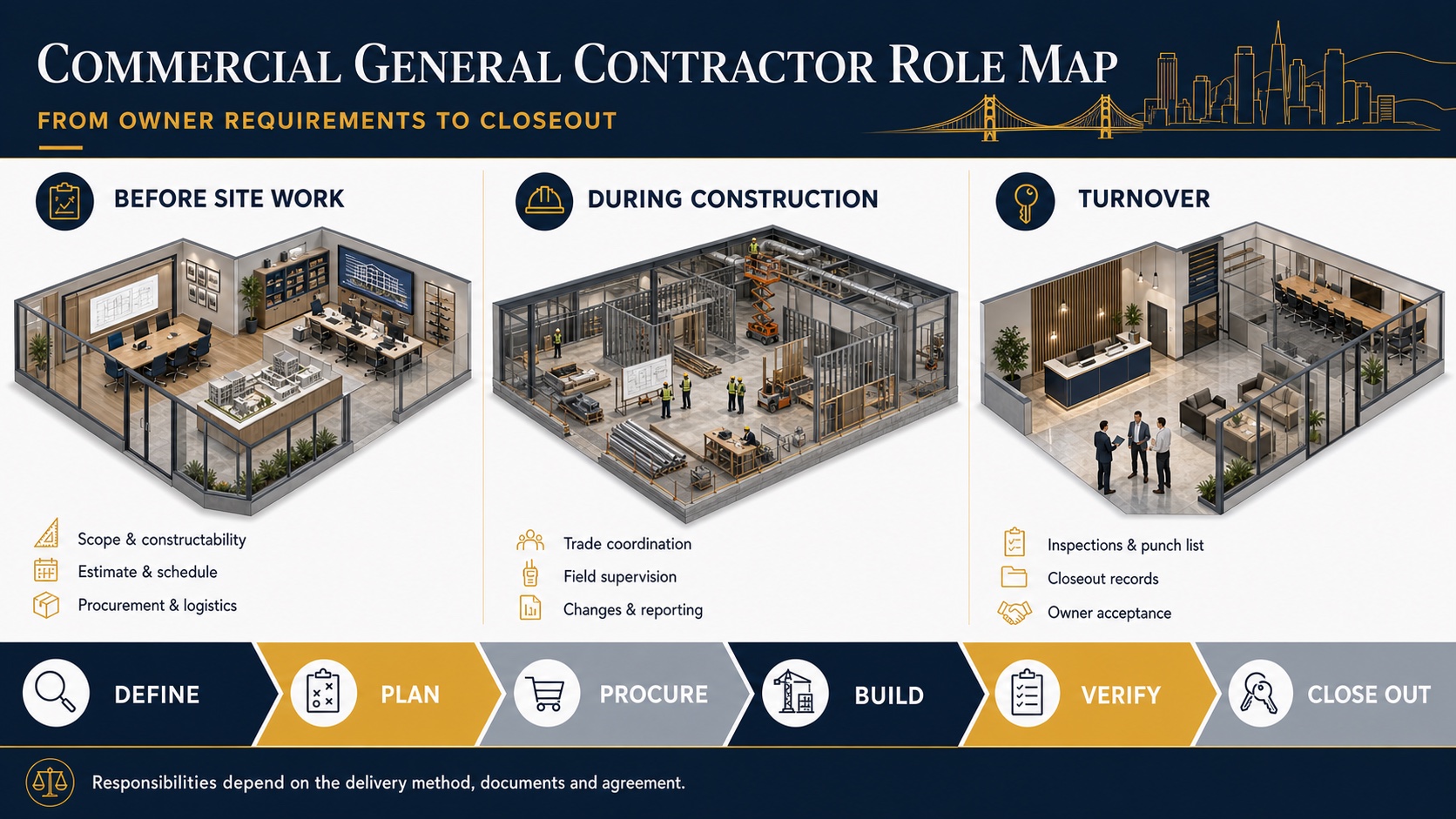
A commercial general contractor turns an owner’s requirements and the design team’s documents into a coordinated construction operation. The role commonly includes preconstruction input, trade procurement, field supervision, schedule and cost reporting, change management, inspections, and closeout. The exact boundary depends on the delivery method, drawings and specifications, permit responsibilities, and the signed agreement.
For owners comparing a general contractor vs. commercial contractor, the useful distinction is not the label alone. It is whether the firm has relevant experience with occupied buildings, commercial systems, multiple specialty trades, building-management requirements, and the documentation needed to turn over a working business space.
What does a commercial general contractor do?
A commercial GC is the central construction coordinator for the work assigned in its contract. The contractor aligns subcontractors, materials, site logistics, field sequencing, information flow, and closeout tasks around the approved project requirements. That does not mean the contractor replaces the owner, architect, engineers, authorities having jurisdiction, landlord, or independent consultants. Each party retains its own decisions and professional responsibilities.
| Project stage | Typical contractor work | Owner-facing decision or output |
|---|---|---|
| Definition and preconstruction | Review scope, existing information and constructability; develop estimate and schedule bases; identify procurement and logistics issues | A clearer basis for scope, budget, sequence and unresolved decisions |
| Procurement and mobilization | Level trade scopes, plan submittals, coordinate long-lead items, site access and building rules | Trade coverage, procurement status and mobilization plan |
| Construction | Supervise the field, coordinate trades, track information, document progress and administer changes under the agreement | Progress reporting and documented decisions |
| Verification and turnover | Coordinate inspections, punch work, training and required closeout records | Acceptance items, manuals, warranties and project records required by contract |
General contractor vs. commercial contractor: what is the difference?
“General contractor” describes a broad construction role. A commercial general contractor applies that role to offices, clinics, retail, hospitality, industrial facilities, common areas, and other business or institutional environments. A residential contractor may be highly capable in homes, but commercial work can introduce different code pathways, accessibility and life-safety coordination, landlord criteria, occupied-building constraints, commercial mechanical and electrical systems, and stakeholder review.
The right comparison is therefore project-specific. Ask whether the candidate has performed a comparable scope in a similar building type and delivery role—not merely whether its portfolio contains a project with a familiar name.
Commercial experience matters most when the constraints are commercial
- Occupied operations: phasing, noise, dust, access and shutdown planning may need to protect tenants or ongoing business activity.
- Building coordination: property management, loading, elevators, security, work hours and insurance requirements can affect execution.
- Specialty systems: HVAC, electrical, plumbing, fire/life-safety, low-voltage and equipment interfaces require coordinated trade scopes.
- Document control: submittals, requests for information, changes, inspections and turnover records need an agreed process.
Who is responsible for what?
Responsibility varies by agreement, but an owner should avoid assuming the GC “owns everything.” The owner defines business requirements and makes timely commercial decisions. Architects and engineers remain responsible for their professional design services. Authorities review and inspect within their jurisdiction. The contractor manages the construction work assigned to it and coordinates the contracted trades.
| Topic | Confirm before construction |
|---|---|
| Design and performance criteria | Who develops, reviews and approves each document or delegated-design item? |
| Permits and inspections | Who prepares, submits, pays for, tracks and closes each requirement? |
| Existing conditions | What has been observed or tested, and what remains an assumption? |
| Cost and schedule | What documents, allowances, exclusions, lead times and owner decisions form the basis? |
| Closeout | Which records, training, testing, punch and acceptance items are required? |
How delivery method changes the contractor’s role
In design-bid-build, the contractor generally prices and builds from a separate design team’s completed documents, subject to the agreement. In negotiated work, the contractor may contribute earlier estimating, constructability and procurement input. In design-build, design and construction responsibilities are organized under one contractual structure, but the exact scope still depends on the agreement and applicable professional requirements.
Early contractor involvement can reveal sequencing, access, phasing or procurement questions while decisions are still being developed. It is not a substitute for complete owner requirements, appropriate design, site investigation, or professional review. Our commercial preconstruction services page explains how estimating, constructability, logistics and procurement planning can support that early definition.
What relevant project evidence looks like
Comparable evidence should show the contractor’s actual role and scope. For example, Constructive Solutions documents a 5,200-square-foot, seven-week design-build tenant improvement for CareMessage in San Francisco. The published scope includes demolition, framing, HVAC, electrical, data/low-voltage, millwork and finishes. At 799 Market Street, the portfolio documents a two-floor market-ready buildout. Those facts help an owner assess relevance; they should not be treated as a prediction for another project.
Questions to ask before engaging a commercial GC
- Which completed projects are comparable in building type, scope, size, constraints and your contractual role?
- Who will lead preconstruction, project management and field supervision on this project?
- What drawings, assumptions, allowances and exclusions form the estimate?
- How will submittals, questions, changes, schedule updates and owner decisions be documented?
- Which long-lead items, shutdowns, access rules or existing conditions need early resolution?
- What closeout documents and acceptance steps are included?
California owners can verify a contractor’s license classification and current status directly through the Contractors State License Board. Insurance, bonding and any project-specific legal or professional requirements should also be reviewed for the actual engagement.
Frequently asked questions
Is every general contractor a commercial contractor?
No. Licensing and allowed scope are jurisdiction-specific, and practical commercial capability depends on relevant work, people, systems and capacity. Verify both the current license information and the team’s comparable role.
Does a commercial general contractor design the project?
Not automatically. Design responsibility depends on the delivery method and contract. In traditional delivery, the owner commonly contracts separately with architects and engineers. Design-build organizes responsibilities differently. Confirm the exact arrangement in writing.
When should a commercial GC become involved?
For projects with phasing, existing-condition, logistics or procurement complexity, early preconstruction involvement can help test assumptions before they harden into the documents. The right timing depends on how the owner procures design and construction services.
Does the GC guarantee the budget, schedule or approvals?
Those obligations depend on the agreement and its stated assumptions, exclusions and remedies. Estimates and schedules have defined bases; authorities control their own reviews. Read project-specific commitments rather than relying on general marketing language.
Discuss a Bay Area commercial construction project
If you are planning a tenant improvement, market-ready suite, office, retail, medical or other commercial project, review Constructive Solutions’ commercial construction services and project portfolio. To discuss scope, delivery method and next-step information, contact the team.
Constructive Solutions, Inc. is a full-service commercial construction company serving San Francisco and Bay Area.
Whatever your vision, we have the resources, experience, and insight to make your concept a reality, and a space where your business can flourish.
Call Us Now for Estimate








Leave a Reply