

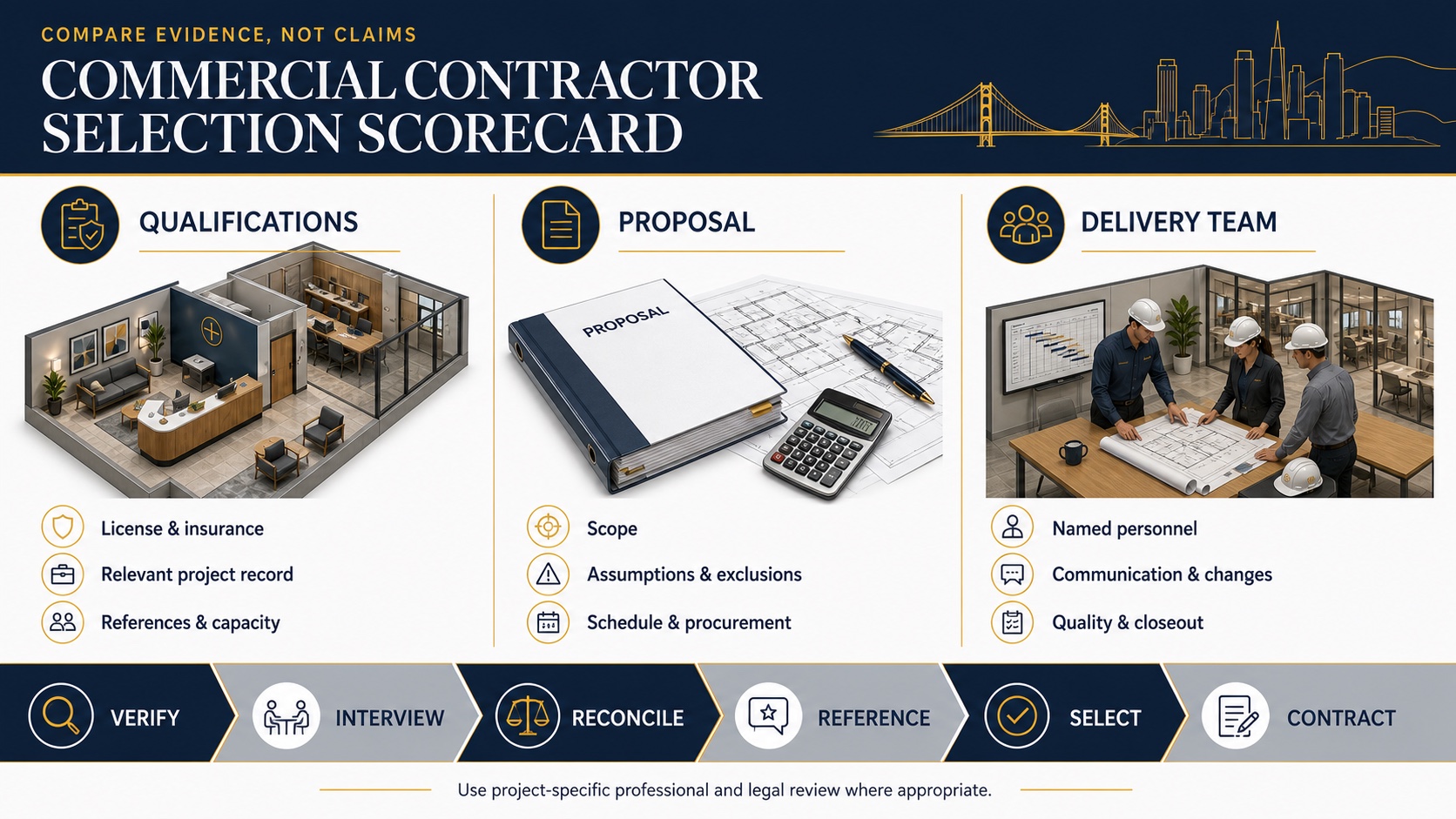
Choosing a commercial general contractor is an evidence review, not a search for the broadest promise or the lowest unqualified number. A useful process compares relevant project history, current license and insurance information, proposal coverage, named personnel, capacity, references, and the systems the team will use to manage construction.
For a San Francisco or Bay Area commercial project, the evaluation should also address the building: landlord requirements, site access, loading, elevators, working hours, occupied operations, inspections, shutdowns, and the project’s design and procurement status. The “best” contractor is the appropriately qualified firm whose proposal and delivery approach fit the actual work.
Start with a written project brief
Contractor comparisons become unreliable when candidates price different assumptions. Before requesting proposals, summarize the intended use, location, approximate area, delivery method, design status, target milestones, landlord or facility constraints, known existing conditions, owner-furnished items, and required proposal format. Identify which information is confirmed and which remains preliminary.
A concise brief does not replace drawings or specifications. It gives each bidder the same operating context and makes unanswered questions visible.
Commercial contractor selection scorecard
| Review area | Evidence to request | What to reconcile |
|---|---|---|
| Qualifications | Current license information, project-specific insurance, relevant completed work and references | Classification, status, actual role, comparable scope and any owner requirements |
| Proposal | Detailed scope, allowances, alternates, exclusions, schedule basis and procurement assumptions | Missing scope, duplicated scope, different quantities, products or responsibility boundaries |
| Delivery team | Named preconstruction lead, project manager and superintendent; current workload and communication process | Who is proposed, availability, decision authority and continuity from award through closeout |
| Commercial terms | Proposed agreement, payment process, change procedure, closeout requirements and dispute terms | Alignment with owner, lender, landlord and counsel requirements |
1. Verify the basics independently
Confirm the exact legal entity proposing the work. In California, use the Contractors State License Board to check license status and classification rather than relying on a logo or a copied number. Request insurance evidence appropriate to the project and have the owner’s broker or adviser review it. Bonding, professional services, safety submittals, prevailing-wage obligations, or other requirements may apply depending on the owner and project; they are not interchangeable badges of quality.
2. Test whether experience is truly comparable
A portfolio image proves very little by itself. Ask what the candidate actually contracted to perform, which team members were involved, whether the building remained occupied, and how the scope relates to your project. Compare use, size, systems, delivery method, jurisdiction, constraints and date.
Constructive Solutions’ published portfolio provides examples with stated role and scope. The CareMessage tenant improvement documents a 5,200-square-foot design-build project delivered in seven weeks, with demolition, framing, HVAC, electrical, data/low-voltage, millwork and finishes. The 351 California Street market-ready project documents an 8,000-square-foot, ten-week design-build scope. These are reference points, not promises about a future cost or duration.
3. Level the proposals before comparing price
A low total may reflect a legitimate approach, but it can also reflect different coverage. Create a bid-leveling matrix that places each contractor’s scope, allowance, alternate, exclusion and qualification on the same rows. Reconcile apparent gaps before selection.
- Which drawing set, addenda and site information were used?
- Are permits, fees, testing, design support, temporary protection and after-hours work included or excluded?
- Which quantities or finishes are allowances rather than fixed scope?
- Who carries hazardous-material investigation, utility upgrades, landlord work and owner-furnished equipment?
- What escalation, tax, freight, storage or lead-time assumptions apply?
- What contingency, if any, is included, controlled and reported?
Our guide to commercial preconstruction services explains how scope, constructability, estimating, scheduling and procurement planning relate before work begins.
4. Interview the people who will run the work
Company experience and proposed-team experience are related but different. Meet the project manager and superintendent expected to be assigned. Ask them to walk through a real issue: an incomplete design detail, an unforeseen condition, a shutdown, a long-lead item or a change. Look for a clear method of documenting facts, options, impacts and decisions.
Questions for the project team
- What comparable work have you personally delivered, and in what role?
- What other commitments will overlap this project?
- How often will the schedule and cost reports be updated?
- How are questions, submittals and change proposals tracked?
- How will work in occupied or shared areas be planned?
- What is your closeout process for punch, training, warranties and records?
5. Conduct useful reference checks
Request references connected to projects that are genuinely comparable, then ask specific questions. Did the proposed people serve on the referenced job? Was the original scope sufficiently defined? How did the contractor communicate unknown conditions and changes? Were closeout items organized? Would the reference include the firm in a future selection process? One reference cannot establish universal performance, but specific responses can test the claims made in the interview.
6. Review the agreement and responsibility matrix
Before award, turn proposal language into clear contract documents. Identify responsibility for design coordination, permits, inspections, owner decisions, existing conditions, temporary work, security, utilities, testing, commissioning, closeout and any landlord interfaces. Confirm the cost and schedule basis and the process for change. Legal and insurance review should be performed by the owner’s qualified advisers where appropriate.
Common contractor-selection mistakes
| Mistake | Better control |
|---|---|
| Selecting on total price before leveling scope | Compare inclusions, exclusions, assumptions and allowances line by line |
| Treating all portfolio work as comparable | Verify role, scope, building conditions and proposed-team involvement |
| Interviewing only business-development staff | Meet the people expected to estimate, manage and supervise the work |
| Relying on verbal understandings | Carry reconciled scope and responsibilities into the signed documents |
Frequently asked questions
How many commercial contractors should I interview?
There is no universal number. Use a short list large enough to create a meaningful comparison but small enough to support a serious, consistent review. The quality and comparability of evidence matter more than the count.
Should I always choose the lowest bid?
No single rule fits every procurement. First determine whether proposals cover the same work and risk allocation. Selection may also consider qualifications, team, approach, schedule basis and commercial terms consistent with the owner’s procurement requirements.
What should a commercial contractor proposal include?
At minimum, look for the documents used, scope, price breakdown, assumptions, allowances, alternates, exclusions, schedule and procurement basis, proposed team, validity period and commercial qualifications. Required detail depends on project maturity and delivery method.
Can a contractor guarantee permits or unforeseen conditions?
Authorities make their own determinations, and concealed conditions may not be knowable before investigation or demolition. The agreement should explain responsibilities, assumptions and the process for responding if conditions differ.
Talk with a San Francisco commercial contractor
Review Constructive Solutions’ commercial construction services, completed project portfolio, and company information. If the fit appears relevant, share your project brief with the team for a project-specific discussion.
Constructive Solutions, Inc. is a full-service commercial construction company serving San Francisco and Bay Area.
Whatever your vision, we have the resources, experience, and insight to make your concept a reality, and a space where your business can flourish.
Call Us Now for Estimate









I agree that a good contractor is licensed. It would seem to be a pretty basic thing but I would imagine that this would be fundamental to ask them in an interview. I’m remodeling my bathroom now that my kids have moved out so I’ll have to find a licensed remodeling contractor to help out.