

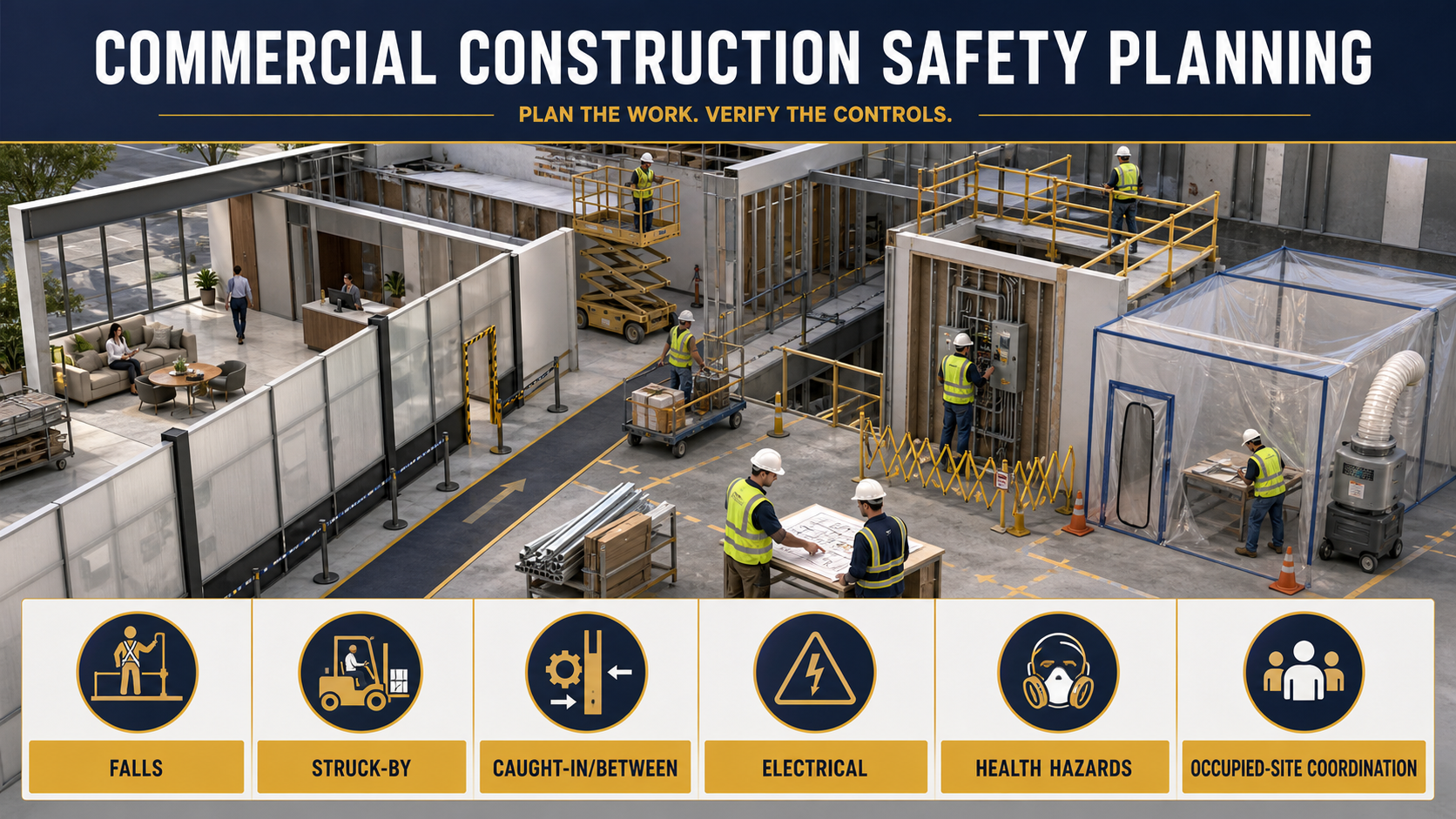
Commercial construction safety planning is a system of responsibilities, hazard recognition, controls, communication and verification—not a generic PPE checklist. Owners should expect the construction team to explain how applicable requirements and project-specific hazards will be addressed, especially when work occurs near occupants, customers, patients or ongoing operations.
The U.S. Bureau of Labor Statistics recorded 1,034 deaths in the private construction industry in 2024. That national figure does not predict the risk of a particular project, but it underscores why safety planning must be specific to the work, site and employers involved.
Begin with responsibility and project context
Each employer is responsible for its workers and applicable safety obligations. A controlling contractor, construction manager, subcontractor, owner, facility operator and design professional can have different contractual and regulatory responsibilities. Those roles should be documented rather than inferred from job titles.
The planning basis should identify the work, sequence, existing conditions, adjacent operations, access, public interfaces, utilities, hazardous materials, equipment, deliveries, shutdowns and emergency coordination. When several employers share a site, the team also needs a reliable method for communicating hazards and changes across company boundaries.
Use the Focus Four as a starting framework
OSHA’s Construction Focus Four materials organize four major fatal-hazard categories: falls, struck-by, caught-in or between, and electrocution. They are a useful planning lens, but not a complete hazard assessment.
| Hazard group | Project questions | Evidence an owner may request |
|---|---|---|
| Falls | Where are elevation changes, openings, edges, ladders, scaffolds or lifts part of the work? | Task planning, designated supervision, access/control approach and inspection records required by the plan |
| Struck-by | How are vehicles, lifting, overhead work, tools and material movement separated from people? | Logistics plan, controlled zones, delivery routes and communication procedure |
| Caught-in/between | Where can excavation, equipment, moving parts, stored material or structural work create exposure? | Task-specific controls, equipment procedures and responsible-person identification |
| Electrical | Which existing and temporary systems, energized conditions, tools and shutdowns apply? | Verified utility information, lockout/coordination procedure and qualified-person responsibilities |
The correct controls depend on the actual task and applicable standard. Owners should avoid prescribing field methods outside their expertise, but they can require a coherent plan and documented responsibility.
Health hazards require equal attention
Construction safety includes exposures that may not cause an immediate visible incident. Demolition, cutting, grinding, coatings, welding, cleaning and material disturbance can introduce silica, asbestos, lead, dust, fumes, noise or other hazards.
OSHA’s construction silica standard establishes task and exposure-control requirements for work involving respirable crystalline silica. It uses a permissible exposure limit of 50 micrograms per cubic meter as an eight-hour time-weighted average and an action level of 25 micrograms. Those numbers should not be converted into a generic site rule; the employer must determine which provisions and controls apply to its tasks.
The prior version of this article incorrectly described 85 dBA as OSHA’s eight-hour construction permissible exposure. OSHA 29 CFR 1926.52 lists 90 dBA for eight hours and requires consideration of combined exposure periods. California requirements and employer programs may impose additional or different obligations. Noise must be evaluated in the applicable regulatory and task context.
Apply the hierarchy of controls
A sound plan does not begin and end with personal protective equipment. The project team should first evaluate whether a hazard can be eliminated or the work changed, then consider engineering and administrative controls, and use PPE as required for remaining exposure.
Examples of planning decisions—not universal field instructions—include:
- Changing sequence to avoid simultaneous incompatible work.
- Using physical separation between construction and occupied areas.
- Coordinating engineered access or protective systems before mobilization.
- Controlling dust at the task and maintaining appropriate containment.
- Planning equipment routes and deliveries around people and operations.
- Scheduling shutdowns and verifying energy-control responsibilities.
The responsible employer and qualified project participants must select, implement and inspect the controls appropriate to the work.
Occupied-site safety is a separate coordination problem
When a commercial renovation occurs in an operating building, protecting workers is only part of the interface. The team may also need to protect occupants, visitors, inventory, sensitive operations and adjacent tenants from construction access, noise, dust, odors, vibration, shutdowns and emergency-route changes.
| Occupied-site control | Decision to document |
|---|---|
| Separation | Work-zone boundaries, controlled entrances and responsibility for maintaining them |
| Movement | Delivery routes, elevator/loading use, spotters or escorts where required, and prohibited times |
| Air and dust | Containment basis, pressure/filtration requirements, cleaning and monitoring responsibilities |
| Noise and vibration | Restricted activities, notice process and response to operational sensitivity |
| Utilities | Shutdown request, approval, notification, verification and restoration |
| Emergency coordination | Current routes, contacts, alarms, muster implications and communication with facility management |
What an owner should review before construction
The owner’s review should focus on evidence and coordination rather than taking over an employer’s safety program. Depending on project and agreement, useful items can include:
- Applicable written safety programs and project-specific plans.
- Named safety leadership and competent/qualified-person roles where required.
- Site logistics and occupied-area separation.
- Hazard communication and multiemployer coordination.
- Training and orientation process.
- Inspection, observation, corrective-action and escalation records.
- Incident and emergency communication procedures.
- Task planning for high-risk or facility-sensitive work.
Documents are not proof of implementation by themselves. Field leadership, worker participation, current conditions and follow-through determine whether the plan functions.
Safety planning during preconstruction
Preconstruction can identify many safety and operational interfaces before work begins: access, lifting zones, temporary protection, hazardous-material information, shutdowns, phasing, public separation, overhead or underground utilities, and work-hour restrictions.
From a contractor-side planning perspective, safety coordination is strongest when the project schedule and estimate reflect the intended controls. If access platforms, containment, off-hours work, temporary utilities or phased protection are required, those items should not remain invisible assumptions.
Frequently asked questions
Who is responsible for safety on a construction project?
Responsibilities depend on each employer’s operations, applicable regulations, project agreements and site role. Every employer must understand its obligations. The presence of an owner or general contractor does not erase another employer’s duties.
Are OSHA’s Focus Four the only construction hazards?
No. They are four major fatal-hazard categories. Projects may also involve silica, asbestos, lead, noise, ergonomics, heat, confined spaces, hazardous materials and facility-specific risks.
Can an owner rely on a contractor’s safety statistics alone?
No single metric establishes project readiness. Review relevant programs, leadership, task planning, site controls, communication, corrective-action practices and comparable-work evidence in context.
Does this guide establish compliance?
No. Compliance depends on the actual workplace, employers, tasks and applicable California and federal requirements. Obtain project-specific safety and regulatory guidance.
Primary sources reviewed
- U.S. Bureau of Labor Statistics: Fatal work injuries in 2024
- OSHA: Construction Focus Four
- OSHA 29 CFR 1926.52: Occupational noise exposure
- OSHA 29 CFR 1926.1153: Respirable crystalline silica
- Cal/OSHA guidance for construction employers
Review Constructive Solutions’ commercial preconstruction and renovation services. For a defined project, share the site, scope and operating constraints.
Constructive Solutions, Inc. is a full-service commercial construction company serving San Francisco and Bay Area.
Whatever your vision, we have the resources, experience, and insight to make your concept a reality, and a space where your business can flourish.
Call Us Now for Estimate









Leave a Reply