


Selecting the right delivery method can change how much control an owner has over cost, schedule, communication, and day-to-day risk. Construction manager at risk (CMaR) is popular because it brings the builder into the project before the drawings are fully finished, so the team can test budget, sequencing, and constructability earlier instead of waiting until bid day. That matters in commercial building work, where phasing, occupied spaces, permit coordination, and long-lead materials can reshape the whole job.
This guide explains what CMaR construction is, how the process works, how a Guaranteed Maximum Price is set, and when it is the right fit for a commercial project.
What Is A Construction Manager At Risk?
Construction Manager At Risk Definition
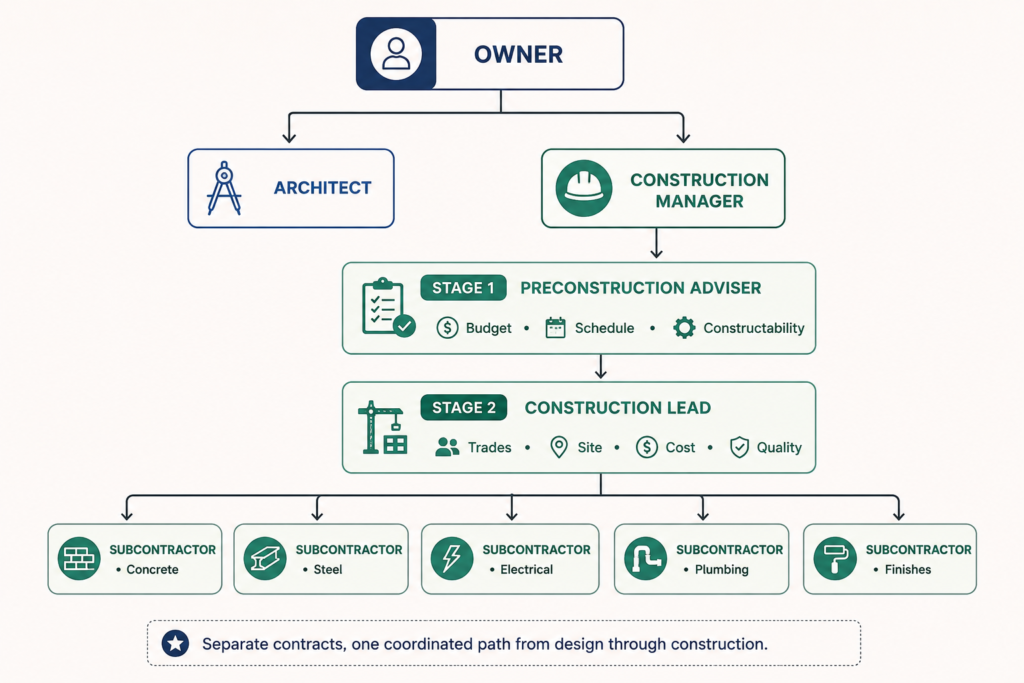
A construction manager at risk, or CMaR, is a project delivery method in which the owner hires the construction manager during design and later retains that firm to lead construction, typically under a Guaranteed Maximum Price (GMP). CMaR refers to the delivery method, while CMR refers to the construction manager or firm performing it.
This method is also known as CM at risk or construction management at risk and, in some contexts, CM/GC.
Unlike design-build, CMaR generally involves separate agreements between the owner and:
- The architect or design professional
- The construction manager
The Construction Manager’s Two-Stage Role
The construction manager comes in early, advises during planning and design, and later transitions into the construction lead who manages subcontractors and delivers the work under the project contract.
At an agreed stage of design, the construction manager typically submits or negotiates a GMP, which commonly governs the cost and contractual terms of the construction phase.
That two-stage role is what makes CMaR distinct.
- Preconstruction Adviser: The owner gets builder input while the design is still taking shape, but still keeps a direct relationship with the architect.
- Construction Lead: Then, during construction, the CM functions much more like a general contractor, with the added advantage of already knowing the project’s budget logic, sequencing constraints, long-lead items, and design priorities because it has been involved from the preconstruction phase.
In AIA’s wording, CMaR is often called CM/GC because the construction manager effectively becomes the general contractor through the at-risk agreement.
CMAA’s Owner’s Guide to Project Delivery Methods notes that on CMaR projects, the GMP is commonly negotiated when design is roughly 50% to 90% complete, and if accepted, the construction manager then becomes the general contractor for the work.
How Does the CMaR Project Delivery Method Work?
The CMaR delivery method works best when the owner wants contractor involvement during design but still prefers separate design and construction contracts. One reason this method often appeals to commercial owners is that they need early budget guidance without giving up the architect relationship.
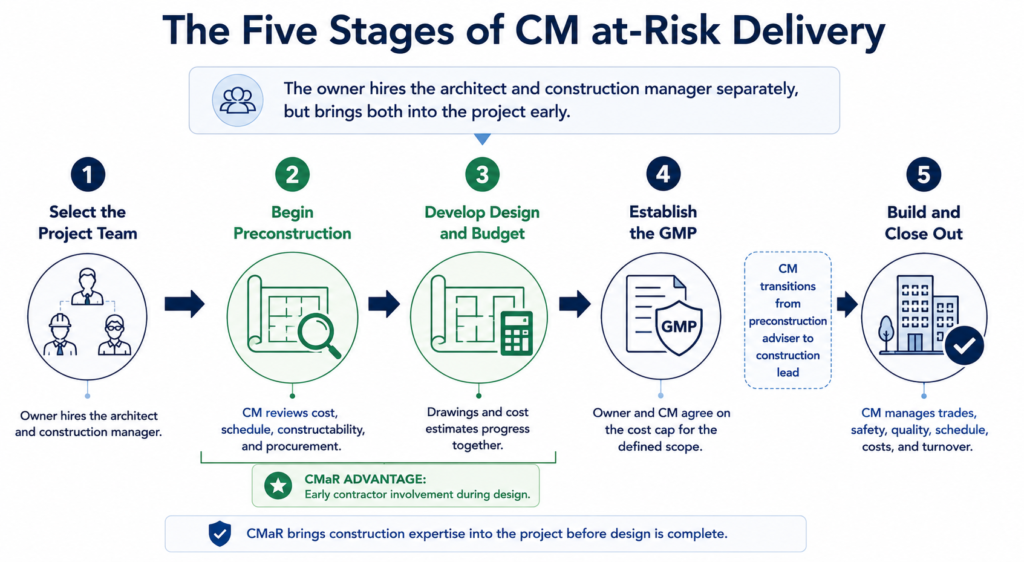
The process usually unfolds in five connected stages.
The Owner Selects The Architect And Construction Manager
First, the owner selects the architect and the construction manager early in the design stage, not after the drawings are fully finished. In CMaR, the CM is usually chosen on qualifications, relevant project experience, team strength, fee structure, and overall approach, rather than only on the lowest price. The architect and CM remain under separate contracts.
The CM Provides Preconstruction Services
During preconstruction, the CM gives advice on constructability, design review, cost estimating, scheduling, value engineering, and procurement strategy. This early participation is one of CMaR’s biggest strengths because a pricing or constructability issue is much easier to solve before they cause expensive redesigns or permit delays.
Design And Cost Estimates Develop Together
As the design advances, the CM updates cost estimates at key milestones so the owner can see whether the project is still aligned with the budget. The team may also identify long-lead materials, early work packages, and trade coordination issues before they become schedule risks.
On a commercial renovation, for example, a team may flag switchgear, air-handling equipment, or specialty glazing early so the schedule does not slip later. This progressive estimating approach is one reason owners use the construction manager at risk delivery method on schedule-sensitive projects.
The Parties Establish The Guaranteed Maximum Price
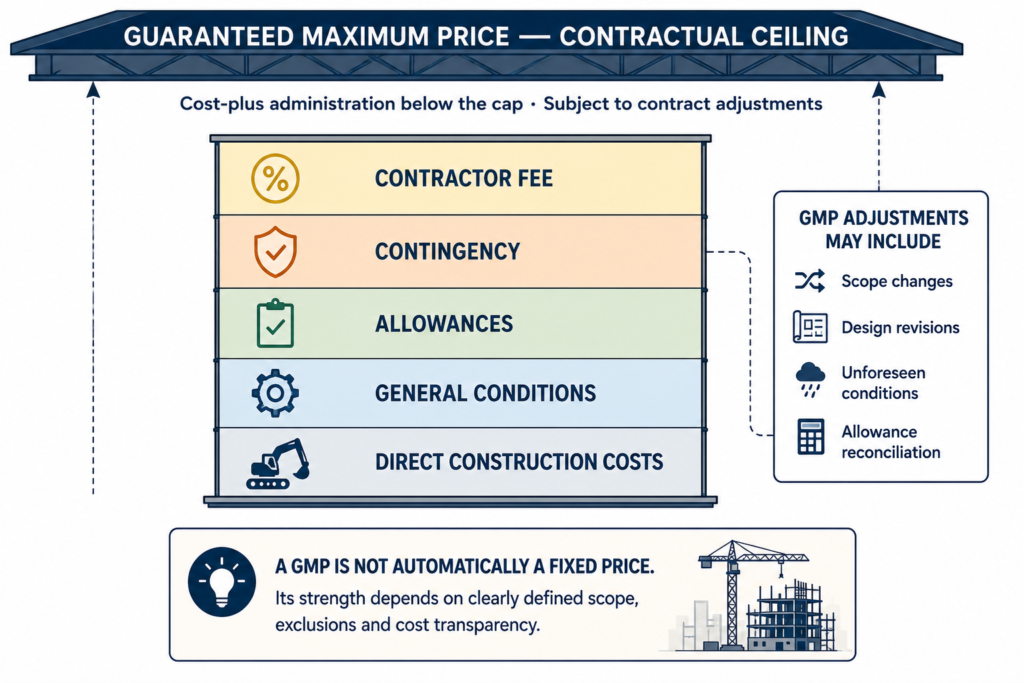
Once the design is sufficiently developed, the owner and CM negotiate the Guaranteed Maximum Price, or GMP. The GMP commonly includes direct construction costs, general conditions, the CM’s fee, allowances, contingencies, and clearly stated exclusions.
Before treating the GMP as a firm cost ceiling, owners should verify what it covers, which costs remain allowances, and which items are excluded.
The CM Manages Construction
Once construction starts, the CM procures trade contractors, supervises the site, manages safety and quality, tracks costs, handles schedule updates, processes changes, and drives the project toward substantial completion and closeout. The CM also ensures the work follows the approved construction documents and reports ongoing cost and schedule performance.
Here, the builder is no longer stepping in cold. By the time construction starts, the CM has already been involved in shaping budget assumptions, sequencing, and logistics, which can make execution more coordinated than in a fully sequential method.
What Is A Guaranteed Maximum Price (GMP)?
The Guaranteed Maximum Price (GMP) is the maximum contract amount an owner is expected to pay for the defined scope of work. It is not the same as an unconditional fixed price but remains subject to the adjustment rules written into the contract.
In a Construction Manager at Risk agreement, the contractor is typically reimbursed for allowable project costs plus an agreed fee, up to the GMP. The price is developed using the available drawings, specifications, estimates, allowances, assumptions, exclusions, and subcontractor pricing.
When Can the GMP Change?
The GMP may change when the contract allows adjustments. Common triggers may include:
- Owner-requested scope changes
- Design revisions
- Differing site conditions
- Code or permit changes
- Allowance reconciliation
- Other approved changes affecting cost or schedule
Because the work below the GMP is generally administered on a cost-plus basis, the supporting documentation is as important as the stated maximum price.
What Should Owners Review in a GMP Contract?
For owners, the contract details matter more than the label itself. Before approving the price, a thorough GMP review should confirm:
- Whether the contract clearly defines the events that may increase or decrease the cost cap.
- Whether cost reporting is open-book, and provides access to estimates, subcontractor bids, labor, materials, and general conditions.
- Whether contingency is owner-controlled, contractor-controlled, or split in some documented way, and how it may be used.
- Whether savings stay with the owner or are shared under an agreed written formula.
- Whether the agreement gives the owner enough documentation and audit rights to verify reimbursable costs.
A Guaranteed Maximum Price is only as reliable as the scope definition, design maturity, estimating method, and agreement language behind it.
Hence, the right question is not only “What is the GMP?” but also “What documentation supports it, who controls the contingency, and how transparent is subcontractor buying?”
Construction Manager At Risk Responsibilities
A construction manager at risk usually carries a broader and more continuous role than a contractor hired after design is complete. Across preconstruction and construction, the responsibilities typically fall into 8 practical areas.
Budgeting And Cost Modeling. During design, the CM develops estimates, updates pricing as drawings evolve, and helps the owner see cost pressure before it becomes a field problem.
Constructability Review. The construction manager checks whether the design can be built efficiently, safely, and in the expected sequence, and suggests revisions where the drawings create unnecessary cost or coordination issues.
Value Engineering And Scope Alignment. Construction management at-risk services often include evaluating alternative materials, methods, and systems so the project can stay aligned with the target budget and operational goals without simply cutting quality.
Scheduling And Phasing. The CM helps build the project schedule early, identifies long-lead items, and plans phased turnover or occupied construction when the facility must stay operational.
Trade Procurement. Once the project moves into construction, the construction manager solicits and manages subcontractor pricing, compares scopes, fills gaps, and coordinates award strategy.
Site Supervision And Safety. During construction, the CM oversees day-to-day field operations, coordinates trades, enforces site rules, and manages safety planning and compliance.
Quality Control And Change Management. The CM at-risk tracks workmanship, submittals, RFIs, and quality issues while also pricing, documenting, and administering change orders when scope or conditions change.
Reporting And Closeout. The construction manager’s role does not end at substantial completion. Cost reporting, punch list coordination, turnover documentation, commissioning support, and closeout follow-through are all part of delivering the project cleanly.
Who Holds the Risk in a CMaR Construction Contract?
| Risk area | Typical responsible party | Important qualification |
| Design accuracy | Owner/design professional | Depends on the design agreement |
| Construction execution | Construction manager | Subject to contract terms |
| Costs above the GMP | Construction manager | Excludes approved changes and stated exceptions |
| Owner-requested scope changes | Owner | Usually handled through change orders |
| Unknown site conditions | Contract-dependent | Must be clearly allocated |
| Schedule performance | Construction manager/shared | Depends on the delay causes and the contract language |
“At Risk” Does Not Mean All Risk
“At risk” does not mean the construction manager assumes every possible risk on the project. It generally means the CM accepts defined contractual responsibility for construction delivery, including certain cost and performance obligations.
Costs above the GMP may become the CM’s responsibility unless they result from approved scope changes, unforeseen conditions, allowances, exclusions, or other contractually permitted adjustments.
The exact allocation of risk always depends on the terms of the agreement.
Benefits of the At-Risk Construction Management
The construction manager at-risk method connects design planning with practical construction expertise, creating a more informed and coordinated path from concept to completion.
Here are the important pros:
Early Contractor Involvement
Early contractor participation is one of the clearest advantages of the CM at risk method. Because the CM joins during design, the owner and design team receive input on constructability, cost, scheduling, procurement, site logistics, and project risk before decisions harden.
That can be especially valuable on phased tenant improvements, medical renovations, lab upgrades, or occupied commercial spaces where every sequencing decision affects operations.
Improved Cost Control
CMaR construction supports progressive budgeting instead of waiting for a final bid surprise. Estimates can be updated as the design develops, and the team can adjust scope, materials, or phasing before the gap between budget and drawings becomes too expensive to fix. That does not guarantee the lowest possible price, but it often gives owners better live control over where the money is going.
Faster Project Delivery
Many commercial owners choose the CM at-risk method because it can significantly speed up project timelines. The team can build a schedule earlier, release selected bid packages sooner, and procure long-lead items before every design detail is final.
That can be valuable on projects that cannot afford occupancy delays, such as a phased retail rollout, a tenant improvement with a lease deadline, or a hospital or lab project where shutdown windows are limited.
Reduced Owner Risk In Construction Administration
Owners still carry contractual responsibilities in CMaR, but once the project moves into construction, the CM generally becomes the primary point of responsibility for subcontractor management and day-to-day construction performance.
That can reduce the owner’s burden of coordinating multiple trade contracts directly, especially compared with advisory CM structures.
Better Constructability And Quality Control
Because the construction manager has seen the design develop, the team can better identify coordination issues early and plan the field work more realistically. In commercial projects with dense MEP systems, operational constraints, or tight site logistics, early constructability input can be more valuable than a later low-bid correction.
During construction, the CM can also coordinate inspections, testing, and corrective work to help ensure that materials and workmanship meet the contract requirements.
Cost Protection Through a Guaranteed Maximum Price
A well-structured GMP provides meaningful cost protection for the agreed scope of work. It gives the owner a cost ceiling for defined work and shifts some overrun exposure to the CM, while still allowing legitimate contract-based adjustments for approved changes and unforeseen events. Though a GMP offers strong cost control, it does not eliminate every additional expense.
Potential Disadvantages of the CMaR Construction
Although CM at-risk services can improve collaboration and cost control, several risks should be considered before selecting this delivery method.
A GMP Can Be Set Before Design Is Complete
A GMP developed from incomplete documents may include larger contingencies, more assumptions, more allowances, and a greater chance of later argument over what was or was not included.
The Owner Must Manage Two Primary Contracts
Because the owner manages two separate contracts with the architect and construction manager, disputes can arise over whether a problem came from design or construction.
Also, CMaR may require more owner involvement in participation, coordination, and decision-making than design-build, which provides a single point of responsibility.
Project Success Depends Heavily On The CM’s Qualifications
CM-at-risk is most effective when led by an experienced and qualified construction manager. Weak estimating, poor communication, or weak preconstruction advice can undermine the entire model long before work starts on site.
The Final Project Cost May Exceed the GMP
Even under a GMP, the final price can move if the owner changes scope, the design evolves, allowances reconcile higher, or site conditions differ from what was known at pricing time.
Cost Pressure Can Affect Construction Quality
Pressure to keep the project below the GMP can lead to cost-cutting decisions that affect materials, workmanship, or overall quality unless the contract includes clear specifications and strong quality-control requirements.
Pricing Transparency Requires Careful Oversight
Competitive pricing in CMaR depends on transparent procurement, so owners should closely review how bids are solicited, compared, documented, and awarded. Open-book cost reporting helps, but transparency has to be actively maintained rather than assumed.
When owners compare the construction manager at risk pros and cons, the main trade-off is:
CMaR can create much better collaboration and earlier cost visibility, but it also demands more disciplined contract review and careful team selection than many people expect.
CMaR vs. Design-Build vs. Design-Bid-Build
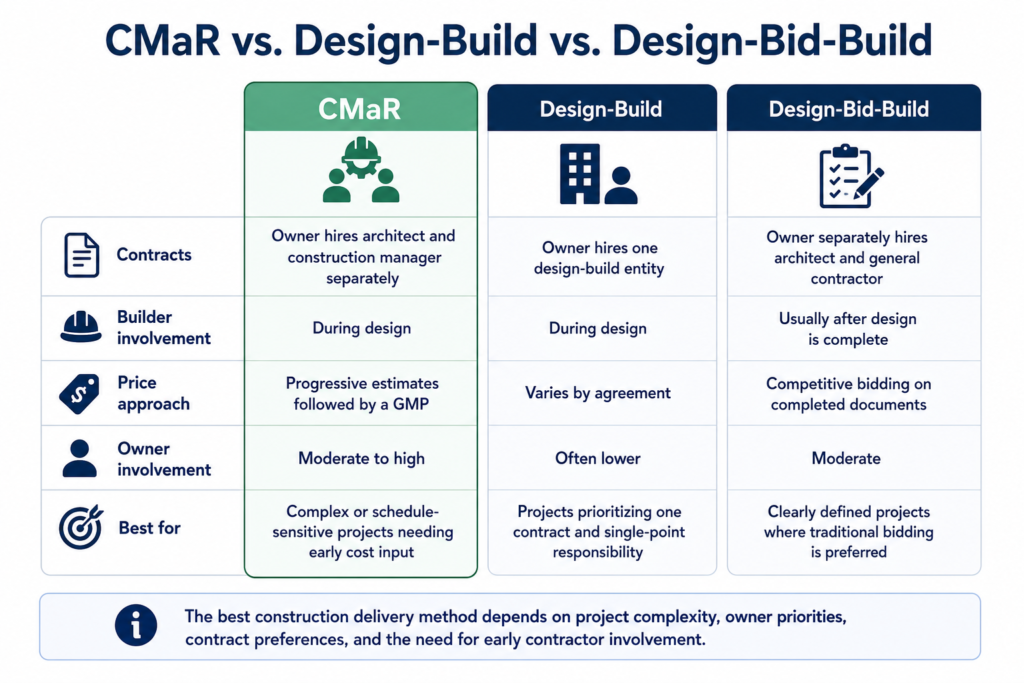
A useful way to understand a construction manager at-risk is to compare it to the two delivery systems owners most often consider beside it: design-build and design-bid-build. There is no single best project delivery method, so the right choice should be tied to project goals.
Construction Manager at Risk Vs. Design-Build
The main difference is contractual structure. CMaR keeps design and construction under separate contracts, while design-build generally combines them into one agreement with one point of accountability.
For some owners, especially those who want to preserve a direct relationship with the architect and stay closely involved in design decisions, that separation is a benefit. For others, the simplicity of one contract is more attractive.
If the owner values more design-side visibility and wants builder input early, CMaR can make sense. If the owner wants one entity to carry both design and construction responsibility, hiring a design-builder may be the better option.
Construction Manager at Risk Vs. Design-Bid-Build
Design-bid-build is the traditional linear sequence: design first, then bidding by general contractors, then construction. That can work well when the plans are complete, and the owner wants strong price competition on finished documents.
CMaR, by contrast, brings the builder in during design, which often gives the owner earlier cost feedback and more room to solve constructability issues before they become change orders.
Key Takeaway: Ultimately, the choice between CMaR, design-build, and design-bid-build depends on whether the owner is looking for early collaboration, single-point responsibility, or a traditional competitive bidding process.
For a closer comparison of project roles, see our guide on Construction Manager vs. General Contractor.
When Should An Owner Use A Construction Manager At Risk?

A Construction Manager at Risk delivery method is often a strong choice for commercial construction projects that are complex, schedule-sensitive, or require early contractor involvement. It works especially well when construction must be completed in phases, the building needs to remain operational, or long-lead materials and equipment must be ordered before the design is fully complete.
CMaR also benefits owners who want to maintain a separate contract with the architect while receiving early input from the construction manager on budgeting, scheduling, constructability, procurement, and trade coordination. Regular cost updates throughout the design phase can help the owner make informed decisions and establish a realistic GMP.
Applications for the CM at Risk Delivery Method
This project delivery method can be ideally used for:
- Medical and life-science facilities
- Educational and institutional buildings
- Industrial and laboratory projects
- Corporate interiors and large tenant improvements
- Retail, hospitality, and occupied-building renovations
- Projects involving costly shutdowns or complex phasing
When Another Construction Delivery Method May Be Better
Another construction delivery method may be more suitable when the project is small and straightforward, the lowest initial bid is the main selection criterion, or the owner prefers a single design-and-construction contract. CMaR may also be less effective when the project scope is too small to justify deeper preconstruction services, or the scope is still too uncertain to establish a meaningful GMP. If the design is too fluid or the owner expects major program changes late in the process, CMaR can become harder to price cleanly and easier to dispute.
Ultimately, an owner should consider using a CM at risk when early collaboration, cost control, schedule certainty, and construction expertise during the design phase are more important than simply selecting the lowest bidder.
How to Select a Construction Manager at Risk
Selecting the right commercial construction manager at risk is as important as selecting the right delivery method. AGC defines qualifications-based selection as central to CMaR, and the final selection criteria can include more than the lowest total construction price.
1. Look at Relevant Project Experience
Start by asking – what relevant experience does your firm have with projects of a similar type, scale, and complexity? For example, if you are converting an office floor into a laboratory, a firm experienced in specialized ventilation, utility shutdowns, clean-room requirements, and long-lead equipment may be a better fit than a contractor without similar lab experience.
2. Review the Preconstruction Team
Next, review the proposed preconstruction team because they will shape the budget, schedule, and bid packaging before the first shovel goes into the ground.
Ask how the CM develops estimates, when they update pricing, how they handle constructability review, how subcontractor bids are solicited and compared, and how contingency, allowances, general conditions, and savings are explained. Open-book estimating is especially helpful because the owner needs visibility into how the GMP is built and how procurement decisions are being made.
3. Evaluate the Firm’s Capabilities as CM
Before making a final selection, review the construction management firm’s:
- Licensing, insurance, bonding, and financial capacity
- Safety and quality-control practices
- Long-lead procurement and scheduling planning
- Change-order management procedures
- References from owners, architects, and consultants
4. Consider Local Market Knowledge
Local market knowledge is a critical factor when selecting a construction manager.
Permits, inspection, site access, labor availability, material procurement, and occupied-building needs can all affect cost and timelines in ways that do not show up in a generic proposal.
In that setting, a CM at-risk should not only know how to estimate and build, but also how to navigate the local conditions and subcontractor market the project will actually use.
Case Study: Boutique Hotel Renovation Through Construction Management
A hotel owner selected a Construction Manager at Risk for the renovation of a 95-room boutique property that needed to remain partially open during construction. The work included guest-room upgrades, lobby improvements, kitchen renovations, new mechanical equipment, and accessibility updates.
Challenges and Steps Taken
During preconstruction, the CMaR developed a floor-by-floor phasing plan that allowed the hotel to keep approximately half of its rooms available. Early investigation also revealed aging plumbing risers and limited electrical capacity that were not fully documented in the original drawings.
To handle these conditions, the construction manager’s team:
- Worked with the design team to price replacement options and separate essential upgrades from optional improvements.
- Established allowances within the Guaranteed Maximum Price.
- Released long-lead mechanical equipment and custom finishes early to protect the schedule.
- Replaced delayed imported fixtures with locally available alternatives that met the design intent and avoided closing completed rooms.
Outcome
The project finished within the revised GMP and opened in phases. By using the CM at-risk delivery method, the owner maintained hotel operations while renovating the property with limited disruption to guests and staff.
Frequently Asked Questions (FAQs)
What Is the Difference Between a Construction Manager at Risk and a General Contractor?
A construction manager at risk typically joins during design to provide preconstruction services before leading construction, while a traditional general contractor is usually hired after the design is substantially complete.
What Is a Construction Manager at Risk?
A construction manager at risk is a construction firm that advises the owner during design and later manages construction under an agreement that often includes a GMP.
What Is a Construction Risk Manager?
A construction risk manager identifies, evaluates, monitors, and helps mitigate project risks, but is not the same role or delivery method as a construction manager at risk.
Is CM as Constructor the Same as CM at Risk?
Construction Manager as Constructor is closely related to CM at Risk, but the terms are not always identical because a CM as Constructor may perform the construction work with or without a GMP, depending on the contract.
What Is the Difference Between a Construction Manager at Risk and a Construction Manager as Agent?
A construction manager at risk holds construction responsibility and typically contracts with subcontractors, while a construction manager as agent advises the owner without directly assuming construction cost or performance risk.
What Does a Construction Manager at Risk Do?
In a CMaR contract, the construction manager usually carries the day-to-day responsibility for building the work, coordinating subcontractors, maintaining schedule control, keeping the site safe, managing quality, and reporting costs during construction.
Final Thoughts
A construction manager at risk can be the right choice when the owner wants early contractor expertise, steady cost input during design, transparent budgeting, and a defined maximum construction price without giving up the direct architect relationship. For many commercial projects, it can be a very sensible middle ground between traditional design-bid-build and fully integrated design-build. The key is choosing the delivery method for the project’s actual needs, rather than assuming one approach works for every project.
Talk to a Bay Area Commercial Contractor
Planning a commercial construction or renovation project in the San Francisco Bay Area? Constructive Solutions, Inc. can help with preconstruction, budgeting, CMAR services, and project delivery planning from concept through completion. Contact us today.
Relevant Resources:
- A Guide to Construction Risk Management: How to Mitigate Different Types of Risks
- Here are 10 Important Lessons Learned from Challenging Design-Build Projects
For a focused comparison of contract structure, design relationship and owner decision factors, read CMAR vs. design-build for commercial projects.
Constructive Solutions, Inc. is a full-service commercial construction company serving San Francisco and Bay Area.
Whatever your vision, we have the resources, experience, and insight to make your concept a reality, and a space where your business can flourish.
Call Us Now for Estimate









Leave a Reply