

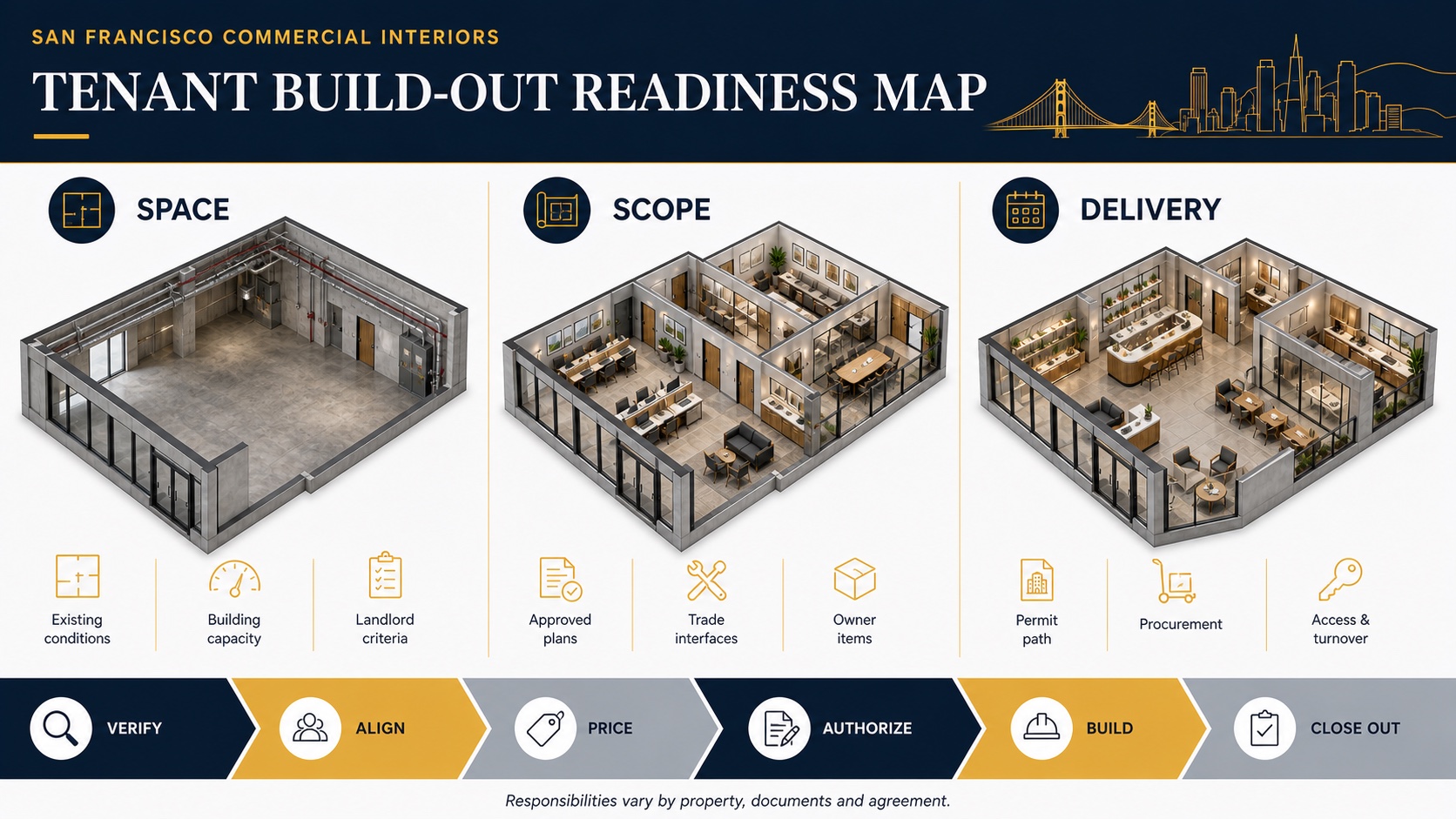
Launching a new office, retail store, medical practice, or restaurant in San Francisco is an exciting step, but tenant improvement projects can get complicated faster than expected. A lease may be signed, move-in dates set, and budgets approved, only for permit reviews, infrastructure upgrades, or code requirements to shift the timeline later and inflate expenses. The challenge is even bigger in a market where construction expenses remain among the highest in the country.
Understanding how TI projects work and the importance of hiring a qualified tenant improvement contractor can help make better decisions before the construction starts.
What Is a Tenant Improvement Project?
A tenant improvement, often called TI, is the work done to customize a leased commercial space for a specific business use. In San Francisco, that might mean turning a raw office floor into private offices, updating a retail storefront, adding treatment rooms for a clinic, or reworking a restaurant kitchen.
What Does a Tenant Improvement Project Include?
A tenant improvement project usually focuses on interiors, including:
- New partitions
- Flooring and ceilings
- Lighting
- HVAC distribution
- Plumbing and electrical
- Accessibility improvements
- Restrooms
- Fire sprinklers
- Storefront updates
- Interior finishes
It typically does not include major structural work or full exterior construction unless the lease specifically requires it.
Tenant Improvement vs. Renovation vs. Build-Out
Tenant improvement is more specific than a general commercial renovation. A renovation may repair or update an existing building for any reason, while a build-out usually means preparing a space for a tenant to occupy and operate. A TI project often sits between the two: it may renovate existing interiors, but the goal is to customize the space for a tenant’s lease, brand, layout, equipment, and workflow.
Common TI projects in San Francisco include office suites, restaurants, retail stores, medical offices, fitness studios, lobby or common-area upgrades, and light industrial interiors.
Depending on the scope, the tenant improvement process may involve:
- Property owners
- Tenants
- Architects
- Engineers
- A commercial general contractor specializing in tenant improvements
- The landlord’s representative
- City reviewers
Who Pays for Tenant Improvements?
Responsibility for tenant improvement costs depends on the lease structure. In many commercial leases, costs may be paid by the tenant, the property owner, or shared between both parties.
Owners often contribute through a tenant improvement allowance (TIA), which is an agreed-upon amount provided to help offset build-out costs. If project expenses exceed the allowance, the tenant typically pays the difference.
The TIA amount, covered work, and payment terms are usually defined in the lease agreement.
First-Generation vs. Second-Generation Build-Outs
Owners should also understand the starting condition of the space. A first-generation build-out starts with shell space, often unfinished and requiring major infrastructure. A second-generation build-out modifies existing interiors, which may reduce scope but can uncover code, utility, or layout issues.
With multiple moving parts involved in a TI project, owners increasingly rely on experienced contractors to manage the process efficiently.
Why You Should Involve a Tenant Improvement Contractor Before Signing a Lease
Many commercial tenants and property owners wait until after lease signing to involve a tenant improvement (TI) contractor, but that is often where budget overruns, permit delays, and schedule conflicts begin.
A tenant improvement contractor should ideally be involved during site evaluation and lease negotiation, rather than after architectural drawings are already completed. Involving a contractor early becomes especially important in San Francisco, where Department of Building Inspection (DBI) approvals and inspections often influence commercial build-out timelines.
Now, let’s deep dive into the primary reasons.
Lease Timelines Often Ignore Real Construction Conditions
Commercial leases are commonly negotiated around optimistic move-in assumptions. Landlords may offer free-rent periods or tenant improvement allowances based on estimated timelines that do not reflect actual San Francisco permitting and construction realities.
An experienced tenant improvement contractor can review whether the proposed construction schedule is achievable before the lease is finalized. They can evaluate whether proposed move-in dates, rent commencement periods, and free-rent windows are realistic before the lease is signed.
Contractors also help identify risks tied to:
- Delayed DBI permit approvals
- Long inspection timelines
- Unrealistic occupancy assumptions
- Missed business opening deadlines
- Incomplete landlord work obligations
This becomes especially important for projects involving change-of-use approvals or certificate of occupancy updates, both of which can extend project timelines significantly.
For example, a tenant leasing a second-generation office suite in SoMa may assume cosmetic upgrades can be completed within 6–8 weeks. However, once electrical panel upgrades, sprinkler revisions, or accessibility corrections are identified during permit review, the project may shift from over-the-counter approval into full in-house review with additional DBI comments and inspections.
Early Contractor Input Reveals Hidden Costs
One of the biggest advantages of early contractor involvement is uncovering infrastructure issues before design and budgeting move too far ahead.
A TI contractor can quickly identify problems such as insufficient electrical capacity, outdated HVAC systems, plumbing limitations, fire/life safety upgrade triggers, or ADA correction requirements. In older San Francisco buildings, seismic retrofit considerations and change-of-use requirements can also significantly affect costs and timelines.
For example, a fitness studio tenant in the Financial District may discover that additional ventilation, upgraded plumbing lines, and higher electrical capacity are needed to support locker rooms, showers, and specialized equipment before the space can open for operations.
Research published in the Civil Engineering Journal found that active contractor involvement during design stages helps reduce later design changes, with design-related cost impacts reported between 5% and 40% on average.
Pre-Construction Planning Reduces Expensive Rework
Early collaboration between the tenant improvement project team creates better coordination from day one. Many San Francisco firms now prefer design-build delivery methods because they streamline design and construction teams under one contract, helping minimize costly change orders and redesigns later in the project.
Also, contractors help define scope clarity, validate whether the TI allowance is realistic, and separate landlord responsibilities from tenant-funded improvements. They coordinate scheduling around occupied-building logistics, material lead times, and subcontractor availability.
This level of planning by contractors during the pre-construction phase reduces the risk of change orders, which can account for an average of 10% of total contract value.
How San Francisco Tenant Improvement Contractors Help Overcome Key Challenges
Tenant improvement projects in San Francisco are far more complex than standard interior renovations. A general contractor without specialized build-out experience in the area may underestimate construction costs, miss compliance triggers, or fail to coordinate effectively with local agencies and property managers. As a result, those mistakes can delay occupancy for weeks or even months.
Here’s why tenant build-out projects need the expertise of specialized contractors.
Helps Navigate Local Permitting Requirements
San Francisco’s permitting process has historically been complicated enough that the city launched PermitSF to make approvals “faster, more transparent, and predictable” for housing and small businesses.
Most tenant improvements require approvals through the San Francisco Department of Building Inspection (DBI), and additional reviews may involve Planning, Fire, or Health departments, depending on project scope.
Even smaller office remodels may trigger:
- In-house permit reviews
- Change-of-use approvals
- Americans with Disabilities Act (ADA) compliance checks
- Mechanical or fire system reviews
- Additional inspections before occupancy
Specialized TI contractors understand how local permits require simultaneous coordination and can often identify approval issues before formal submission.
Overcoming ADA, Seismic & Code Compliance Challenges
San Francisco’s commercial buildings, especially older downtown properties, frequently trigger accessibility and seismic upgrade requirements, which are major concerns during renovation work.
Like other U.S. regions, tenant improvements in California can trigger mandatory ADA upgrades involving restrooms, entrances, path-of-travel corrections, counters, and shared common areas. In older San Francisco properties, especially pre-1970 structures, TI work may also activate seismic upgrade requirements tied to occupancy changes or structural modifications.
Experienced tenant improvement contractors know how to evaluate:
- ADA upgrade exposure
- Path-of-travel requirements
- Restroom accessibility corrections
- Fire/life safety compliance
- Soft-story or seismic retrofit considerations
These issues can significantly affect project budgets or lead to expensive compliance costs if discovered too late during inspections.
MEP Upgrades Often Become Major Cost Drivers
Mechanical, electrical, and plumbing (MEP) upgrades are among the most common hidden costs that can make up to 30-50% of construction costs.
Many older San Francisco buildings were not designed for modern electrical loads, upgraded HVAC demands, or new plumbing layouts required by restaurants, medical offices, or retail concepts. Older buildings may require switchgear upgrades, electrical panel replacement work, utility coordination, or additional structural review for HVAC systems, all of which can quickly increase project costs and extend construction timelines beyond standard interior build-outs.
Specialized tenant improvement contractors coordinate closely with engineers to evaluate infrastructure capacity before construction begins.
They also account for local labor conditions and long material lead times involving switchgear, HVAC equipment, specialty fixtures, and code-compliant systems.
Better Coordination Means Fewer Delays
Successful tenant improvement projects rely heavily on early coordination between contractors, architects, engineers, landlords, inspectors, and subcontractors.
Specialized contractors help streamline communication, coordinate landlord approvals, manage phased construction in occupied buildings, and create realistic budgets and schedules from the start.
In a city where permit delays, labor costs, and infrastructure limitations already create pressure on timelines, specialized tenant improvement contractors are often the difference between a controlled project and a costly one.
Occupied-Building Logistics Add Another Layer of Complexity
Many San Francisco tenant improvement projects take place inside occupied office towers, mixed-use buildings, retail centers, or multi-tenant commercial properties where construction activity must be carefully coordinated around existing tenants and daily operations.
Contractors often need to manage freight elevator scheduling, restricted work hours, noise limitations, debris removal procedures, building access rules, and after-hours construction requirements imposed by property management.
For example, a downtown office TI project may only allow demolition or material deliveries during designated evening hours to avoid disrupting other tenants. Specialized TI contractors understand how to plan around these logistical constraints early, helping reduce scheduling conflicts, delays, and operational disruptions during construction.
In San Francisco, early planning and experienced tenant improvement contractors play a major role in keeping commercial build-outs on schedule, compliant, and within budget.
How Much Does a Tenant Improvement Cost in San Francisco?
Construction costs in San Francisco sit at the upper end of the U.S. market because of labor rates, seismic standards, and strict building codes. On average, San Francisco tenant improvement costs per square foot range from $150 to $250.
| Space Type | Typical TI Cost (SF) | Typical Scope |
| Office | $100–$250+ / sq. ft. | Basic to high-end office build-outs, partitions, finishes, and MEP updates |
| Retail | $120–$300+ / sq. ft. | Store build-outs, fixtures, lighting, storefront improvements |
| Restaurant | $175–$450+ / sq. ft. | Kitchen installation, plumbing, ventilation, grease systems |
| Medical | $350–$700+ / sq. ft. | HVAC upgrades, compliance work, specialized equipment infrastructure |
Tenant build-out costs can also vary depending on the type of space and the infrastructure involved. A standard office build-out in San Francisco usually costs between $100-$250 per square foot, while retail spaces often range from $120-$300 per square foot.
Cushman & Wakefield’s 2026 Office Fit Out Cost Guide places San Francisco among the most expensive office build-out markets nationally, with average office improvement costs exceeding $220 per square foot.
Projects with specialized requirements tend to push costs higher. For example, restaurant build-outs can reach $175-$450 per square foot because of kitchen, plumbing, and ventilation systems. Medical facilities typically range from $350-$700 per square foot due to added HVAC, medical gas lines, and technical upgrades.
Factors That Can Increase TI Costs
Several factors can push tenant improvement costs beyond the standard build-out range in San Francisco.
- The condition of the existing space plays a major role. Shell spaces and first-generation units generally cost more because they require complete infrastructure work, while second-generation spaces may reuse existing layouts and systems.
- Regulatory compliance also adds cost, particularly Title 24 energy standards, CALGreen requirements, ADA upgrades, and fire life safety improvements.
- Older buildings can trigger seismic retrofits and code-driven structural modifications during renovation.
- Converting a space from one occupancy type to another (for example, office to medical or retail to restaurant) can increase TI costs as it often requires additional permitting, code compliance, life-safety upgrades, and MEP modifications.
- Labor pricing is another contributor, with electrical, plumbing, and HVAC trades carrying premium rates in California markets.
- Design changes during construction can lead to permit modifications, plan updates, and additional review fees, increasing overall project costs.
Under San Francisco DBI guidelines, tenant improvement permits are often valued at about $218 per square foot, with permit fees based on total project value.
Hidden Costs Property Owners Miss
Property owners often budget only for visible construction costs and overlook expenses that surface later in the project. Hidden costs usually come from existing building conditions discovered after demolition, such as outdated electrical systems, non-compliant restrooms, fire sprinkler upgrades, or ADA path-of-travel corrections.
Soft costs are frequently underestimated, including architectural design fees, engineering services, permit and plan check fees, and project management expenses. Most projects in shell spaces keep a 10-15% contingency, while second-generation spaces generally plan a 5-10% contingency reserve.
Tenant improvement allowances may help offset some expenses, but they typically do not cover all overages, especially when renovation costs exceed the negotiated allowance amount and require amortization into rent.
A knowledgeable San Francisco tenant improvement contractor can help identify cost variables before budgeting begins and plan for unexpected expenses during preconstruction planning.
When Should You Hire a Tenant Improvement Contractor?
The best time to hire a San Francisco tenant improvement contractor is before the lease is finalized, not after construction problems appear.
You should contact a contractor before:
- Signing a new commercial lease
- Approving a tenant improvement allowance
- Submitting permit drawings
- Committing to an opening date
- Selecting a space for a restaurant, retail, office, medical, or specialty use
- Making the landlord work promises
- Starting demolition
- Ordering long-lead equipment
- Finalizing construction budget
How to Choose a San Francisco Tenant Improvement Contractor
Selecting the right contractor is one of the critical decisions in a tenant improvement project. In San Francisco, contractors need more than construction experience; they must be familiar with local challenges.
Here is some useful guidance on how to select the right fit.
Prioritize Contractors Who Have Completed Local San Francisco Projects
Tenant improvements in San Francisco involve challenges that differ from those in many other markets.
For example, a contractor renovating a 7,500-square-foot office suite inside a mixed-use building may discover that material deliveries are limited to evening freight windows and demolition work is restricted after business hours due to active tenants. Contractors with prior local TI experience would typically account for these building logistics and scheduling constraints earlier in the project plan.
Look for contractors with completed tenant improvements across office towers, retail centers, mixed-use properties, healthcare interiors, and older downtown buildings, as this experience can be especially valuable during complex build-outs.
Review Similar Tenant Improvement Projects
Past project experience provides insight into whether a contractor understands your project type.
Many Bay Area contractors showcase office TI projects ranging from several thousand square feet to large tenant build-outs exceeding 70,000 square feet, including conference areas, collaborative workspaces, lobby upgrades, and market-ready improvements. Examples across the region also include retail, healthcare, hospitality, and shell-to-tenant conversions.
Owners should review project portfolios for similarities in occupancy type, scope, and complexity.
Verify Licensing, Insurance, and Safety Records
Professionals should carry an active contractor license through the California Contractors State License Board (CSLB), general liability coverage, and workers’ compensation insurance. In addition, they should demonstrate bonding capacity as required and documented safety procedures.
This becomes especially important in occupied buildings where construction occurs alongside active tenants and daily operations.
Ask About Pre-Construction Services They Provide
When evaluating a tenant improvement contractor, ask what pre-construction services they provide and how early they become involved in the project. Quality general contractors contribute long before construction begins.
Pre-construction services may include:
- Feasibility reviews
- Budgeting and cost estimation
- Constructability analysis
- Permit coordination
- Infrastructure assessment
- Project scheduling
- Procurement planning
- Value engineering
Early involvement of a commercial general contractor helps reduce redesign and change orders later.
Understand their Project Delivery Method
Property owners should clarify whether the contractor operates under design-build or traditional design-bid-build delivery.
In design-bid-build, architects complete plans first, followed by contractor bidding and construction.
Design-build approach increasingly supports TI work because architects and construction teams coordinate under a unified process, improving communication and minimizing rework.
Request Detailed Budget and Schedule Breakdowns
A tenant improvement proposal should explain more than the construction cost. Request contractors itemized budgets showing soft costs, hard costs, allowances, contingencies, permit assumptions, and construction milestones.
TI construction costs can vary substantially depending on infrastructure requirements, project type, and finish levels. This makes transparent budgeting essential during early planning.
Questions to Ask Before Hiring a Tenant Build-Out Contractor
Once you’ve shortlisted potential contractors, these are some of the important questions you can ask to assess their fit for your project.
- Are you licensed, bonded, and insured in California?
- How many tenant improvement projects have you completed in San Francisco?
- Will you handle permit documentation and inspections?
- Who will manage the project day-to-day and be the main point of contact?
- What is your estimated project timeline? How do you build schedules around lease deadlines?
- How do you handle change orders and unexpected costs?
- Can you provide an itemized estimate and payment schedule?
- Can you coordinate with landlords and building managers?
- What challenges do you foresee with this project?
- Can you perform a pre-lease site walk?
- Do you handle occupied-building work?
- Can you provide references and examples of similar TI projects?
Answers to these questions will help you evaluate a contractor’s experience, project management skills, and their ability to deliver within San Francisco’s permitting and lease constraints.
Common Tenant Improvement Mistakes and How Contractors Help Avoid Them
Tenant improvement projects often run into problems long before demolition or construction begins. An experienced commercial general contractor can help identify many of these risks before they affect the schedule or budget.
1. Unclear Landlord-Tenant Responsibilities in the Lease Clauses
Tenant improvement disputes often happen because responsibilities are not clearly divided. Many commercial leases define a tenant improvement allowance but leave other details open.
Items such as demolition costs, code upgrades, delivery conditions, owner work, change approvals, or schedule commitments may remain undefined.
Contractors familiar with TI work help review lease terms early and help clarify which work belongs to the landlord versus the tenant before commitments are finalized. This helps reduce legal conflicts and change-order disputes.
2. Assuming the TI Allowance Covers Everything
Tenant Improvement Allowances (TIA) are frequently misunderstood or poorly negotiated. Property owners sometimes treat the allowance amount as the full construction budget, but in reality, the project often includes additional costs. Missing details about what the TI allowance covers can create disputes when construction begins, especially if upgrades exceed the approved scope.
Contractors familiar with lease build-outs develop more complete budgets during preconstruction planning. This helps tenants align improvement plans with available allowances and avoid funding gaps later.
3. Designing Without Operational Input
Layouts occasionally move into design before future users review how the space will actually function.
For example, a retail tenant may realize later that storage capacity is insufficient, while an office team may request additional meeting rooms after drawings are complete.
These late changes often trigger redesigns and change orders. Contractors help coordinate early stakeholder reviews to avoid rework.
4. Building a Schedule Without Contingency Time
Many tenant improvements are planned around fixed move-in deadlines, leaving little room for flexibility. However, factors such as material lead times, permit review comments, inspections, and building access restrictions can quickly affect the timeline.
Tenant improvement contractors typically build schedule buffers and milestone tracking into project planning to reduce missed occupancy targets.
5. Poor Documentation During Construction
Missing or incomplete documentation of permits, change orders, inspection records, approval logs, or close-out documents is a common mistake that can create payment and legal disputes later.
Experienced contractors help prevent this by keeping project documents organized and ensuring all required paperwork is properly managed throughout the process.
6. Weak Coordination Between Stakeholders
Most tenant improvement projects involve multiple parties, including landlords, designers, contractors, property managers, and tenants. When communication breaks down, these projects can face approval bottlenecks and conflicting expectations.
Tenant improvement contractors act as the central coordinator, keeping everyone aligned and ensuring all teams work toward the same project goals.
7. Failing to Evaluate Space Conditions Before Finalizing Plans
Many tenants move ahead with lease agreements or design layouts before confirming whether the space can actually support their operational and construction needs. Existing limitations such as insufficient power capacity, structural constraints, inaccessible utilities, or loading access issues often remain unnoticed until construction begins.
A tenant improvement contractor assesses existing site conditions early and identifies feasibility concerns before design and build decisions are finalized.
Planning a Commercial Build-Out in San Francisco?
Before you sign a lease or commit to an opening date, get a contractor’s view of the space. Schedule a pre-lease consultation with Constructive Solutions, Inc. From early planning to project completion, we help manage the entire build-out process as per your requirements.
Frequently Asked Questions (FAQs)
What does a San Francisco tenant improvement contractor do?
A San Francisco tenant improvement contractor manages the construction and customization of leased commercial spaces.
Do tenant improvements in San Francisco require permits?
Yes, most tenant improvement projects in San Francisco require permits and may involve reviews from DBI, Planning, Fire, or other agencies, depending on the project scope.
Who pays for tenant improvements: landlord or tenant?
It depends on the lease. Some landlords provide a tenant improvement allowance, while tenants may pay for custom finishes, business-specific improvements, equipment, and costs above the allowance.
Should I hire a tenant improvement contractor before signing a lease?
Yes, it can be beneficial to involve a tenant improvement contractor before signing a lease, as they can identify constructability risks and determine whether the lease timeline and tenant improvement allowance are realistic.
How long does a San Francisco tenant improvement build-out take?
The timeline depends on the size and complexity of the project. Cosmetic work may take a few weeks, while larger structural build-outs can take several months when design, permits, construction, inspections, and landlord approvals are included.
Relevant Resources:
- Tenant Improvements That Attract High-Quality Tenants for Your Commercial Property
- Tenant Improvement: How To Budget and Negotiate TI Allowance
Constructive Solutions, Inc. is a full-service commercial construction company serving San Francisco and Bay Area.
Whatever your vision, we have the resources, experience, and insight to make your concept a reality, and a space where your business can flourish.
Call Us Now for Estimate











Leave a Reply