A highly motivated and experienced civil engineer with more than 20 years in the construction industry, Rami Tawasha serves as a senior project manager at Constructive Solutions, Inc., a commercial general contractor based in San Mateo, San Jose and San Francisco. Proficient in a broad range of services from design-build and seismic retrofit to tenant improvement and renovation for corporate offices, medical facilities, industrial, hospitality centers, and retail spaces across the San Francisco Bay Area.
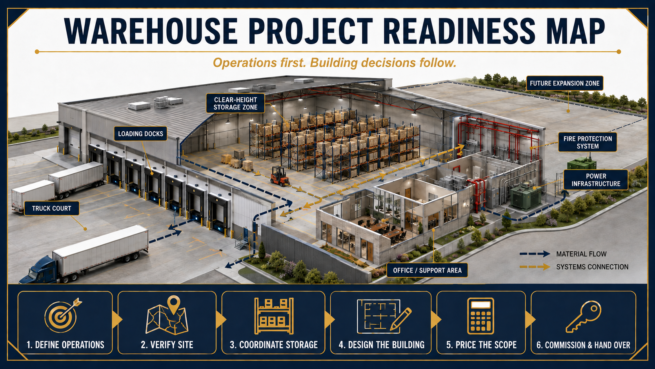
An owner-focused warehouse construction guide covering operational requirements, site and dock planning, storage and structural coordination, building systems, estimate assumptions, permits and handover.
An owner-focused comparison of TPO, PVC, EPDM, modified bitumen, BUR, metal, green and liquid-applied commercial roofing systems.
A commercial owner’s guide to construction change orders: scope documentation, pricing inputs, schedule effects, contract authority, directives, approval controls and recordkeeping.
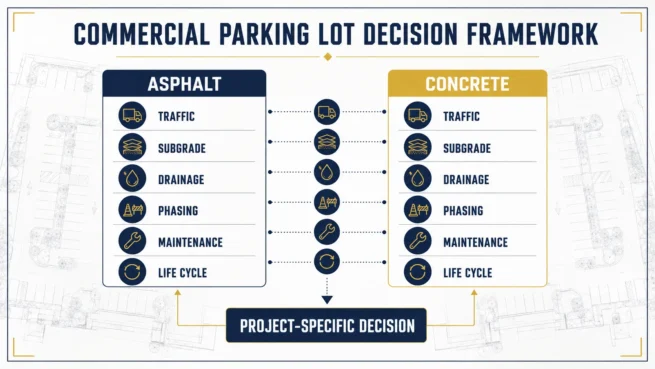
When constructing or replacing a commercial parking lot, owners and property managers often grapple with the question of whether to choose an asphalt parking lot or a concrete parking lot. The fact is, each paving material has its advantages and disadvantages, and thoroughly weighing them will only tell you which is the better option. In this blog, we examine the pros and cons of both asphalt and concrete in terms of durability, longevity, costs, appearance, environmental impact, and other vital factors.
Each construction project is full of numerous different moving pieces and each activity comes with its own set of risks. In the absence of proper risk management, these unidentified hazards can jeopardize project success and the bottom line, emphasizing the role of construction risk management at every stage. For these reasons, we have created an extensive guide for commercial contractors and owners on construction risk management, helping them address and prevent different risks flawlessly to ensure a smooth project completion.
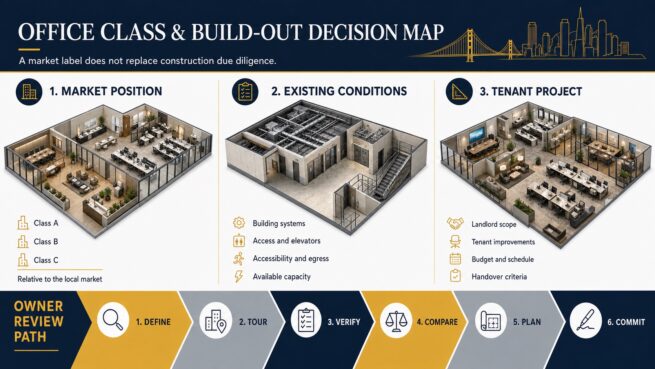
In commercial real estate, office buildings are primarily classified into three categories: Class A, Class B, and Class C. No two office spaces are constructed the same. Each office space type is differentiated based on its age, location, price, amenities, and existing conditions. Understanding how commercial buildings are classified is extremely important for tenants or investors to acquire the perfect office space for their growing business. In this blog, we will explain the features and limitations of Class A, Class B, and Class C office spaces. Discover what key factors to consider while choosing your ideal business space.
A seven-point due-diligence guide for evaluating a local commercial builder using licensing, project evidence, permitting, capacity and project controls.
A charming restaurant design is just as influential as delicious food or world-class services in crafting a memorable dining experience. From open layouts and integration of restaurant technology to Instagrammable decor and sustainable building practices, there’s an exciting range of design trends transforming the restaurant industry. In this blog, we will delve into the seven most popular restaurant design and construction trends shaping the future of gastronomic places.
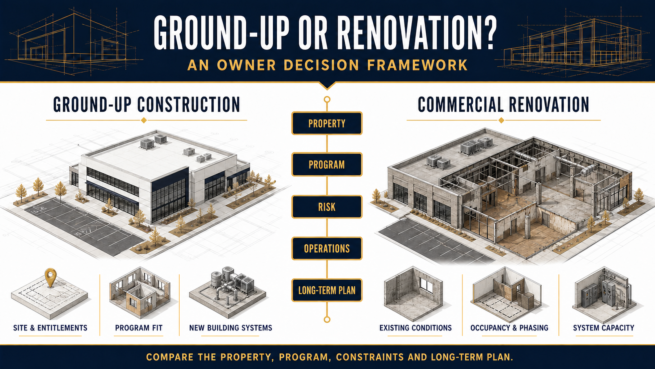
An owner decision framework for comparing ground-up commercial construction with renovation using due diligence, program, schedule and risk.
Repositioning offices to life science labs is a complex process that requires implementing significant upgrades to meet specific life science regulations and compliance standards. In this blog, you will learn the vital considerations to take for completing a successful adaptive reuse project and how to leverage the ongoing need for life sciences buildings.