

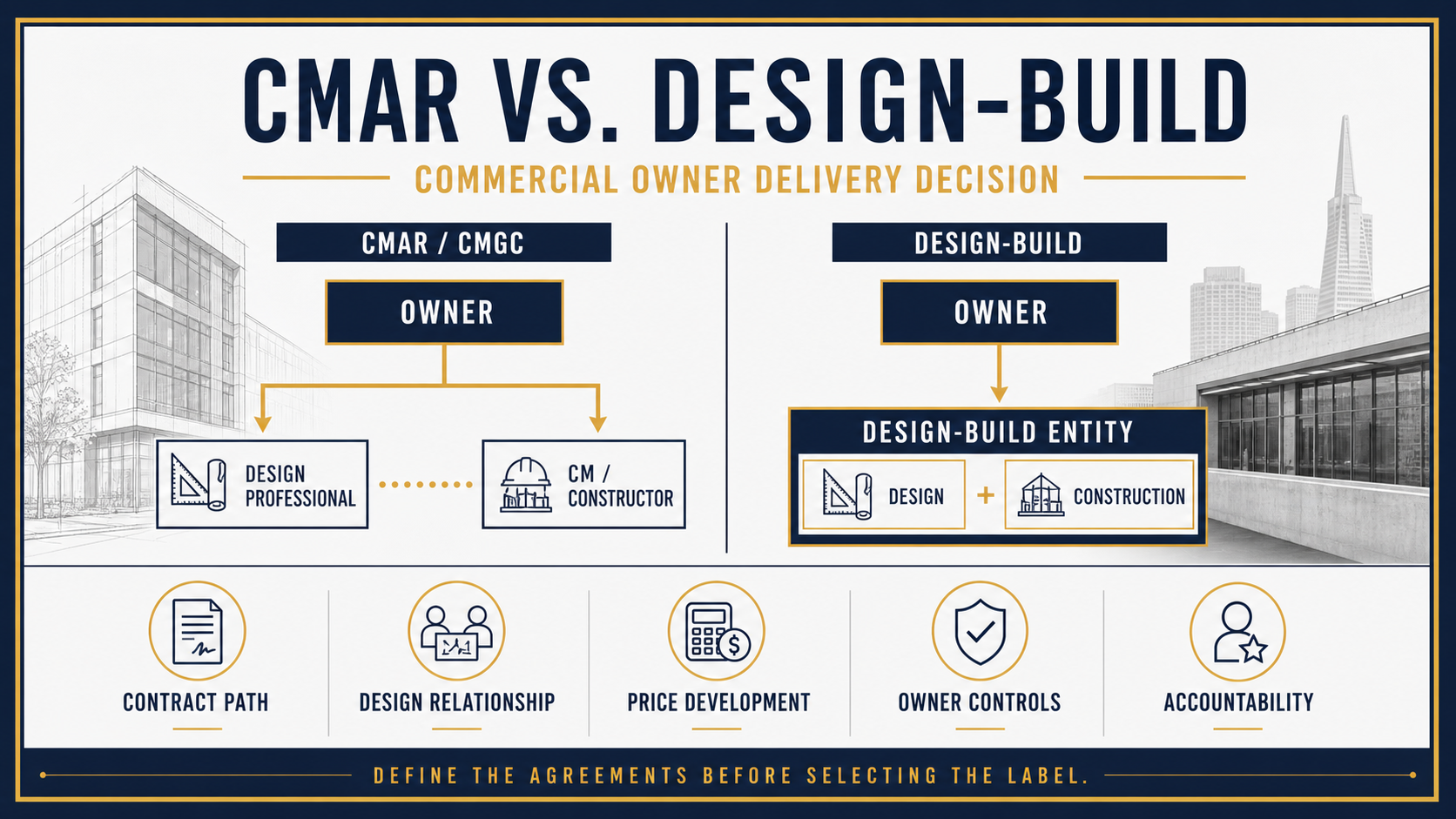
CMAR and design-build both bring construction expertise into a commercial project before the drawings are fully complete. They are not the same arrangement. The practical choice is how the owner wants contracts, design responsibility, pricing development and construction accountability to be organized.
This guide uses CMAR for construction manager at risk, also called CMaR, CM/GC or construction manager as constructor in some settings. The Construction Management Association of America describes construction management as a professional service addressing scope, function, cost, schedule, quality and safety. The Design-Build Institute of America identifies a single owner-to-design-builder contract for design and construction as design-build’s fundamental distinction. Actual duties still follow the signed agreements, procurement rules and project facts; this is an owner planning framework, not legal or procurement advice.
CMAR vs. design-build at a glance
| Decision area | CMAR / CMGC | Design-build |
|---|---|---|
| Primary contract path | The owner commonly has separate agreements with the design professional and construction manager. | The owner commonly contracts with one design-build entity for the agreed design and construction responsibilities. |
| Early construction input | The CM can advise during design on constructability, estimates, logistics, schedule and procurement. | The design-builder coordinates design and construction input within one integrated delivery team. |
| Design relationship | The owner commonly retains a direct relationship with the architect or designer. | The designer is commonly part of, or engaged by, the design-build team for the defined scope. |
| Price development | A GMP or other construction agreement may be developed as information matures. | The price may be established at different stages; the agreement must identify the basis and remaining open decisions. |
| Owner’s central question | Do we want early constructor input while retaining a separate design relationship? | Do we want one contractual path for the defined design and construction work? |
What CMAR changes for a commercial owner
In CMAR, the construction manager can participate while the design is developing. That gives the team a structured opportunity to test constructability, update estimates, examine schedule logic, identify long-lead items and plan site logistics. A current U.S. General Services Administration CMc example illustrates the common pattern: a separate architect/engineer agreement, constructor involvement during design, and a later general-contractor role under an agreed guaranteed maximum price.
A GMP is not self-explanatory. Before treating it as a complete project commitment, the owner should review the drawing and specification basis, scope narrative, alternates, allowances, contingencies, exclusions, escalation treatment, change rules, insurance, bonds, schedule assumptions and open procurement decisions. Those documents explain what the number includes and what may still change.
The owner should also define whether preconstruction is a distinct service, what happens if the parties do not reach a construction agreement, and who may use the resulting estimates or work product. For a deeper explanation, see how the CMAR delivery method works.
What design-build changes for a commercial owner
Design-build places the agreed design and construction responsibilities under one design-build entity. The structure can reduce the contractual handoff between a separately retained designer and contractor, while allowing design, estimating, procurement and field planning to develop together. It does not remove the owner’s need to define the project.
The owner still needs a written program, performance criteria, site and existing-condition information, approval authority, reporting expectations and a clear change process. Depending on the project, the owner may also retain independent support for programming, entitlement, commissioning, testing, inspections, legal review or lender requirements. Those roles should be mapped before procurement so “single point of responsibility” is not mistaken for “the owner has no responsibilities.”
Five tests for choosing the delivery path
- Contract preference: Does the owner require a direct agreement with the architect, or prefer one design-and-construction agreement?
- Decision readiness: Can the owner provide timely user, operational, landlord, funding and executive decisions as the design develops?
- Definition level: Which requirements are fixed, which remain flexible, and what information is reliable enough to support pricing?
- Risk and reporting: How will assumptions, allowances, contingencies, design changes, buyout and cost reports be reviewed?
- Market and property constraints: Do phasing, occupancy, shutdowns, permits, building rules or long-lead systems require construction input now?
How to compare CMAR and design-build proposals fairly
Ask competing teams to respond to the same owner requirements and pricing template. A useful comparison separates professional services, design services, construction cost, general conditions, fee, insurance, bonds, allowances, contingencies, alternates and exclusions. It also identifies the schedule basis, design deliverables, estimate milestones and decision dates.
Do not compare only the bottom-line number. One proposal may include surveys, investigations, coordination or closeout services that another leaves to the owner. Create a responsibility matrix covering design disciplines, permitting, utility coordination, hazardous-material evaluation, commissioning, testing, furniture or equipment interfaces, move coordination and record documents. Any item marked “by owner” should have a named owner and budget path.
Commercial situations where the distinction matters
For an occupied renovation, tenant improvement, market-ready suite or technical commercial interior, early decisions can affect access, occupant separation, shutdowns, procurement and turnover. CMAR may suit an owner that wants early construction input while preserving a direct designer relationship. Design-build may suit an owner that wants one integrated entity to coordinate the defined design and construction work.
Neither approach guarantees a lower cost, faster schedule or dispute-free result. Team capability, scope clarity, decision discipline, contract terms and site conditions remain material. A delivery method is an organizing system—not a substitute for due diligence.
Build the decision around the actual project
Constructive Solutions provides commercial preconstruction services to help owners define scope, test budget and schedule assumptions, and organize a path to construction. For an integrated approach, see our commercial design-build contractor page. For conventional construction delivery, visit our commercial general contractor page.
FAQs
Is CMAR the same as design-build?
No. CMAR commonly preserves separate owner agreements with the designer and construction manager. Design-build commonly uses one owner-to-design-builder agreement for the defined design and construction responsibilities.
Does a GMP eliminate change orders?
No. The scope basis, allowances, exclusions, owner changes, concealed conditions and other contract provisions still matter. Review the complete GMP package and change procedure.
Does design-build eliminate the need for an owner’s advisor?
Not necessarily. An owner may retain independent programming, technical, commissioning, testing, legal or project-management support depending on its capabilities and project needs.
Can an owner use preconstruction before selecting the final construction agreement?
Often, yes. The preconstruction scope should state the services, deliverables, compensation, ownership or use of work product, and what happens if the parties do not proceed together.
Which method costs less?
No delivery label establishes cost by itself. Compare equivalent scope, assumptions, services, risk allocations and current market pricing rather than relying on a universal claim.
Constructive Solutions, Inc. is a full-service commercial construction company serving San Francisco and Bay Area.
Whatever your vision, we have the resources, experience, and insight to make your concept a reality, and a space where your business can flourish.
Call Us Now for Estimate







It’s interesting that 79 percent of project owners use design-build processes. I’m looking to hire a commercial contractor to start building and digging for my new building. I’ll be sure to find one that has a good track record and that I can work with.