

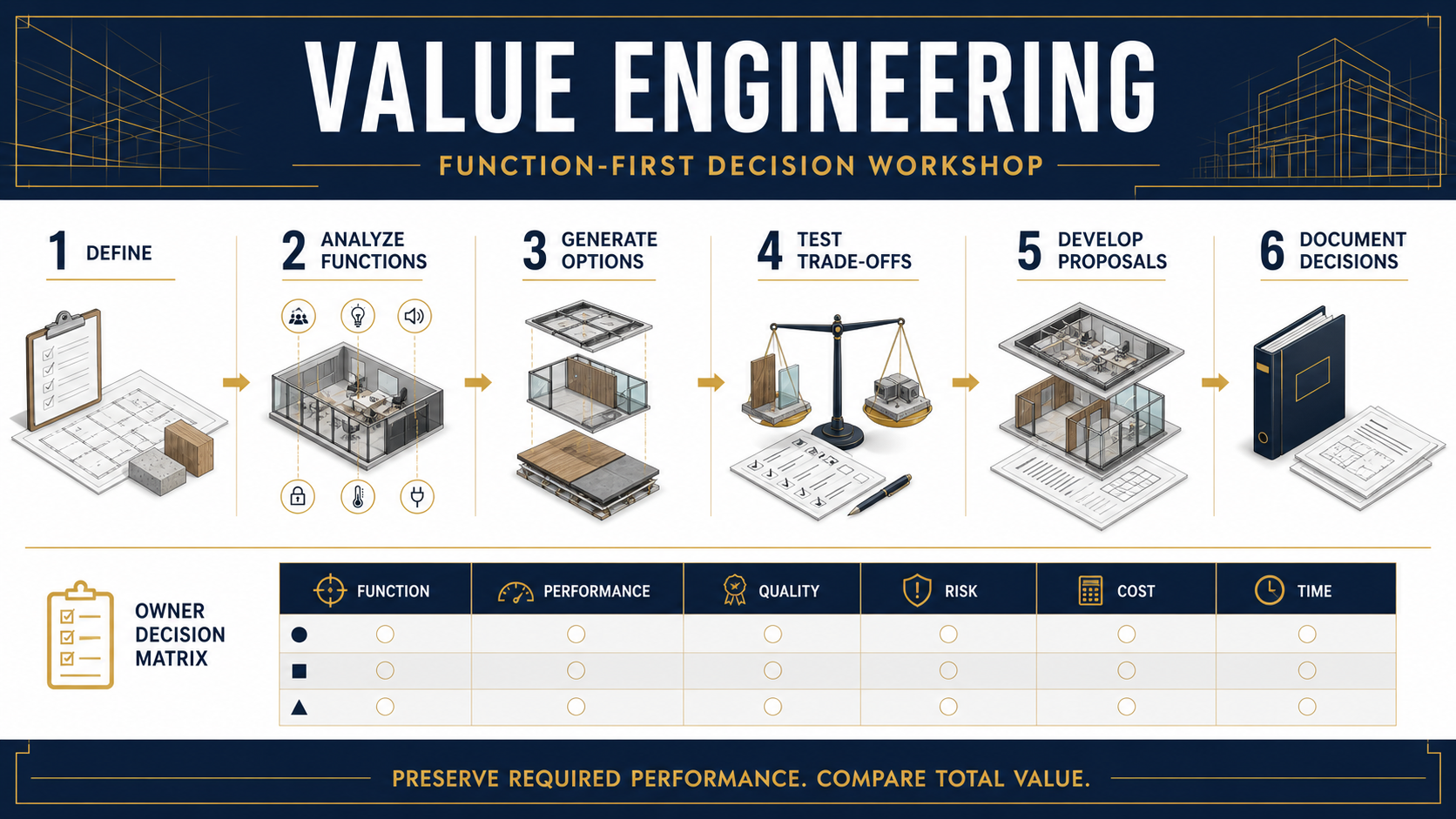
Value engineering in construction is a structured way to improve project value by examining the functions a facility must perform and comparing viable ways to deliver them. It is not a late-stage instruction to choose the cheapest material. A credible process protects required performance, quality and safety while making cost, schedule, constructability and operating implications visible to the owner.
This guide is for commercial owners, property managers, design teams and project stakeholders deciding when and how to use value engineering. Recommendations remain project-specific and should be reviewed by the responsible architect, engineers, contractor, owner and other qualified professionals.
What Value Engineering Means in Commercial Construction
Every commercial project has required functions: occupants must enter and move through the space; building systems must support the intended use; assemblies must satisfy approved documents; and the completed facility must be maintainable. Value engineering asks what each element must accomplish, what resources it consumes and whether another solution can provide the required function with a better overall balance.
The method may evaluate layout, structural systems, mechanical and electrical strategies, material assemblies, procurement packages, phasing or details. A proposal is not valuable merely because its first cost is lower. It must be technically feasible, aligned with the owner’s requirements and reviewed for consequences elsewhere in the project.
Value Engineering Is Not Cost Cutting
| Function-based value engineering | Simple cost cutting |
|---|---|
| Defines the required function and performance criteria first | Starts with a target reduction without documenting what must be preserved |
| Uses a multidisciplinary team to generate and test alternatives | Substitutes an item without complete design, trade or owner review |
| Compares first cost, lifecycle considerations, schedule, quality, risk and operations | Focuses primarily on initial price |
| Documents assumptions, effects and required approvals | Leaves downstream consequences to be discovered later |
| Rejects an option when required performance cannot be protected | Accepts reduced scope or quality without a transparent owner decision |
When Should Value Engineering Begin?
The strongest opportunity is usually before major design and procurement decisions are locked. During programming and early design, the team can compare systems, layouts and delivery strategies without reworking completed documents. During commercial preconstruction, contractor input can add current estimating, logistics, constructability and procurement information.
Value engineering can still occur later, but the team should account for redesign, permit revisions, procurement commitments and schedule effects. A late proposal is not automatically beneficial simply because its material price is lower.
A Six-Stage Owner Decision Workshop
1. Define Requirements and Constraints
Confirm the project program, approved budget framework, schedule milestones, performance criteria, quality expectations, risk tolerance, operating needs and non-negotiable requirements. Record which decisions the owner controls and which require design, agency, landlord, utility or other approval.
2. Analyze Functions
Describe what each studied element must do rather than naming a preferred product. For example, an interior partition may need to separate space, control sound, support equipment, resist moisture or meet a rated assembly. The function statement gives the team a neutral basis for evaluating alternatives.
3. Generate Options
Invite ideas from the owner, architect, engineers, contractor, estimators, specialty trades and facility representatives appropriate to the subject. Keep idea generation separate from final selection so a promising approach is not discarded before its implications are understood.
4. Test Trade-Offs
Screen each option for technical feasibility, code and accessibility interfaces, quality, safety, schedule, procurement, maintenance, energy, warranty, appearance and operational impact. The responsible design professionals must evaluate changes affecting their documents and design responsibilities.
5. Develop Proposals
Turn a promising idea into a comparable proposal. State the original basis, alternate scope, assumptions, affected disciplines, estimate basis, schedule effect, lifecycle considerations, unresolved risks and required approvals. Identify whether the proposal changes the owner’s program or merely delivers the same function differently.
6. Document Decisions
Record accepted, rejected and deferred proposals with the reason for each decision. Update drawings, specifications, estimates, procurement logs and schedules only after approval. This prevents an informal suggestion from becoming an undocumented scope gap.
How Owners Can Compare Value Engineering Proposals
| Decision factor | Questions to ask | Evidence to request |
|---|---|---|
| Required function | What must the original solution do, and does the alternate preserve it? | Owner requirements, design criteria and function statement |
| Performance and quality | What changes in durability, acoustics, appearance, capacity or maintainability? | Product data, calculations, samples and designer review |
| Cost | Are design, installation, testing, operations and future replacement considered? | Itemized estimate, assumptions and exclusions |
| Schedule and procurement | Does the option affect design, permit review, submittals, lead time or sequence? | Updated milestone and procurement analysis |
| Risk | Which uncertainties move to the owner, designer, contractor or supplier? | Risk register, contract review and responsibility matrix |
| Operations | How will users, facility staff, shutdowns and maintenance be affected? | Operations review and lifecycle assumptions |
Examples of Value Engineering Questions
A commercial project team might compare ceiling systems while preserving acoustic and access requirements; study equipment locations to reduce distribution complexity while maintaining capacity and service clearances; review modular dimensions to reduce waste without changing the design intent; or compare phasing strategies for an occupied building. These are examples of questions, not universal recommendations.
Each proposal must be evaluated in the context of the property, approved documents, product compatibility, code requirements and contract. An alternative suitable for one Bay Area office may be inappropriate for another building or use.
Who Participates and Who Approves?
The owner sets value priorities and makes business decisions. The architect and engineers evaluate design implications within their disciplines. The general contractor and trades can contribute estimating, sequencing, procurement and constructability information. Facility and operations representatives identify maintenance and user effects. The contract and approved project procedures determine who may authorize a change.
Constructive Solutions can contribute contractor-side commercial construction and preconstruction input when engaged for that scope. That role does not replace the authority of the owner, design professionals or authority having jurisdiction.
What Project Evidence Can and Cannot Show
Completed-project records help an owner judge whether a team has managed comparable commercial conditions. Constructive Solutions’ portfolio includes the 799 Market Street lobby renovation, the 351 California Street seismic retrofit and the CareMessage tenant improvement. These records document their stated scopes; they do not prove that a particular alternate will reduce the cost or duration of another project.
Frequently Asked Questions
Does value engineering always reduce construction cost?
No. A study may identify a lower-cost way to preserve a required function, but it may also confirm the original solution or support a higher first-cost option with better lifecycle value. Results depend on the project and the owner’s priorities.
Is a product substitution the same as value engineering?
Not by itself. A substitution becomes part of a credible value process only when the team compares function, performance, compatibility, cost, schedule, risk and approval requirements.
Can value engineering happen after permits are issued?
It can, but design revisions, agency review, procurement and contract changes may offset the expected benefit. The project team should evaluate those consequences before approval.
How should a value proposal be documented?
At minimum, record the original basis, alternate scope, function, assumptions, estimate, schedule effect, risks, discipline reviews, required approvals and final owner decision.
Review Constructive Solutions’ commercial preconstruction services, construction capabilities and completed-project evidence, or start a project conversation.
Primary Sources Reviewed
Constructive Solutions, Inc. is a full-service commercial construction company serving San Francisco and Bay Area.
Whatever your vision, we have the resources, experience, and insight to make your concept a reality, and a space where your business can flourish.
Call Us Now for Estimate







Leave a Reply