


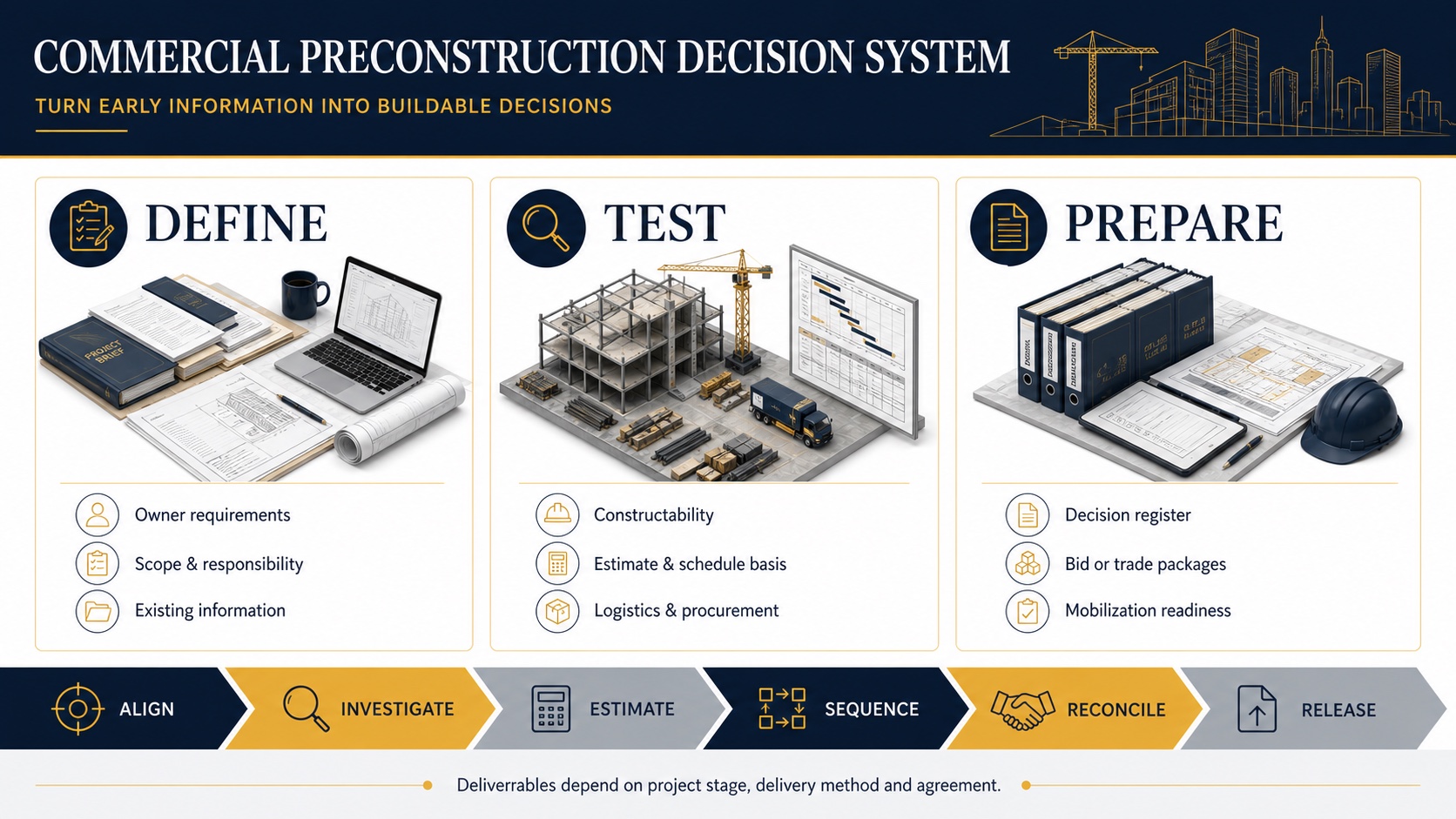
Commercial preconstruction services turn early project information into decisions that can be priced, sequenced, procured and built. The work may include scope definition, existing-condition review, constructability, estimating, scheduling, logistics, procurement planning, trade outreach and decision tracking. The actual deliverables depend on project stage, delivery method and agreement.
Preconstruction does not guarantee a final cost, completion date, permit approval or risk-free project. Its value is a clearer basis: what is known, what remains assumed, which decisions are due, and how the current scope relates to budget and schedule.
What are commercial preconstruction services?
Preconstruction is the planning and analysis performed before field construction. It connects the owner’s business requirements with design information, site conditions, construction methods, trade input and procurement realities. On a small tenant improvement it may be a focused estimating and logistics effort. On a larger or phased project it may involve multiple estimate updates, bid packages, design-assist input and a formal decision register.
The contractor’s scope should be written. “Preconstruction” can mean different things to different firms, and an attractive list of services is not proof that each deliverable is included.
Who participates?
| Participant | Typical contribution | Boundary to confirm |
|---|---|---|
| Owner and stakeholders | Business requirements, priorities, approvals, funding and risk decisions | Decision authority and response dates |
| Architect and engineers | Professional design, code analysis, performance criteria and technical responses | Design responsibility and deliverable stage |
| Commercial contractor or construction manager | Constructability, estimate, schedule, logistics, procurement and trade-market input | Advisory versus contractual commitments |
| Specialists, landlord and authorities | Building criteria, surveys, investigations, approvals and specialty review | Who obtains, relies on and pays for each input |
Core preconstruction deliverables
1. Owner requirements and scope definition
Record intended use, area program, operational needs, quality level, equipment, phasing, landlord constraints, target milestones and owner-furnished items. Translate open questions into decisions with owners and dates.
2. Existing-condition and document review
Index available drawings, surveys, reports, lease criteria and utility information. Compare records with observed conditions and identify where investigation or a qualified specialist is needed. A site walk is useful evidence, but it does not verify concealed conditions by itself.
3. Constructability review
Evaluate how proposed assemblies, systems and details could be built within site, building and operational constraints. Track questions for the design team rather than silently pricing around incomplete information.
4. Estimate and cost basis
An estimate should identify the documents used, date, scope, quantities, allowances, exclusions, assumptions, escalation treatment and contingency approach. As the design develops, reconcile changes between estimate versions. “Accurate” is not a useful promise without a defined basis and maturity level.
5. Schedule and decision logic
A useful preconstruction schedule connects design deliverables, owner decisions, reviews, procurement, shutdowns, construction activities, inspections and turnover. It distinguishes controllable activities from third-party dependencies.
6. Logistics and phasing
Review loading, elevators, staging, work hours, occupied areas, temporary protection, access, security, utility shutdowns and waste routes. In an operating office, clinic or retail setting, logistics can shape design and sequence.
7. Procurement and trade strategy
Identify long-lead or decision-sensitive items, appropriate trade packages, bidder coverage, submittal needs and release dates. Early release can create risk if design and responsibility are not sufficiently defined; the owner should understand that tradeoff.
Preconstruction decision register
| Field | Purpose |
|---|---|
| Issue and source | Connect the question to the drawing, report, field observation or requirement that created it |
| Current assumption | Show what the estimate or schedule currently assumes |
| Options and effects | Describe relevant scope, cost, schedule, operational or design implications without presenting an unsupported guarantee |
| Owner and due date | Assign responsibility and connect the decision to procurement or design milestones |
| Disposition | Record the decision and update affected documents |
How much do preconstruction services cost?
There is no defensible universal percentage. Pricing may be a fixed fee, hourly or staff-based fee, phase-based fee, or part of a broader negotiated construction arrangement. Cost depends on project size and complexity, design duration, number of estimate updates, trade outreach, investigations, scheduling detail, technology and deliverables.
Ask each provider to state what is included, how many revisions or meetings are assumed, which third-party costs are excluded, and whether any fee is credited later. Compare scope before comparing totals.
What preconstruction does—and does not—establish
- It can: expose assumptions, compare options, organize decisions, test current documents and prepare procurement.
- It cannot: reveal every concealed condition, control authority review, freeze market availability or substitute for professional design.
- It should: state confidence, limitations and the date of information behind each estimate or schedule.
- It should not: convert an early model into a guarantee through vague marketing language.
Choosing a commercial preconstruction provider
- Ask for comparable projects and verify the firm’s actual role, not only the finished photographs.
- Meet the people who will estimate, schedule and lead the transition into construction.
- Review a sample deliverable with confidential information removed.
- Confirm how design questions, estimate revisions and owner decisions are tracked.
- Define deliverables, exclusions, reliance limitations and handoff obligations in the agreement.
- For California construction services, independently verify contractor information through the Contractors State License Board.
First-party project evidence
Constructive Solutions’ published portfolio documents design-build delivery for the 5,200-square-foot CareMessage tenant improvement, including demolition, framing, HVAC, electrical, data/low-voltage, millwork and finishes. The 2765 16th Street core-and-shell project documents a broad scope involving abatement, demolition, concrete and saw cutting, structural steel, waterproofing, roofing, electrical and plumbing. These records demonstrate relevant coordination experience; they do not establish a future project’s cost or duration.
Frequently asked questions
When should preconstruction start?
Start when contractor input can still influence scope, design, logistics or procurement. The right point depends on delivery method and project complexity.
Is preconstruction the same as estimating?
No. Estimating is one component. Preconstruction can also include constructability, schedule, logistics, procurement, trade strategy, decision tracking and transition planning.
Does preconstruction include design?
Not automatically. Professional design responsibility depends on the delivery method and agreement. Contractor input should be distinguished from architectural or engineering services.
Can preconstruction guarantee the final price?
Commercial terms vary, but an early estimate should not be treated as an unconditional guarantee. Review the documents, assumptions, exclusions, allowances, contingencies and later contract language.
What should the owner receive at the end?
Typical outputs may include an aligned scope basis, estimate, schedule, logistics plan, procurement log, decision register, responsibility matrix and bid or trade-package status. The agreement should list the actual deliverables.
Discuss commercial preconstruction services
Review Constructive Solutions’ dedicated commercial preconstruction services, broader construction services and project portfolio. A useful first conversation starts with the current documents, location, intended use, target decisions and known constraints.
Constructive Solutions, Inc. is a full-service commercial construction company serving San Francisco and Bay Area.
Whatever your vision, we have the resources, experience, and insight to make your concept a reality, and a space where your business can flourish.
Call Us Now for Estimate









It was an amazing insightful blog