

A commercial construction estimate is a documented forecast based on the information available at a stated point in the project. The number is only as useful as its scope, drawings, quantities, assumptions, exclusions, market basis and risk treatment.
This guide explains what a commercial construction cost estimator does, how estimates develop, and how an owner can compare them responsibly. An estimate is not automatically a bid, contract price, appraisal or guarantee of final cost.
Need early cost and scope alignment for a Bay Area project? Estimating is one part of commercial preconstruction, alongside constructability, schedule, procurement and logistics planning.
What Is a Commercial Construction Estimate?
A construction estimate organizes the anticipated cost of a defined scope. Depending on project stage, it may use historical benchmarks, measured quantities, assemblies, subcontractor input, vendor quotations or a combination.
Every estimate should identify its purpose. An early feasibility estimate helps test whether a concept aligns with available funding. A later estimate may compare design options, support value engineering, establish a control budget or form the basis of a proposal. Numbers developed for different purposes or information levels are not directly comparable.
Estimate, Budget, Bid and Quote: Important Differences
| Term | What it generally means | What the owner should verify |
|---|---|---|
| Estimate | A forecast based on stated information, methods and assumptions. | Purpose, scope, date, design basis, inclusions, exclusions and risk. |
| Project budget | The owner’s funding plan for the complete project. | Construction, design, permits, owner items, contingency, escalation and other obligations. |
| Bid or proposal | An offer to perform defined work under stated commercial terms. | Documents, price basis, alternates, qualifications, validity and contract conditions. |
| Supplier or trade quote | Pricing for a particular product or scope. | Quantity, freight, tax, labor, accessories, lead time, exclusions and expiration. |
| Contract sum | The agreed compensation established by the executed contract. | Scope, allowances, unit prices, alternates and change provisions. |
The construction budgeting guide explains how an owner combines the construction forecast with non-construction and risk categories.
How Construction Estimates Develop
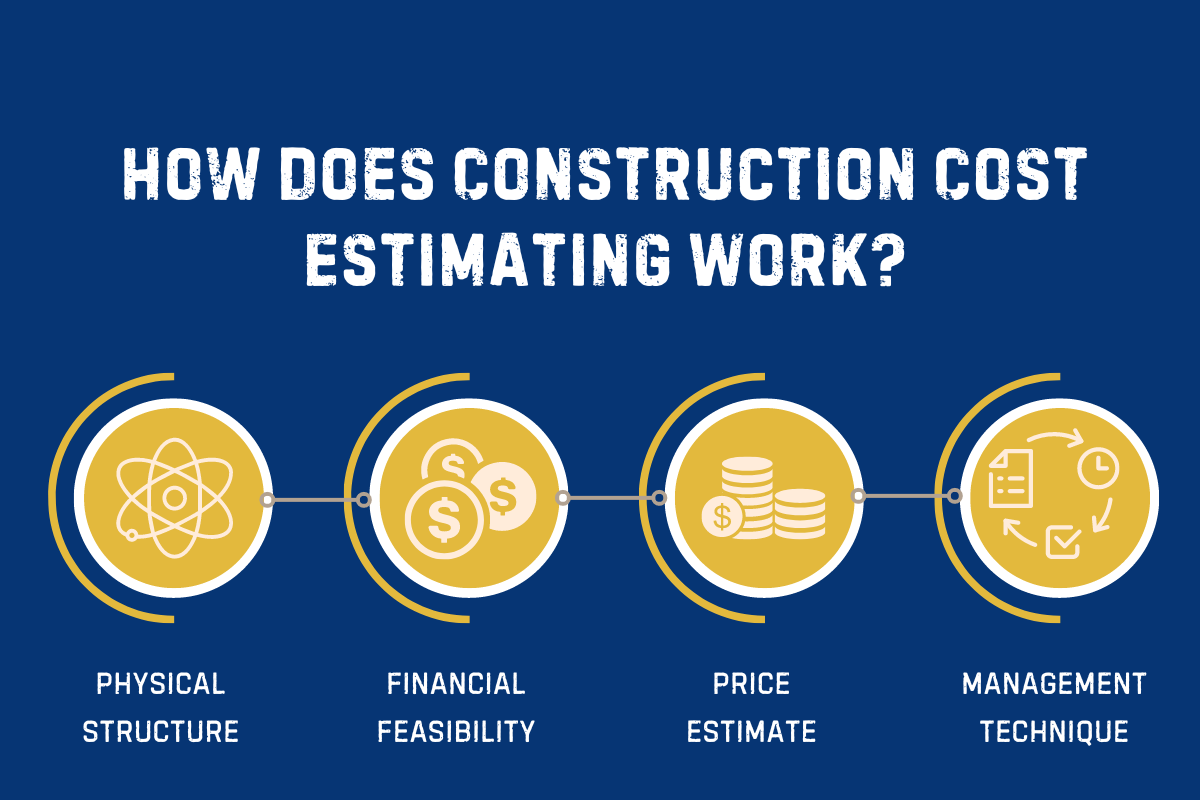
Early feasibility or conceptual estimate
When design is limited, the estimator may use area, occupancy, comparable projects, major systems and explicit allowances. This estimate should state what is unknown and how uncertainty is treated. It is useful for option screening, not detailed procurement.
Schematic and design-development estimates
As plans and narratives develop, the estimator can measure more scope and compare systems. Reconciliation between estimate versions should explain scope growth, design decisions, quantity change, market movement and corrected assumptions.
Detailed preconstruction or bid-stage estimate
With coordinated drawings and specifications, quantities and trade scopes can be developed in greater detail. Subcontractor and supplier input may replace earlier allowances. Missing details, unclear interfaces and qualifications still need to be documented.
Estimate names and expected precision vary among organizations. Do not rely on a label alone; review the actual information and method.
What a Basis of Estimate Should Document
A basis of estimate allows another reviewer to understand how the forecast was built. It should address:
- Project, location, estimate date, author, purpose and revision.
- Drawings, specifications, narratives and addenda used.
- Area, quantities, occupancy, quality level and major system assumptions.
- Work breakdown and scope responsibility by trade or package.
- Labor, material, equipment, subcontractor and supplier data sources.
- Site access, working hours, phasing, temporary protection and occupied-building logistics.
- Permit, utility, testing, commissioning and closeout assumptions.
- Allowances, alternates, unit prices, contingency and escalation treatment.
- Taxes, insurance, bonds, overhead and other commercial inclusions as applicable.
- Exclusions, unresolved decisions, qualifications and key risks.
The U.S. Government Accountability Office’s cost-estimating guide emphasizes purpose and scope, technical baseline, work breakdown structure, ground rules and assumptions, data, methodology, risk, documentation and updates. It is written for government programs, not as a commercial-building pricing standard, but its documentation principles are useful. See the GAO Cost Estimating and Assessment Guide.
Commercial Construction Estimating Workflow
- Define the decision. Identify whether the estimate supports feasibility, design selection, budgeting, procurement or a proposal.
- Confirm the information set. Log every document and revision so the estimate can be reconstructed.
- Build the scope structure. Separate packages and responsibility boundaries; do not allow gaps to disappear between trades.
- Quantify the work. Measure the available design and document quantity assumptions where details are incomplete.
- Develop rates and pricing. Use sources appropriate to the project date, location, scale, logistics and procurement strategy.
- Add project requirements. Include supervision, temporary facilities, protection, testing, closeout and other project-wide obligations.
- Analyze risk and alternatives. Keep allowances, contingency, alternates and owner decisions visible rather than burying them in unit rates.
- Review and reconcile. Check quantities, formulas, trade interfaces and changes from the previous estimate.
- Present the result. Communicate total, range or scenarios with the assumptions needed to interpret them.
- Update when information changes. A prior estimate should not be presented as current after material scope, schedule or market changes.
What Does a Commercial Construction Cost Estimator Do?

The estimator interprets project information, develops quantities and pricing, documents assumptions, coordinates trade input, identifies gaps, evaluates alternatives and communicates uncertainty. Estimators may work for owners, designers, general contractors, subcontractors, consultants or suppliers; their scope and perspective differ.
Qualifications should match the assignment. Relevant considerations include experience with the project type and region, ability to read the applicable documents, knowledge of trade interfaces and logistics, data-source transparency, quality-control process and communication. A particular degree, software package or number of years does not by itself establish estimate quality.
How Owners Should Review an Estimate
- Compare the same scope. Normalize exclusions, alternates, allowances and owner-supplied items before comparing totals.
- Check the information date. Confirm drawing revision, quote validity and assumed construction period.
- Trace major cost drivers. Understand quantities, systems and assumptions behind high-value packages.
- Review interfaces. Verify who carries demolition, patching, controls, power, permits, testing and temporary work.
- Separate uncertainty. Distinguish measured scope from allowances, contingency and unresolved options.
- Reconcile changes. Require an explanation of variance from the prior budget or estimate.
- Connect cost and time. Verify that phasing, working hours, procurement and the construction project schedule use consistent assumptions.
Online Cost Calculators vs. Project-Specific Estimates
Online calculators and square-foot benchmarks can help frame an early question, but they generally cannot see the existing building, design, system capacity, landlord criteria, access, schedule or trade boundaries. They should not be represented as a bid or final project budget.
For broad cost-per-square-foot search intent, use the protected commercial construction cost guide. This page remains focused on the estimating process and owner review, avoiding competition with that established cost owner.
Common Estimating Errors
- Comparing totals built from different drawings or scopes.
- Using an early benchmark after design and site information have changed.
- Omitting demolition, protection, access, testing or closeout.
- Counting an allowance as a fixed commitment.
- Applying a universal contingency without evaluating project risk.
- Ignoring procurement lead times, escalation or phased work.
- Burying qualifications where decision-makers cannot see them.
- Claiming “100% accuracy” despite unresolved scope and future conditions.
Commercial Construction Estimating FAQs
How accurate is a commercial construction estimate?
Accuracy cannot be determined from a label or percentage alone. It depends on information maturity, scope definition, data, methodology, risk treatment and review. The estimate should state its purpose and uncertainty rather than guarantee a result.
Is an estimate the same as a contractor’s bid?
No. An estimate is a forecast. A bid or proposal is an offer under stated scope and commercial conditions. Only an executed agreement establishes the parties’ contractual obligations.
What should be excluded from a construction estimate?
There is no universal exclusion list. The estimator should state every exclusion clearly, and the owner should account for excluded obligations elsewhere in the project budget.
When should an estimate be updated?
Update when the design, scope, schedule, procurement strategy, site information or material pricing basis changes materially, and at planned project decision points.
Can estimating software replace an experienced estimator?
Software can organize quantities, pricing and reports. It does not determine whether the scope is complete, assumptions are reasonable or trade interfaces are coordinated.
Turn an Estimate Into a Decision Tool
A credible estimate is transparent enough to review, reconcile and update. Constructive Solutions, Inc. serves commercial clients in San Francisco and the Bay Area. Review our commercial preconstruction services, commercial construction services and project portfolio, or contact the team about a defined project.
Constructive Solutions, Inc. is a full-service commercial construction company serving San Francisco and Bay Area.
Whatever your vision, we have the resources, experience, and insight to make your concept a reality, and a space where your business can flourish.
Call Us Now for Estimate









Leave a Reply