

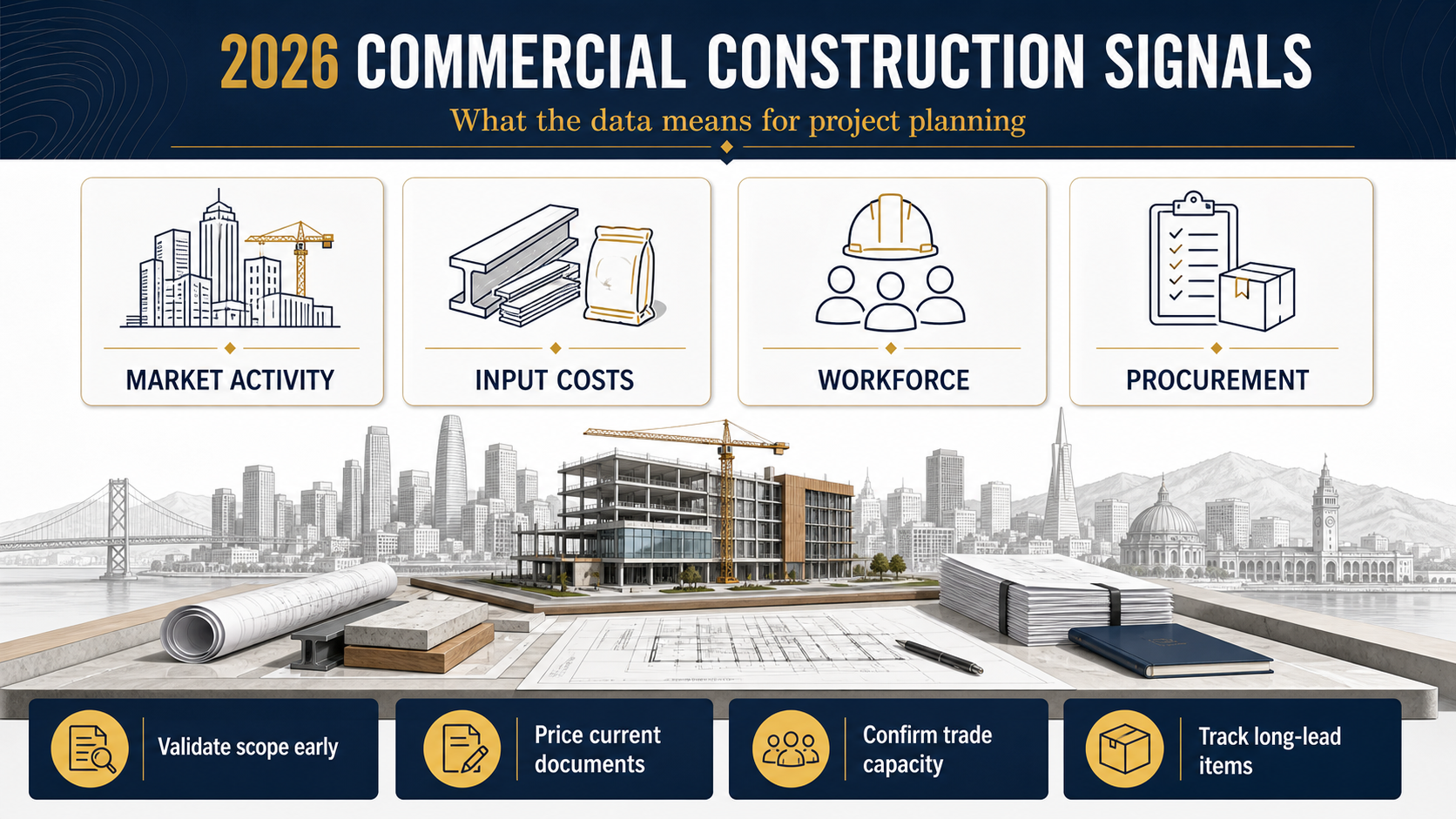
The 2026 commercial construction market is not moving in one direction. National spending data show growth in some categories and contraction in others, while material-price volatility, workforce constraints and uneven procurement conditions continue to affect project planning. For owners, the practical response is not to predict the market perfectly. It is to make scope, pricing assumptions, trade capacity and long-lead decisions visible early.
This guide translates the latest U.S. Census Bureau, Bureau of Labor Statistics and Associated General Contractors of America evidence into owner actions. These figures are not Bay Area estimates and cannot price a specific project. They are context for better questions during feasibility and commercial preconstruction.
2026 Construction Market Snapshot
The U.S. Census Bureau estimated total nonresidential construction at a seasonally adjusted annual rate of approximately $1.277 trillion in June 2026, 2.1% below June 2025. Within private nonresidential work, office construction was approximately $115.8 billion, up 15.1% year over year; commercial construction was approximately $115.3 billion, down 5.3%; and health care was approximately $56.3 billion, down 4.6%.
These values measure construction put in place at annualized national rates. Census notes that the series is seasonally adjusted but not adjusted for price changes. A higher spending figure can reflect a mix of project volume, timing and prices; it does not automatically mean more available contractors or faster delivery in a particular city.
| June 2026 national signal | Published figure | What an owner should—and should not—infer |
|---|---|---|
| Total nonresidential construction | $1.277T annual rate; -2.1% year over year | Demand is uneven. Do not use this aggregate to forecast one Bay Area project. |
| Private office | $115.8B annual rate; +15.1% | Office spending increased nationally, but project type, geography and price effects vary. |
| Private commercial | $115.3B annual rate; -5.3% | National commercial spending declined; this does not establish local bid competition. |
| Private health care | $56.3B annual rate; -4.6% | National spending declined, while individual outpatient and medical projects still require local validation. |
Input Costs Are Moving Faster Than Bid Prices
AGC’s July 2026 analysis of Bureau of Labor Statistics producer-price data reported that inputs to new nonresidential construction rose 7.1% from June 2025 to June 2026. Over the same period, the index for bids on new nonresidential buildings rose 3.5%. AGC also reported year-over-year increases of 52.4% for aluminum mill shapes, 26.0% for copper and brass mill shapes, and 16.9% for steel mill products.
These are indexes, not a material escalation allowance for an individual project. The owner takeaway is that a months-old estimate may no longer describe current procurement conditions, especially when design quantities, suppliers or alternates remain unresolved.
Owner actions for price uncertainty
- Date every estimate and identify the document set on which it is based.
- Separate quantity development from unit-price movement.
- Identify packages with volatile inputs instead of applying one blanket percentage.
- Confirm quote validity, freight, tax, escalation assumptions and exclusions.
- Ask who owns price risk before and after award; document the contractual answer.
Workforce Availability Remains a Planning Variable
The Bureau of Labor Statistics reported approximately 317,000 construction job openings in June 2026 on a not-seasonally-adjusted basis, representing a 3.6% openings rate. In AGC and Sage’s 2026 contractor survey, more than 80% of firms trying to hire reported difficulty filling hourly craft or salaried positions.
National labor indicators do not prove that a specific Bay Area trade is unavailable. They do support a disciplined capacity check. We recommend asking bidders which scopes they expect to self-perform or subcontract, whether key trade partners have reviewed the current schedule and how labor loading will change across phases.
Procurement Is More Than a Lead-Time List
In the AGC/Sage outlook, 41% of respondents said they accelerated purchases after winning contracts, 29% used alternative suppliers and 24% specified alternative materials or products to address supply-chain conditions. Respondents most frequently identified electrical equipment—such as switchgear, transformers, generators and controls—and mechanical equipment as continuing long-lead concerns.
A procurement log becomes useful when it connects design, approval, release and need-on-site dates. Listing “switchgear: long lead” without an approved one-line diagram, released equipment requirements, responsible buyer and required delivery date does not create a plan.
| Procurement field | Question it answers |
|---|---|
| Design information required | What must be decided before pricing or release? |
| Submittal responsibility | Who prepares, reviews and approves technical information? |
| Quote and release date | When was market information confirmed and when must the order be placed? |
| Manufacture and delivery | What duration is current, and what conditions could change it? |
| Need-on-site date | Which construction activity depends on arrival? |
| Alternate strategy | Which equivalent can be reviewed without compromising required performance? |
Financing and Scope Discipline Affect Starts
Sixty-three percent of respondents in the AGC/Sage survey said an owner had postponed, scaled back or canceled a project in the prior six months. Thirty-seven percent cited reduced or uncertain funding, 34% cited financing that was unavailable or too expensive, and 23% cited rising material or labor costs.
This is a contractor survey, not a probability that any one project will stop. It highlights why owners should establish a funding boundary, decision gates and an approval process before extensive design and procurement commitments accumulate. If a project must be phased, the team should confirm whether each phase can operate, receive approval and preserve the intended future work.
How Owners Should Read Contractor Backlog
Thirty-nine percent of AGC/Sage respondents reported larger backlog than a year earlier, while 30% reported smaller backlog. Backlog alone does not establish capacity for your project. The relevant questions concern the specific people, trade partners, sequence and start window being proposed.
We recommend asking who will lead preconstruction and the field, when those people become available, which comparable constraints they have managed, and whether the current schedule has been reviewed by the key trades. A long project list is not a substitute for an executable staffing plan.
Four Decisions to Make Before Going to Market
1. Validate Scope Early
Define the program, quality expectations, landlord responsibilities, permitting path and known existing conditions. Price uncertainty grows when bidders must make different assumptions about the work.
2. Price Current Documents
Record the date and design basis of every estimate. Reconcile changes from the prior estimate so the owner can distinguish scope development, quantity movement and market pricing.
3. Confirm Trade Capacity
Obtain project-specific input from the trades most likely to control sequence, coordination or procurement. Verify interest again when documents or timing change materially.
4. Track Long-Lead Decisions
Connect owner selections and design approvals to release dates. An early purchase should follow technical and contractual review; “buy early” is not a universal answer.
What This Means for Bay Area Commercial Owners
National data provide context, while Bay Area decisions still require local documents, jurisdictional review, building rules, supplier input and trade pricing. Our role during preconstruction is to help make those project-specific conditions visible and comparable. We do not convert a national percentage into a promised project cost or completion date.
Completed records such as the 2765 16th Street core-and-shell project, 351 California Street lobby project and Alameda Health Systems Eastmont Wellness project show documented commercial contexts. They are evidence of those projects only, not market forecasts.
Frequently Asked Questions
Are commercial construction prices rising in 2026?
National input indexes rose sharply year over year through June, but individual project prices depend on scope, quantities, location, timing, bidders and procurement. Current project-specific pricing is still required.
Should owners delay a project until prices stabilize?
Market timing is a business and financial decision. Before deciding, compare the cost of waiting with current feasibility, funding, operational need, design readiness and available mitigation strategies. This article is not financial advice.
Does a large contractor backlog mean there is no capacity?
No. Backlog is a broad signal. Owners should verify the actual proposed team, trade partners and start window for their project.
How often should an estimate be refreshed?
Refresh when the design, quantities, schedule, procurement plan or market conditions change enough to affect the decision. The appropriate interval is project-specific.
Review our preconstruction services, commercial construction capabilities and completed-project evidence, or start a project conversation.
Primary Sources Reviewed
Constructive Solutions, Inc. is a full-service commercial construction company serving San Francisco and Bay Area.
Whatever your vision, we have the resources, experience, and insight to make your concept a reality, and a space where your business can flourish.
Call Us Now for Estimate









Leave a Reply