

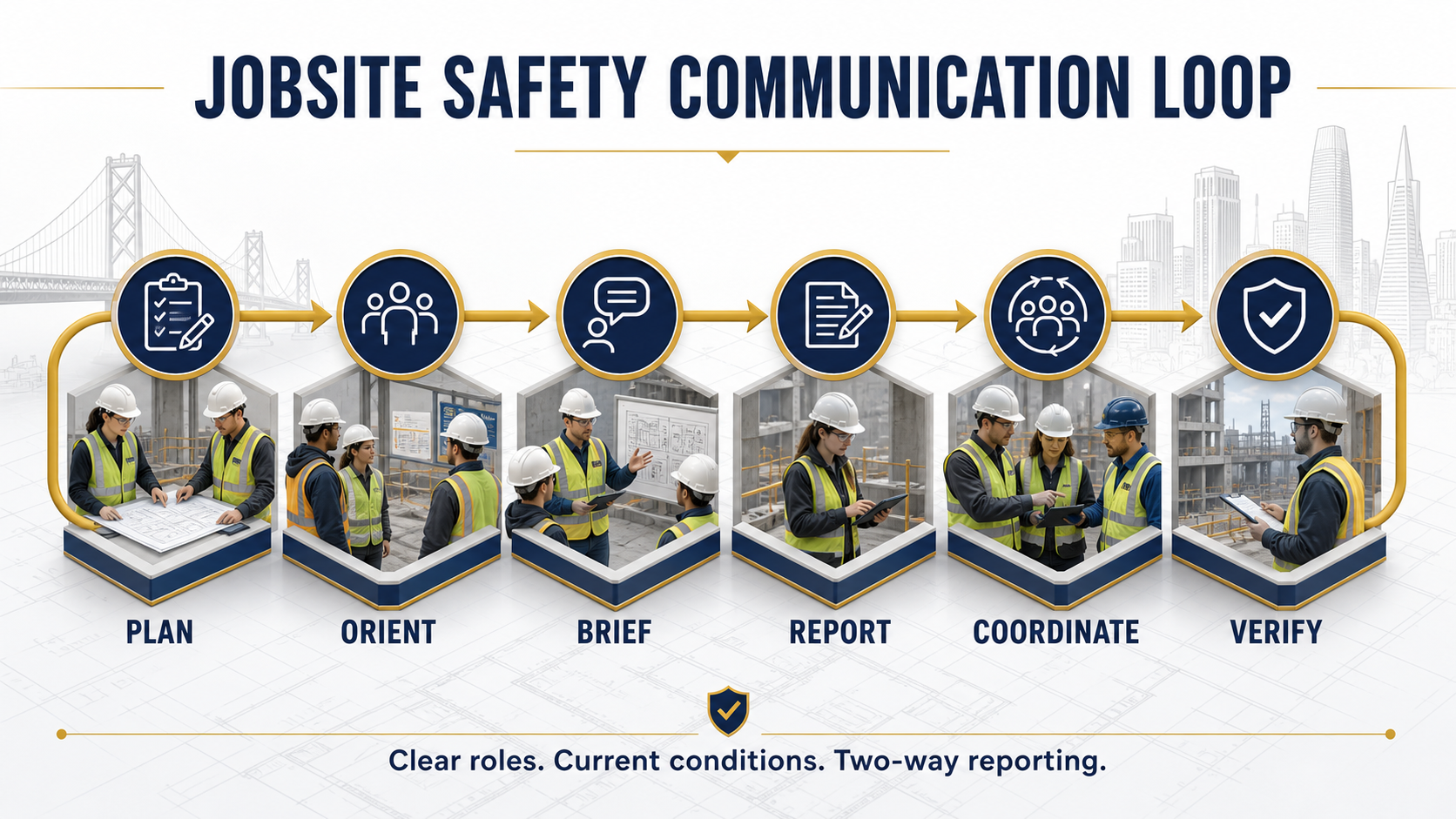
Jobsite safety communication is not a slogan, a poster, or a one-time orientation. On a commercial construction project, it is the system that keeps current information moving between employers, supervisors, workers, the owner, and an operating facility. The system must make it clear who communicates a hazard, who receives the report, what changes before work proceeds, and how the response is confirmed.
From a commercial-contractor planning perspective, we look for communication requirements early—during scope review, logistics planning, phasing, and subcontractor coordination—because many failures begin as unclear responsibilities or outdated assumptions. That planning does not replace any employer’s safety obligations. It helps the project team identify the interfaces that require a deliberate communication path.
Safety boundary: This article provides general owner and project-team planning information. It is not a site-specific safety plan, regulatory interpretation, emergency procedure, or substitute for the responsibilities of employers, competent or qualified persons, safety professionals, and authorities. The actual work, workforce, site conditions, and applicable California and federal requirements determine the necessary program, training, and controls.
What a Safety Communication System Must Accomplish
A useful system does more than distribute rules. It gives people information they can understand and a practical way to respond when conditions do not match the plan. OSHA’s recommended practices emphasize worker participation, prompt reporting, and protection from retaliation. California’s Injury and Illness Prevention Program requirements also include responsibility, communication, hazard assessment, correction, training, and recordkeeping.
For a commercial project, that translates into six connected functions:
- Plan: identify responsibilities, project interfaces, and communication channels before mobilization.
- Orient: explain site-specific conditions, contacts, reporting methods, and emergency information.
- Brief: connect each shift’s work, sequence, crews, equipment, and changing conditions.
- Report: make it straightforward to raise hazards, close calls, injuries, illnesses, and questions.
- Coordinate: exchange information across employers and with the owner or facility team.
- Verify: document the response, communicate the resolution, and confirm that affected people received the update.
1. Assign Communication Responsibilities Before Mobilization
A project should not depend on everyone assuming that someone else will make the call. Before work begins, the team should identify the employer representatives with authority, the project’s communication chain, emergency contacts, after-hours contacts, and the process for notifying the owner or facility operator.
On a multiemployer worksite, each employer retains its own responsibilities. The coordination plan should explain how the general contractor, subcontractors, temporary staffing firms where applicable, and host facility will exchange information about hazards and work that can affect others. Contract documents and preconstruction meetings can establish the interface, but the day-to-day process still needs named people and usable channels.
Owners can ask for a responsibility matrix without trying to direct field safety. Useful questions include: Who receives a worker concern? Who has authority to pause or re-sequence affected work? Who informs adjacent tenants? Who confirms that a shutdown, access change, or emergency-route change has been communicated?
2. Make Orientation Site-Specific
General training and site orientation serve different purposes. OSHA’s construction training rule requires employers to instruct employees in recognizing and avoiding unsafe conditions and in the regulations applicable to their work environment. A project orientation should then connect that foundation to the actual site.
Depending on the project, orientation may address controlled access, active operations, delivery routes, restricted areas, emergency contacts, reporting methods, sanitation, site rules, and interfaces with occupants or the public. The responsible employer must determine the training required for each worker and task.
Orientation also needs to be understandable. Cal/OSHA’s model IIPP guidance describes communication in a form readily understandable by employees and includes translation where appropriate. A signature on a roster confirms attendance; it does not prove comprehension. The team should use questions, demonstrations, or other appropriate checks rather than treating the meeting as paperwork alone.
3. Tie Daily Briefings to the Work in Front of the Crew
A daily briefing is most useful when it reflects current work rather than repeating a generic script. The discussion should connect the day’s tasks, sequence, locations, adjacent crews, equipment movement, deliveries, shutdowns, access, and changes from the prior plan.
The briefing is also a two-way checkpoint. Workers often see field conditions first. Give them a clear opportunity to identify missing information, conflicting activities, changed conditions, or controls that are not functioning as intended. If a concern cannot be resolved during the briefing, the team needs an escalation path and a way to communicate what happens next.
For occupied renovation, the daily coordination horizon may also include facility events, patient or customer movement, sensitive work hours, elevator or loading access, noise restrictions, and temporary route changes. These operating constraints belong in the same current-information loop as the construction sequence.
4. Build a Reporting Process Workers Can Actually Use
OSHA recommends a process for workers to report injuries, illnesses, close calls, hazards, and other safety concerns, with prompt follow-up and an anonymous option where appropriate. Reporting should be encouraged and free from retaliation.
The reporting method can vary—direct supervisor contact, a project number, a digital form, a written card, or another channel—but it should answer four questions:
- What kinds of conditions or events should be reported?
- Who receives the report during and after normal hours?
- What should the worker expect after reporting?
- How will the response reach everyone affected by the same condition?
Technology can support this process, but it should not become a substitute for trust, supervision, or employer responsibilities. The prior version of this article centered on tracking individual workers through active RFID. That narrow surveillance example has been removed. A reliable system prioritizes current hazard information, accessible reporting, timely response, and documented closeout.
5. Communicate Changes Before They Become Field Conflicts
Construction conditions change. A delivery arrives early, an existing utility differs from the record, an occupied area becomes unavailable, a new subcontractor mobilizes, or a shutdown window moves. The communication system should define which changes trigger a renewed review, who approves the revised plan, and how affected employers and facility contacts receive it before work continues.
Verbal coordination can be fast, but significant changes should not disappear with the conversation. The project can use a daily log, coordination record, updated logistics plan, meeting action item, request-for-information process, or other appropriate record. The goal is not paperwork for its own sake. It is a shared current version of the decision.
6. Coordinate Across Employers and the Operating Facility
OSHA’s multiemployer guidance calls for host employers, contractors, and staffing agencies to exchange information about hazards, controls, emergencies, and the work that may affect others. On a commercial project, this coordination may extend to building management, security, engineering staff, tenants, clinical operations, or retail operations.
| Communication moment | Information to exchange | Evidence an owner may review |
|---|---|---|
| Before mobilization | Roles, known conditions, site rules, access, emergency interface | Responsibility matrix, logistics plan, meeting record |
| Before a new activity | Task, location, adjacent work, responsible supervision, applicable controls | Task-planning or coordination record appropriate to the employer |
| When conditions change | What changed, who is affected, revised sequence or access, approval path | Updated plan, action item, field notice, or daily log |
| After a concern or close call | Immediate response, responsible follow-up, affected-party notice | Report, corrective-action record, and communicated resolution |
| For occupied operations | Noise, dust, routes, deliveries, shutdowns, alarms, notices | Facility coordination log and approved notification |
Consistency matters. Conflicting PPE rules, reporting channels, access instructions, or emergency information can undermine trust and create confusion. Differences between employer programs should be resolved by the responsible parties rather than left for workers to interpret in the field.
7. Close the Loop and Keep Useful Records
A report is not closed merely because it was received. Someone must evaluate it, determine the appropriate response, communicate the decision, verify implementation, and let the reporting person or affected group know what changed. If the issue reveals a broader gap, the team may need to update orientation material, a logistics plan, scheduling rules, or another part of the program.
Records should be proportionate to the work and applicable requirements. Useful project records can include orientation and training documentation, daily briefing records, inspection observations, corrective actions, employer-coordination notes, and facility notices. They help establish continuity when supervisors or crews change and provide evidence that decisions were carried through.
What Owners Should Review Without Taking Over Safety
An owner can evaluate whether the project has a credible communication structure while respecting the employer’s field responsibilities. During preconstruction, we recommend confirming:
- named project and employer contacts with decision authority;
- a site-specific orientation and communication process;
- a worker reporting and non-retaliation pathway;
- multiemployer and facility-coordination responsibilities;
- a process for changing conditions and nonroutine work;
- emergency and after-hours communication interfaces; and
- records that show issues are followed through to resolution.
These items do not demonstrate perfect performance, and no document can guarantee an incident-free project. They do show whether communication has been treated as an operational system rather than a box to check.
Frequently Asked Questions
Is a daily safety meeting enough?
No single meeting creates an effective system. Daily briefings are one part of orientation, worker reporting, employer coordination, change communication, emergency information, and follow-through.
Should construction workers be tracked electronically?
Technology may support access control, accountability, or emergency response when lawfully and appropriately implemented, but it is not a universal safety requirement or a substitute for hazard assessment, supervision, training, and two-way reporting. Privacy, labor, contractual, and operational considerations require project-specific review.
What safety certifications should an owner require?
There is no universal list of three credentials that proves readiness for every construction task. Required training and qualifications depend on the employer, role, activity, equipment, hazard, and applicable standard. Ask each bidder to identify the project-specific training, competent or qualified roles, and verification process relevant to its proposed work.
How does safety communication change in an occupied building?
The team must coordinate construction information with facility operations. Access, deliveries, separation, dust, noise, utilities, alarms, and emergency routes may affect occupants as well as workers. Assign who approves changes and who issues notices before work begins.
Primary Sources Reviewed
- OSHA: Worker Participation
- OSHA: Communication and Coordination for Host Employers, Contractors, and Staffing Agencies
- OSHA 29 CFR 1926.21: Safety Training and Education
- California Code of Regulations, Title 8, Section 3203: Injury and Illness Prevention Program
- Cal/OSHA: Model IIPP for High-Hazard Employers
Planning Work in an Operating Bay Area Commercial Property?
Review Constructive Solutions’ commercial preconstruction services and commercial renovation services. For a defined project, share the site, scope, schedule, and operating constraints so the team can discuss coordination requirements in context.
Constructive Solutions, Inc. is a full-service commercial construction company serving San Francisco and Bay Area.
Whatever your vision, we have the resources, experience, and insight to make your concept a reality, and a space where your business can flourish.
Call Us Now for Estimate









It’s a great point that the employees need to be held accountable as well so that safety is a high priority. My sister is trying to get some new construction equipment for her worksite this year. She needs to make sure that the equipment that she is using is safe and can get the job done on time.