

A cost-effective commercial contractor is not simply the contractor with the lowest initial price. For an owner, cost-effective delivery means defining value, comparing equivalent scope, documenting assumptions, making timely decisions and controlling authorized changes. The result remains project-specific; no contractor can responsibly guarantee savings before the scope, conditions and responsibilities are known.
This guide explains the construction-side decisions that make proposals more useful and delivery more transparent. Constructive Solutions’ public project records do not publish audited savings, return-on-investment or cost-avoidance figures, so the examples and frameworks below are not presented as proof of a particular financial result.
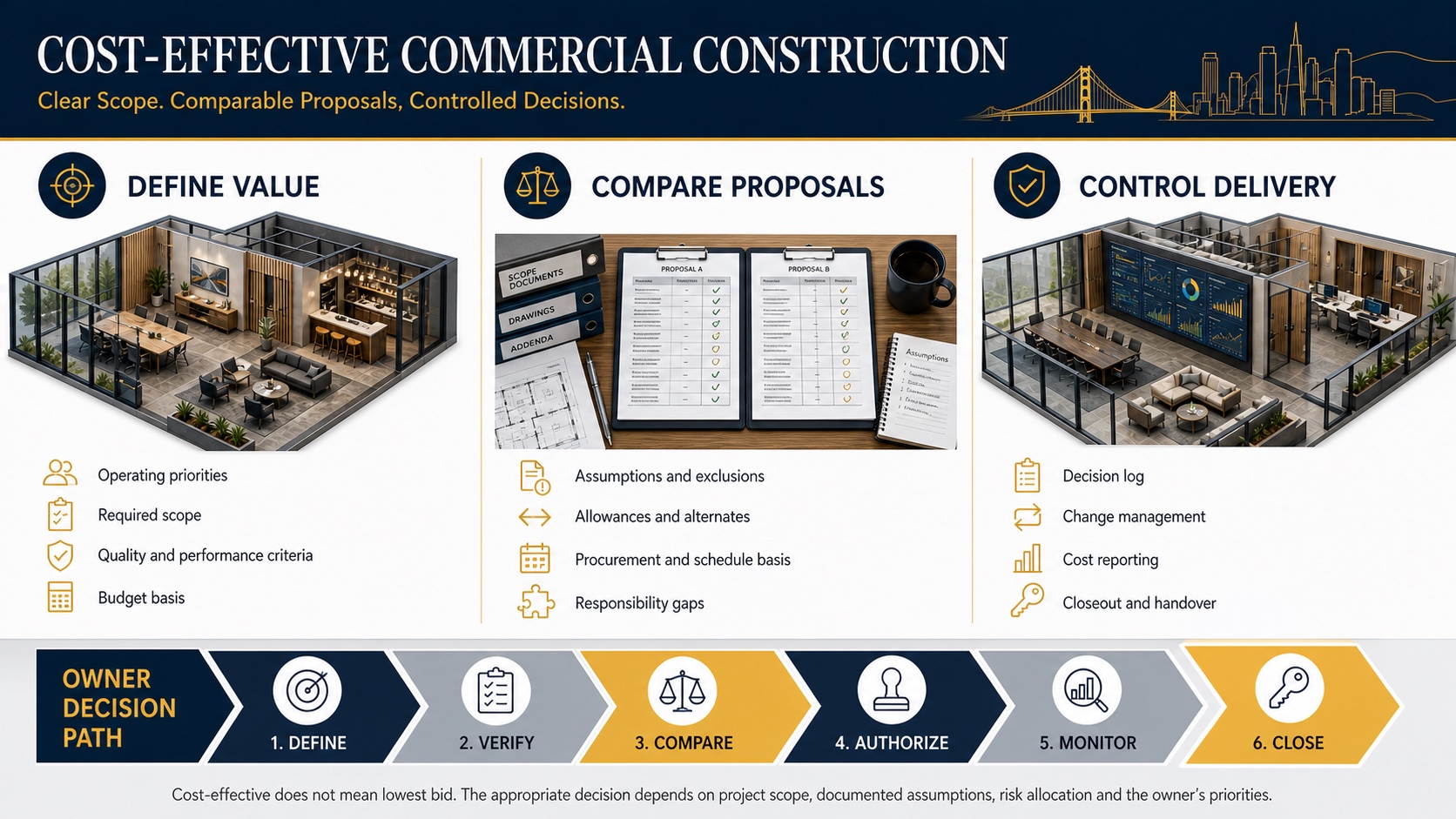
What does cost-effective mean in commercial construction?
Cost-effective means selecting and delivering the scope that best aligns with the owner’s approved priorities, required performance, operational needs, risk allocation and budget basis. It is different from “cheap.” A low bid can omit necessary work, carry different assumptions or defer decisions that later affect cost and schedule. A higher initial option can also be unjustified if it does not support an owner requirement.
The contractor’s role is to make construction information visible: quantities and scope, assumptions, exclusions, allowances, alternates, procurement constraints, logistics, change effects and forecast information. The owner, design team and advisers remain responsible for their assigned business, design, legal and financial decisions.
Define value before asking for a price
A useful contractor brief should state what the space or building must do, what must be retained, what performance or quality criteria matter, when operational constraints apply and which decisions remain open. Without that basis, proposals may price different projects under the same name.
| Owner input | Construction question | Decision output |
|---|---|---|
| Operating priorities | What cannot be interrupted, and what can be phased? | Approved logistics, shutdown and protection basis |
| Required scope | Which spaces, systems, finishes and closeout items are included? | Scope narrative and responsibility matrix |
| Quality and performance | What criteria must proposed options satisfy? | Option-comparison criteria |
| Budget basis | What is included, excluded, allowed or held as contingency? | Transparent cost structure |
Use preconstruction to expose decisions early
Commercial preconstruction can connect design development with existing-condition review, constructability, scope completeness, logistics, procurement and budget structure. It does not eliminate uncertainty. Its value is to identify assumptions and choices while the team can still evaluate them deliberately.
Useful deliverables can include a basis-of-estimate narrative, quantity or system breakdown, alternates, allowances, responsibility matrix, procurement log, decision log and reconciliation from one design milestone to the next. The appropriate deliverables depend on the agreement and project stage.
Compare commercial contractor proposals on the same basis
The California Contractors State License Board recommends comparing written bids based on identical plans, specifications and scope. For a commercial project, that principle also means checking qualifications, project team, assumptions, exclusions, allowances, schedule basis, logistics, insurance and responsibility boundaries.
| Proposal area | Compare explicitly | Red flag |
|---|---|---|
| Scope | Drawing/specification set, addenda, inclusions and quantities | A lump sum with no clear basis |
| Allowances | Amount, covered scope, markup treatment and reconciliation | Unlike allowances presented as equivalent |
| Exclusions | Who owns omitted permits, utilities, testing, design, vendors or equipment | Necessary work with no assigned party |
| Schedule basis | Release dates, review durations, lead times, access and phasing | A completion date detached from dependencies |
| Team and controls | Proposed staff, reporting, change process and closeout | A sales promise without an execution plan |
Evaluate value-engineering options responsibly
Value engineering should compare function, performance, durability, maintenance, appearance, availability, coordination, code path and operational impact—not only subtract cost. Each option should state what changes, what remains equivalent, which parties must review it and how it affects other systems.
“Savings” should be measured against a documented base option and should not be counted twice across scope reductions, allowances and procurement. Design acceptance and authority approval remain required where applicable. An option that transfers cost or risk to operations is not automatically better value.
Manage allowances, alternates and contingencies
Allowances
An allowance is a placeholder for defined work that is not fully selected or priced. State what it covers, what is excluded, how it will be reconciled and which markups or taxes apply under the agreement.
Alternates
Alternates let the owner compare optional scope without obscuring the base proposal. Identify dependencies and the last responsible decision date before procurement or sequence is affected.
Contingency
Contingency is not undocumented scope or discretionary savings. Define who controls it, which risks it addresses, how usage is authorized and how the balance is reported.
Coordinate procurement and decision timing
Early purchasing is useful only when the team understands the approved product, quantity, submittal status, storage, deposits, cancellation terms, interfaces and design risk. A procurement log should connect required-on-site dates with submittals, approvals, fabrication, delivery and installation readiness.
Likewise, a decision log should show the decision owner, information needed, required date and downstream effect. Timely decisions support control, but the contractor should not present every unresolved design item as an owner delay without documenting the agreed responsibility and dependency.
Use change control as a decision process
Changes can arise from owner requests, design development, authority comments, concealed conditions, coordination or other events. A disciplined process records the initiating condition, scope, supporting detail, cost and time basis, responsibility under the agreement, authorization status and forecast effect.
Proceeding before authorization can sometimes be necessary for safety or property protection, but routine informal direction creates ambiguity. The agreement should establish who may authorize work and how urgent conditions are documented.
What a cost report should show
- Original contract or approved control budget basis.
- Approved changes, pending changes and potential exposures shown separately.
- Allowances and contingency usage with remaining balances.
- Committed, invoiced and forecast information as defined by the agreement.
- Clear notes for assumptions, open decisions and items outside the contractor’s control.
Reports are decision tools, not guarantees of the final amount. Their reliability depends on timely and accurate input from the responsible parties.
Verify the contractor and relevant experience
Check the contractor’s current California license status through the CSLB license lookup. Ask for projects comparable in use, scope, size, existing conditions, logistics and delivery method; contact references; review the proposed team; and compare how each bidder will investigate, document, communicate and close out the work.
Constructive Solutions’ public portfolio includes commercial tenant-improvement, renovation and core-and-shell records. Those records demonstrate disclosed scopes; they are not presented as proof of a guaranteed savings rate or cost outcome.
Frequently asked questions
Is the lowest bidder the most cost-effective commercial contractor?
Not necessarily. First confirm that proposals share the same scope, assumptions, allowances, exclusions, schedule basis and responsibilities. Then evaluate qualifications, execution plan and risk—not price in isolation.
Can a general contractor guarantee construction savings?
A responsible contractor can provide option comparisons and cost information, but outcomes depend on scope, market conditions, design, existing conditions, decisions and agreements. Savings claims need a defined baseline and should be qualified.
When should cost planning begin?
It should begin when the owner can define initial goals and constraints, then become more detailed as investigation and design progress. Early estimates should be labeled with their assumptions and level of completeness.
Build a clearer commercial project basis
Review Constructive Solutions’ commercial preconstruction services, guide to choosing a commercial contractor and commercial construction services. To discuss the property, available documents and next owner decisions, contact the team.
Constructive Solutions, Inc. is a full-service commercial construction company serving San Francisco and Bay Area.
Whatever your vision, we have the resources, experience, and insight to make your concept a reality, and a space where your business can flourish.
Call Us Now for Estimate









Leave a Reply