

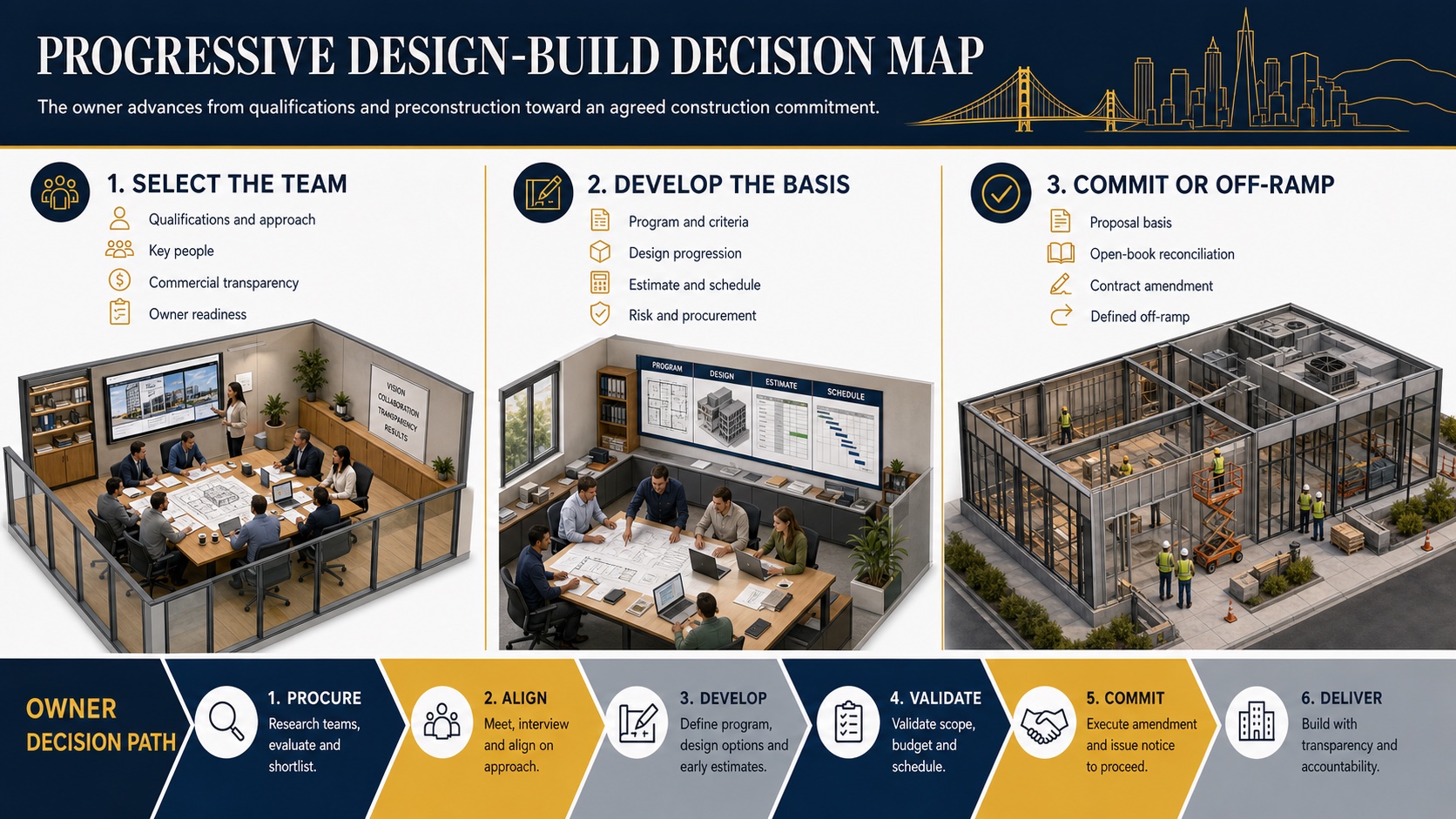
Progressive design-build is a design-build approach in which an owner selects the design-builder before the design and final construction price are fully developed. The owner and design-build team then progress the program, design, estimate, schedule, risk allocation and procurement strategy toward an agreed construction commitment—or a defined off-ramp.
This guide compares progressive design-build vs. design-build approaches from an owner’s perspective. It is not legal or procurement advice. Authority to use a delivery method, selection requirements, professional responsibilities and contract terms depend on the owner, jurisdiction and project.
What is progressive design-build?
The Design-Build Institute of America describes progressive design-build as an approach in which the owner progresses toward a design and contract price with the selected team. Like other design-build arrangements, it organizes design and construction under a single point of contractual responsibility. Its distinguishing feature is when and how the team develops the final scope and commercial commitment.
The design-builder is commonly selected with significant emphasis on qualifications, team and approach. An initial agreement covers preconstruction and design-development services. When the design reaches an agreed stage, the design-builder submits a construction proposal based on the developed documents, assumptions and commercial terms. If the parties agree, they execute the applicable amendment or second-phase agreement.
Progressive design-build vs. traditional design-build
“Traditional design-build” can describe several procurement structures. In a best-value or fixed-price competition, competing teams may develop technical proposals and offer price information before selection. In progressive design-build, the owner generally selects the team earlier and develops the design and price with that team after award.
| Decision area | Progressive design-build | Earlier-price design-build competition |
|---|---|---|
| Selection basis | Qualifications, team, approach and stated commercial factors | Technical proposal, qualifications and price or best-value factors |
| Design at selection | Owner requirements and early design basis may still be developing | More definition may be needed to support comparable proposals |
| Price development | Developed after selection through the agreed preconstruction process | Material price information offered during competition |
| Owner control point | Accept the construction proposal, negotiate, revise or use the defined off-ramp | Select among competitive proposals and administer the awarded agreement |
Neither approach is universally better. The choice depends on owner readiness, procurement authority, scope maturity, market conditions, schedule, complexity, competition goals and the owner’s ability to participate in decisions.
How the progressive design-build process works
1. Owner preparation and procurement
The owner establishes project goals, available information, performance requirements, selection criteria, commercial expectations and the proposed contract structure. A fair procurement communicates the information respondents need and evaluates the capabilities required for the actual project.
2. Team selection and alignment
The owner evaluates the design-builder, proposed designers and key people. Interviews may explore approach, collaboration, estimating, schedule, trade procurement, risk, prior comparable roles and team availability. Selection should be based on the published process and applicable requirements.
3. Phase-one services
The selected team develops the program, design, estimate, schedule, logistics, permitting approach, procurement plan and risk register. The owner makes timely decisions and validates that the evolving solution meets its criteria. Open items, allowances and assumptions should remain visible.
4. Construction proposal and validation
At the agreed design milestone, the design-builder prepares the construction proposal. The owner and its advisers review scope coverage, drawings and specifications, estimate, subcontractor input, allowances, contingencies, exclusions, schedule, procurement, insurance, bonds and other commercial terms.
5. Commitment or off-ramp
If the parties agree, they execute the construction amendment or second-phase agreement. If they do not, the contract should explain the off-ramp, compensation, document rights, transfer obligations and next steps. Qualified legal counsel should review the project-specific structure.
What should be developed before the construction commitment?
| Workstream | Owner-facing output | Control question |
|---|---|---|
| Program and criteria | Confirmed requirements, priorities and unresolved decisions | What must the project deliver, and who accepts it? |
| Design | Documents sufficient for the agreed proposal basis | What remains incomplete or subject to later development? |
| Estimate | Reconciled quantities, trade input, allowances, contingencies and exclusions | What evidence supports each material cost assumption? |
| Schedule | Milestones, decision dates, reviews, procurement and construction sequence | Which owner or third-party dependencies control the path? |
| Risk and procurement | Responsibility matrix, trade strategy and documented open risks | Who owns each risk, and what remains an assumption? |
Owner readiness for progressive design-build
Progressive design-build requires active owner participation. The owner needs authorized decision-makers, clear governance, timely access to users and advisers, a process for validating cost and design, and the ability to maintain the stated procurement and commercial principles.
The DBIA progressive design-build best-practices release emphasizes owner readiness, qualifications-focused procurement, phased contracting and transparent cost development. Those controls matter because the final price is developed with the selected team rather than obtained as a fully comparable construction bid at the outset.
Potential advantages and trade-offs
Potential advantages
- Early integration of design, estimating, constructability and procurement
- Ability to test options before the final construction commitment
- Continuity of the selected team through design development
- Transparent tracking of assumptions and estimate evolution when the process is well structured
Trade-offs and controls
- Less direct price competition at the final design stage unless the owner builds independent validation into the process
- High reliance on team competence, transparency and owner participation
- Need for clear document rights and an executable off-ramp
- Risk of premature commitment if scope, estimate and responsibilities are not sufficiently reconciled
These are possible characteristics, not guaranteed outcomes. Contract language and project execution determine the actual obligations.
Verified design-build evidence—and its boundary
Constructive Solutions documents commercial design-build roles at 1611 Telegraph Avenue in Oakland, the 351 California Street market-ready project and the 799 Market Street buildout. These records support general design-build and commercial coordination experience. The public project records do not establish that the projects used progressive design-build, and this guide does not present them that way.
Questions before selecting a PDB approach
- Does the owner have authority to use the proposed procurement and contract structure?
- Are the project goals and performance criteria clear enough to select the right team?
- How will estimates be validated and trade procurement remain transparent?
- What design milestone and proposal content support the construction commitment?
- Who makes decisions, and how will unresolved issues be documented?
- What happens to documents, licenses and procurement work if the parties use the off-ramp?
Frequently asked questions
Is progressive design-build the same as design-build?
It is a design-build approach. The principal distinction is that the selected team develops the design and final construction proposal progressively after selection.
Does PDB guarantee a lower price or fewer changes?
No. It can create a framework for early collaboration and transparent development, but outcomes depend on scope, market, information, decisions, contract terms and execution.
Does the owner have a guaranteed off-ramp?
Only the actual agreement defines the off-ramp, compensation, document rights and transition obligations. Owners should obtain project-specific legal advice.
Discuss a commercial design-build project
Review Constructive Solutions’ commercial design-build services, preconstruction services and verified project portfolio. To discuss an appropriate delivery structure for a defined Bay Area project, contact the team.
Constructive Solutions, Inc. is a full-service commercial construction company serving San Francisco and Bay Area.
Whatever your vision, we have the resources, experience, and insight to make your concept a reality, and a space where your business can flourish.
Call Us Now for Estimate






Leave a Reply