

The best questions for a commercial renovation contractor are the ones that expose how the team understood your building, documents, operating constraints and proposal basis. A polished interview matters less than comparable evidence: relevant project records, disclosed assumptions, an executable logistics plan and a clear method for decisions, changes and closeout.
From a contractor’s side of the table, we see owners get the most useful answers when they provide the same information to every team and ask each proposer to identify uncertainty. This guide turns the interview into a commercial due-diligence process. It is not a substitute for legal, insurance, design or licensing advice.
1. Which Completed Projects Are Truly Comparable?
Ask for examples that match the conditions that drive your work: occupied versus vacant, office versus medical or retail, high-rise versus standalone, lobby versus full-floor, structural versus finish work, and similar mechanical, electrical, plumbing or life-safety interfaces. A general portfolio is helpful, but it does not answer whether the proposed team has dealt with your project’s defining constraints.
Then ask what the contractor actually performed. Was the firm the general contractor, construction manager, design-builder or a subcontractor? Which proposed staff members participated? What facts can be verified? A good answer distinguishes company experience from an individual’s prior employment and avoids turning one project into a universal outcome claim.
2. Is the California License Active and Appropriate?
Use the California Contractors State License Board’s current license-check service rather than relying only on a proposal or website badge. Confirm the business name, license status and classifications relevant to the offered work. CSLB also provides bond, workers’ compensation and disclosure information; status can change, so verification should be current when the owner makes a selection.
Insurance requirements should be established with the owner’s risk and legal advisors. CSLB advises consumers to verify workers’ compensation and commercial general liability information and explains that general liability insurance is not itself required for every California contractor license. The project agreement, property owner and lender may impose additional requirements.
3. What Existing Conditions Has the Contractor Verified?
Commercial renovations carry uncertainty behind walls, above ceilings and within active systems. Ask what the contractor observed, what documents were reviewed and what remains unknown. Existing drawings may not reflect prior tenant work or field modifications. A team should not imply certainty where access or design information is incomplete.
Useful answers identify targeted next steps: field verification, ceiling access, utility information, equipment data, selective investigation, testing by qualified specialists or design-team resolution. The proposal should state whether these activities are included and who authorizes invasive work.
4. What Exactly Does the Proposal Include?
Request a scope narrative tied to the issued documents. It should identify included work, exclusions, allowances, alternates, owner-furnished items, temporary work, working hours, permits, supervision, cleanup and closeout. If a value is carried for incomplete design, label it as an allowance or assumption instead of presenting it as resolved scope.
| Proposal item | Question to ask | Why it matters |
|---|---|---|
| Document basis | Which drawings, specifications and addenda were priced? | Prevents comparison across different information |
| Allowances | What quantity, quality or unit basis supports each allowance? | Shows where final scope may change the amount |
| Exclusions | Who is expected to perform or pay for each excluded item? | Reveals responsibility gaps |
| Alternates | Does each alternate include related design, labor and system effects? | Avoids evaluating an isolated material swap |
| General conditions | What staffing, temporary facilities, protection and hours are assumed? | Connects jobsite support to the execution plan |
5. How Will Occupied-Site Logistics Work?
If employees, tenants, patients, customers or neighbors remain nearby, ask for more than “we will minimize disruption.” The contractor should address access, temporary separations, egress, fire protection, noise, dust, odor, shutdowns, deliveries, elevators, security, waste removal and daily communication. The plan should reflect property-management rules and the actual building.
Ask which activities require off-hours work and whether those hours are included in the proposal. Identify who approves shutdowns and occupant notices. A schedule that ignores building rules is not an execution plan.
6. Who Will Manage the Project Day to Day?
Request the proposed project manager, superintendent and key support roles, then ask about availability and decision authority. The company’s résumé does not tell you who will coordinate trade work, review field conditions, maintain records and communicate with the owner.
We recommend defining one owner representative and one contractor point of contact, supported by a responsibility matrix. The team should know who can approve cost, design clarification, after-hours access and schedule changes—and which decisions require a formal owner process.
7. How Are Schedule Assumptions Documented?
Ask the contractor to show the logic behind the schedule: design releases, permit milestones, procurement decisions, mobilization, phasing, inspections, commissioning if applicable, owner work and turnover. A completion date without these dependencies is difficult to evaluate.
Current supplier input should support lead-time assumptions for important items. The proposal should also state what owner decisions are needed and when. No qualified contractor can guarantee that agencies, utilities, vendors or undiscovered conditions will behave exactly as predicted.
8. How Will Changes and Unforeseen Conditions Be Managed?
Ask how the contractor documents a changed condition, obtains design direction, prices the effect and receives authorization before proceeding. The agreement should establish notice and approval requirements. The contractor should not decide legal entitlement, and the owner should not rely on an informal conversation as the only project record.
A useful change proposal separates scope, labor, material, equipment, subcontractor, schedule and other contractually allowed effects. It should explain the source of the change and identify any pending information.
9. What Quality-Control and Inspection Process Is Proposed?
Ask how submittals, mockups, first installations, concealed work, testing, inspections and deficiencies will be coordinated. Quality control is not simply a final punch list. It begins with confirming requirements and continues through installation and documentation.
The responsible design professionals and authorities having jurisdiction retain their respective roles. A contractor’s internal checks do not replace required inspections, testing or professional review.
10. What Does Complete Closeout Mean?
Define turnover before construction begins. Depending on the project, closeout may include inspections, correction lists, record information, warranties, manuals, training, keys, attic stock, equipment data and evidence required by the owner or property manager. Ask who assembles, reviews and delivers each item.
Substantial completion, occupancy authorization, owner acceptance and final contract completion can be different milestones. The agreement and project team should use precise terms rather than one vague “done” date.
Use a Proposal-Normalization Matrix
| Evaluation area | Evidence to compare | Follow-up if unclear |
|---|---|---|
| Relevant experience | Comparable project, role and proposed staff | Request specific records and references |
| Scope | Document list, narrative, inclusions and exclusions | Issue a written clarification to every proposer |
| Logistics | Building-specific access and phasing concept | Walk the site with the proposed superintendent |
| Controls | Schedule, submittal, RFI, change and reporting process | Review a redacted sample workflow |
| Closeout | Deliverable matrix and responsibility | Add missing requirements before award |
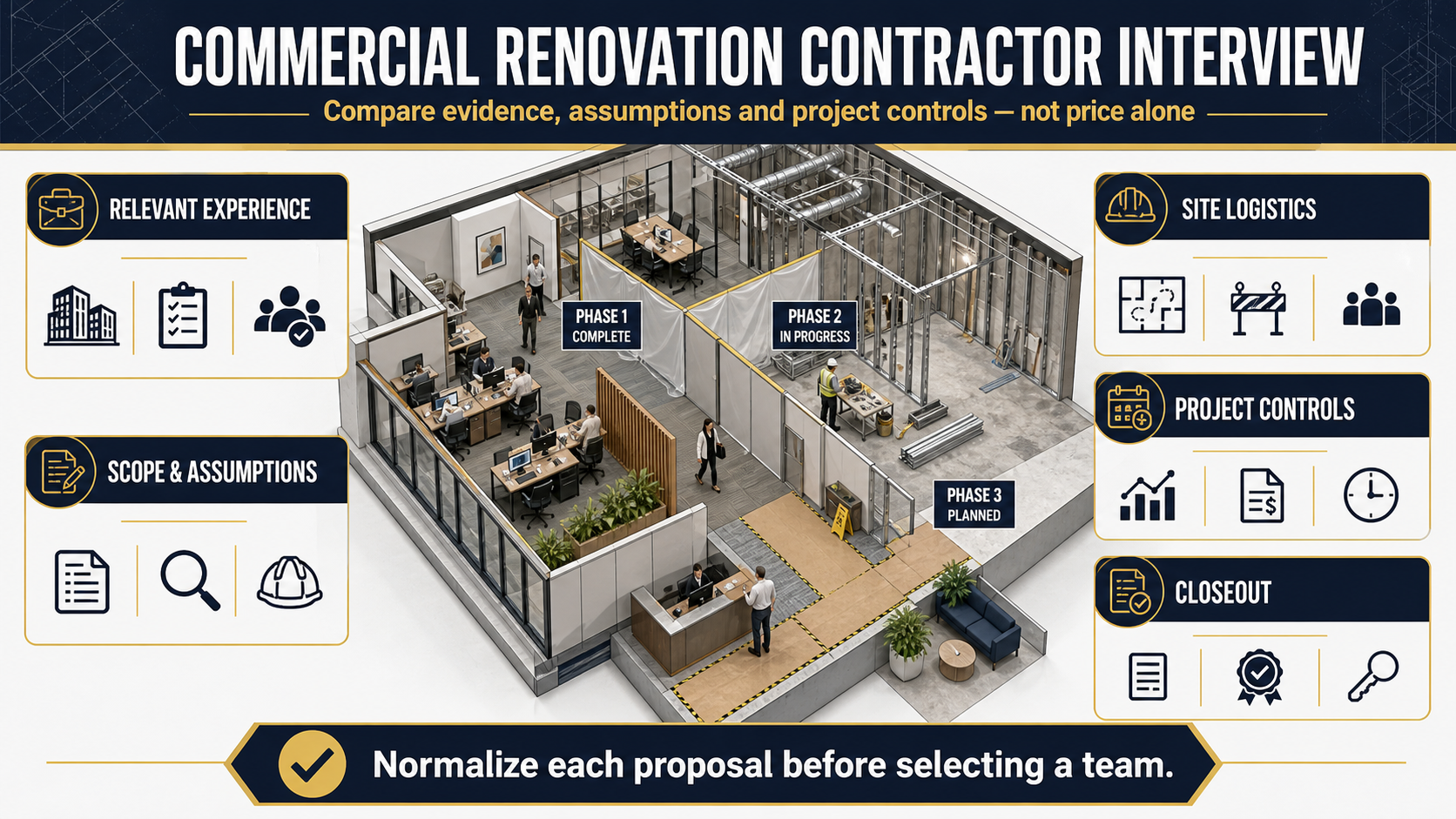
The accompanying infographic summarizes this method: compare relevant experience, scope and assumptions, site logistics, project controls and closeout. Normalize the proposals before selecting a team; price alone does not reveal whether the proposals contain the same work.
Bounded Project Evidence
Our preserved portfolio includes the documented 799 Market Street lobby renovation and 351 California Street lobby project. These records demonstrate completed commercial renovation contexts. They do not guarantee another project’s approval, cost, duration or operating outcome.
Frequently Asked Questions
Should an owner always choose the lowest commercial-renovation proposal?
No universal selection rule applies. Owners should compare scope, assumptions, qualifications, logistics, risk and contract terms with their advisors. A lower total may reflect a different proposal basis rather than a more efficient plan.
How many contractors should be interviewed?
The right number depends on procurement requirements and the owner’s ability to provide consistent information and evaluate responses. A focused group of qualified teams is more useful than many incomparable bids.
Can a contractor confirm code compliance during an interview?
A contractor can discuss constructability and coordination, but project-specific code analysis belongs with the responsible design professionals and authorities having jurisdiction. Avoid treating an interview statement as an approval.
When should the owner involve a contractor?
Early involvement can help test existing-condition, phasing, procurement and estimate assumptions. The scope and authority of that involvement should be defined by the delivery method and agreement.
Review our commercial renovation services and preconstruction approach, or share your project information when you are ready for a scope-based discussion.
Primary Sources Reviewed
Constructive Solutions, Inc. is a full-service commercial construction company serving San Francisco and Bay Area.
Whatever your vision, we have the resources, experience, and insight to make your concept a reality, and a space where your business can flourish.
Call Us Now for Estimate







Leave a Reply