

A commercial construction project schedule is a decision and communication system—not merely a list of dates. It connects scope, design, approvals, procurement, field activities, inspections, owner decisions and turnover so the project team can understand sequence, dependencies and current risk.
This guide explains how owners and project teams develop, review and maintain a construction schedule. It does not promise a completion date. The contract, approved scope, project constraints and current information determine schedule obligations.
Planning a San Francisco Bay Area commercial project? Early schedule development belongs in commercial preconstruction, where scope, budget, procurement and logistics can be tested together.
What Is a Construction Project Schedule?
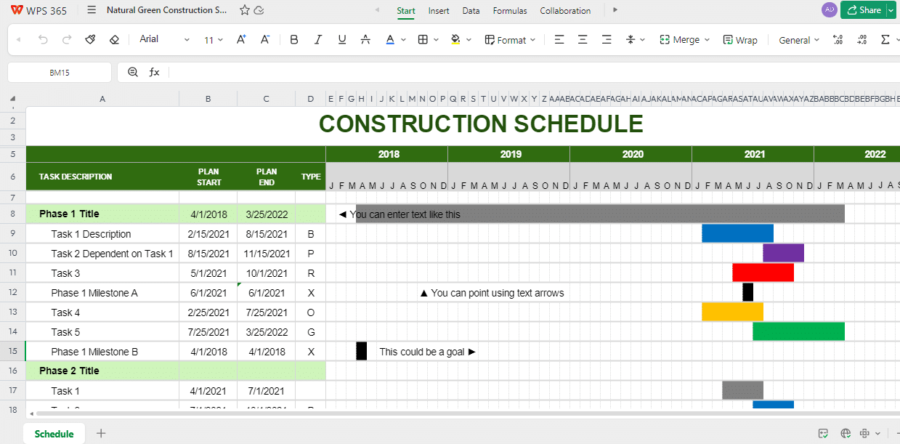
A construction project schedule organizes the work into activities and milestones, assigns logical relationships, and places them on a time scale. A useful schedule shows more than field installation. It can include owner decisions, design deliverables, landlord review, permits, submittals, fabrication, deliveries, shutdowns, inspections, commissioning and closeout.
The appropriate level of detail depends on the project, delivery method and contract. A one-page milestone plan may support early feasibility; construction typically requires a more detailed baseline and short-interval planning by the team performing the work.
Construction Schedule Types Owners May See
| Schedule | Primary purpose | Owner review focus |
|---|---|---|
| Feasibility or milestone schedule | Tests target dates and major phases before full information exists. | Assumptions, approvals, lease dates, funding and decision deadlines. |
| Design and preconstruction schedule | Coordinates surveys, design packages, estimates, permits and procurement. | Required inputs, review durations, package strategy and long-lead decisions. |
| Baseline construction schedule | Documents the planned sequence and timing used to manage the work. | Contract requirements, logic, milestones, calendars, constraints and acceptance. |
| Procurement and submittal schedule | Tracks selections, submittals, review, fabrication and delivery. | Owner selections, design review, release dates and substitution risk. |
| Look-ahead schedule | Translates the baseline into near-term activities and commitments. | Access, shutdowns, tenant impacts, upcoming decisions and constraints. |
| Recovery or mitigation schedule | Explains a proposed response when progress differs from the accepted plan. | Cause, responsibility, feasibility, cost, risk and required authorization. |
These names are commonly used, but required formats and update procedures come from the project agreement. An initial forecast should not be mistaken for an accepted contractual baseline.
How to Build an Achievable Construction Schedule
1. Define the Schedule Purpose and Basis

Start with the decision the schedule must support. Is it testing a lease date, planning design and permits, establishing a construction baseline or coordinating occupied-space work? Record the schedule date, drawing and scope basis, calendars, working hours, required milestones and known constraints.
Identify assumptions explicitly. Examples include agency review periods, landlord access, utility shutdowns, existing-condition information, owner-furnished equipment and availability of selected materials. An assumption is not a commitment by the party it concerns.
2. Organize the Complete Scope
Break the project into manageable work packages that reflect the actual delivery strategy. Include planning and administrative work that can control field progress: surveys, hazardous-material investigation when applicable, design, owner approvals, permits, submittals, samples, mockups, procurement, fabrication, testing, inspections and turnover.
The work breakdown should be detailed enough to assign responsibility and understand sequence without creating thousands of activities that cannot be meaningfully updated.
3. Establish Activity Logic

Link activities according to physical, contractual and operational relationships. A successor may require completion of a predecessor, or activities may overlap only after a defined portion is complete. Avoid using date constraints to conceal missing logic.
Pay special attention to interfaces: design approval before procurement, equipment dimensions before rough-in, inspections before concealment, power availability before startup, and testing before turnover. The critical path is the chain of activities that currently controls the calculated completion date; it can change as the project changes.
4. Develop Durations From a Stated Basis

Duration should reflect quantity, production approach, crew plan, work hours, access, inspections, curing, testing and other project conditions. Procurement duration should distinguish submittal preparation, review, resubmittal, fabrication, shipping and site readiness.
Do not present an unsupported duration as certainty. Early schedules should use qualified ranges or documented assumptions when design, permit or vendor information is incomplete.
5. Load Milestones, Resources and Constraints

Check whether the sequence assumes labor, equipment, work areas or shutdown windows that cannot occur together. Identify contractual milestones separately from internal planning goals. Distinguish hard constraints—such as a documented no-access period—from preferences that the team can evaluate.
Owner decisions are schedule activities too. Equipment selection, finish approval, lease coordination and access authorization need a responsible party and required-by date.
6. Coordinate Schedule, Budget and Procurement
The schedule and estimate should use the same scope and assumptions. Acceleration, phasing, temporary protection, premium freight, overtime or extended general conditions can change cost. Conversely, value-engineering or procurement decisions can change sequence and lead time.
Use the commercial construction estimating guide and construction budgeting guide to align time and cost rather than reviewing them as separate documents.
7. Review the Baseline With the People Responsible

The project team should test the sequence, access, trade interfaces, inspection plan and procurement dates. Owners should confirm their milestones, review periods and furnished-item responsibilities. Design professionals should review activities that depend on design deliverables or professional services within their scope.
Baseline acceptance does not transfer every schedule risk to one party. Responsibility and entitlement are governed by the contract and facts.
8. Update, Forecast and Communicate

At each update, record actual starts and finishes, remaining duration, approved scope changes, new constraints and current procurement information. Compare the forecast with the accepted baseline and explain material variance.
A good update answers: What changed? Why? Which milestone is affected? What decision or action is needed? What mitigation is being evaluated? Avoid silently rewriting the baseline to make variance disappear.
Owner Schedule Review Checklist
- Does the title block identify project, schedule type, status date and revision?
- Are scope, drawings, calendars, assumptions and exclusions documented?
- Are owner, landlord, utility, design and authority activities visible?
- Do procurement activities include submittal, review, fabrication and delivery?
- Are contractual milestones distinguished from forecasts and internal targets?
- Does logic support the dates, or are excessive fixed constraints driving them?
- Are occupied-building access, shutdown and phasing restrictions represented?
- Does the update show actual progress, remaining work and current variance?
- Are proposed changes authorized under the contract before the baseline is changed?
The U.S. General Services Administration describes a project schedule as a living tool and emphasizes balancing scope, cost and time, with communication as the project evolves. Its guidance is written for federal projects, but the planning principle is useful for commercial owners. See GSA project schedule management guidance.
Common Schedule Risks to Test Early
- Incomplete scope or existing-condition information.
- Owner, landlord or design decisions without required-by dates.
- Permit, utility or inspection assumptions presented as guaranteed durations.
- Long-lead equipment released after the required procurement date.
- Occupied-space restrictions, shutdowns or after-hours work omitted from the plan.
- Trade stacking or work-area conflicts that are not physically achievable.
- Testing, commissioning, training and closeout compressed into a single milestone.
- Scope changes added without analyzing time and cost effects.
Commercial Construction Scheduling FAQs
Who creates the construction project schedule?
The responsible party depends on the delivery method and contract. The general contractor commonly develops the construction schedule with input from subcontractors, suppliers, the design team and owner. Early milestone schedules may be developed collaboratively during preconstruction.
What is the difference between a baseline and an update?
The baseline is the accepted plan used for comparison. An update records progress and current forecast against that plan. Changes to the baseline should follow the agreement rather than being made simply to remove variance.
Can scheduling software prevent delays?
No. Software can calculate logic, organize dates and support reporting, but it cannot correct incomplete scope, unrealistic assumptions, missing decisions, inadequate resources or poor field coordination.
How often should a construction schedule be updated?
The contract or project-management plan should define the required cadence. Update frequency should be sufficient to support decisions and reflect the pace and risk of the work.
Does an approved schedule guarantee completion on the stated date?
No. It documents the accepted plan and current assumptions. Actual performance can be affected by changes, approvals, procurement, site conditions, weather, resources and other events. Contract terms govern schedule obligations and remedies.
Move From a Target Date to a Defensible Plan
A useful schedule makes the work, assumptions, interfaces and decisions visible. Constructive Solutions, Inc. serves commercial clients in San Francisco and the Bay Area. Review our commercial preconstruction services, commercial construction services and project portfolio, or contact the team about a defined project.
Constructive Solutions, Inc. is a full-service commercial construction company serving San Francisco and Bay Area.
Whatever your vision, we have the resources, experience, and insight to make your concept a reality, and a space where your business can flourish.
Call Us Now for Estimate









Leave a Reply