


A local commercial builder can bring practical knowledge of nearby jurisdictions, building operations, trade availability and site logistics—but proximity by itself is not proof of capability. Owners should verify the same fundamentals they would require from any construction partner: an active license, appropriate insurance, relevant completed work, a capable team, transparent project controls and a clear contract.
This Bay Area due-diligence guide explains what “local” should mean in a commercial selection process and how to test it with evidence. It supports contractor evaluation; it does not replace project-specific legal, insurance, licensing, design or procurement advice.
What Is a Local Commercial Builder?
In this context, a local commercial builder is a licensed construction company that regularly plans and delivers commercial work within the project’s broader market. The term can include general contractors and design-build contractors, depending on the owner’s delivery model and the services included in the contract.
Local does not have to mean the closest office. A contractor serving San Francisco, Oakland, San Mateo, San José and surrounding Bay Area communities may be better aligned than a company located a few blocks away but focused on a different project type. Define the relevant market by jurisdiction, building type, scope, trade network and operational conditions.
Why Local Knowledge Can Matter
Commercial construction decisions are shaped by the actual property and authority having jurisdiction. A builder familiar with the market may be able to identify questions that need early attention, such as:
- which local planning, building, fire, public-works or health reviews may apply;
- how property-management rules affect deliveries, elevators, shutdowns and work hours;
- which trade partners have appropriate capacity and qualifications for the scope;
- how dense streets, loading restrictions, occupied buildings or neighboring uses affect logistics;
- which building systems and existing conditions should be investigated before pricing;
- how local code amendments and current permit procedures differ among jurisdictions.
These are potential advantages, not guaranteed outcomes. Permit decisions belong to the reviewing authority, and labor, materials, inspections and site conditions can affect any contractor’s schedule.
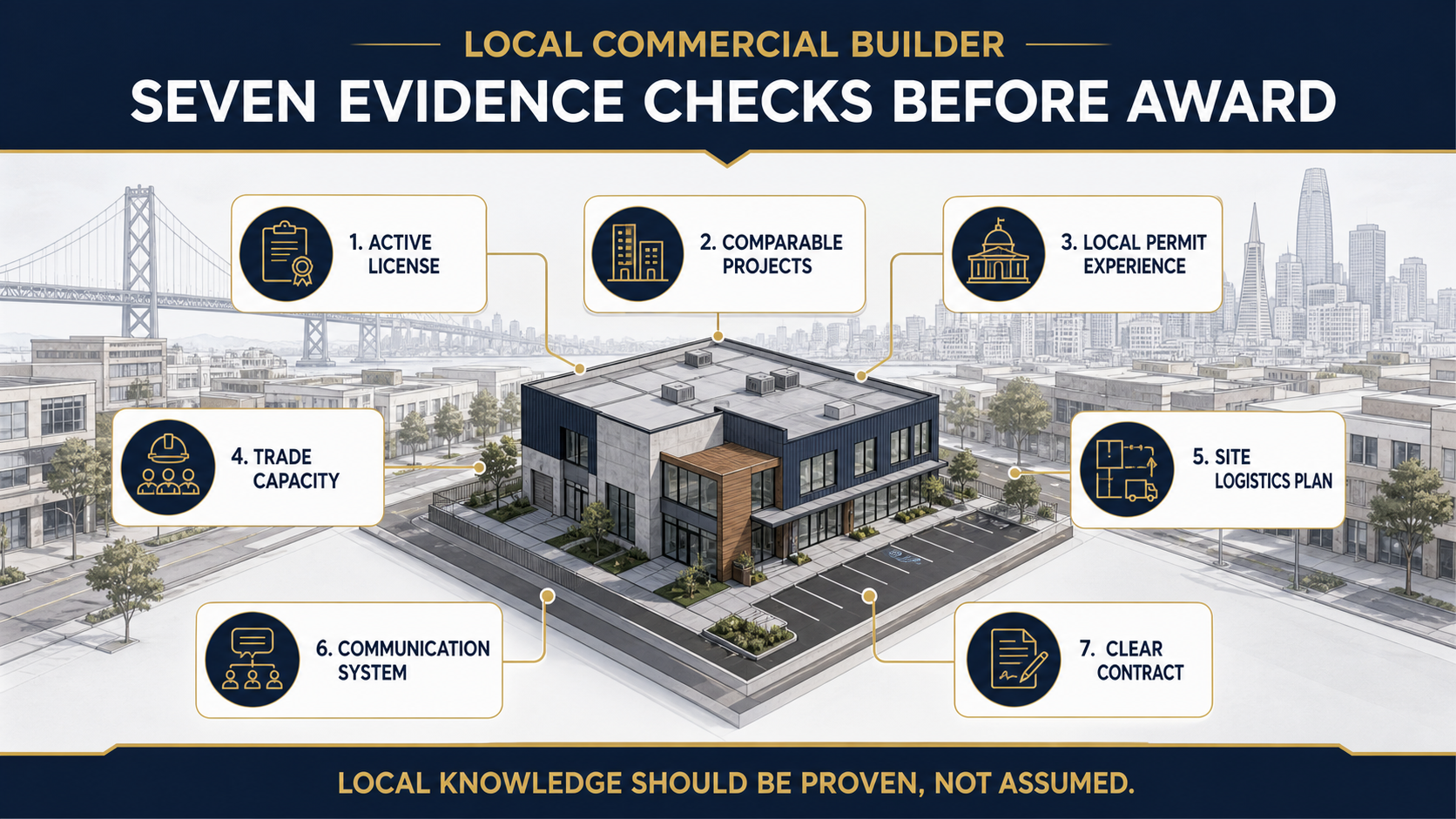
Seven Evidence Checks Before Hiring a Local Commercial Builder
1. Verify an Active and Appropriate California License
Use the CSLB license lookup to confirm status and business information. California’s CSLB states that work requiring a permit, using employee labor or reaching the current statutory threshold generally requires an appropriate active license. Verify the rule and classification for the proposed project rather than relying on an advertisement or proposal header.
Request current insurance information and review project-specific requirements with qualified advisers. CSLB notes that workers’ compensation rules depend on employment and classification conditions, while commercial general liability coverage is not universally required by the state. The owner, lender, landlord or contract may require additional coverage or limits.
2. Review Comparable Completed Projects
Ask for projects that match the proposed use, scope, building condition and operating environment. A contractor with nearby residential work is not automatically qualified for an occupied commercial tenant improvement, medical office, seismic retrofit or multi-floor renovation.
For each example, ask what the contractor actually performed, which constraints were managed, who led the project and whether that team is available. Review first-party project pages, photos and references. Specific evidence is more useful than broad statements about experience.
3. Test Local Permit and Authority Experience
Ask the contractor to describe likely approvals and responsibility boundaries without promising an approval date. Bay Area jurisdictions use different processes. Oakland, for example, identifies building permits for commercial tenant improvements and related MEP permits, with additional reviews possible for exterior modifications or a change of use. San José publishes its own commercial tenant-improvement submittal and plan-check requirements.
A credible answer should distinguish between the contractor’s coordination role, the design professional’s documents and the authority’s review. Statements such as “we know the city, so permits are automatic” are a warning sign.
4. Confirm Trade Capacity and Procurement Strategy
Local relationships can be valuable when they are backed by a real procurement plan. Ask which major trades will be involved, when they will review the documents, how bids will be compared and how qualifications, safety and insurance will be verified. The contractor should explain contingency plans for limited availability or long-lead equipment rather than promising that local relationships eliminate risk.
5. Require a Site-Specific Logistics Plan
Commercial projects may share loading areas, elevators, egress routes, utilities and occupied spaces. Ask how the builder will manage deliveries, temporary protection, access, debris, noise, dust, shutdowns, signage, security and emergency communication. The plan should respond to the building and neighborhood—not reuse a generic checklist without adjustment.
6. Evaluate the Communication and Control System
Identify the proposed project manager and superintendent. Confirm meeting cadence, reporting format, schedule updates, submittal and RFI tracking, cost forecasting and escalation procedures. Ask to see a sample report with confidential information removed. Local access is useful only when the right team is available and decisions are documented.
7. Review Contract Clarity and Closeout
The agreement should define scope, price basis, schedule obligations, insurance, payment, changes, allowances, owner responsibilities, dispute terms and closeout. Have qualified counsel and insurance advisers review the project-specific documents. Clarify permit, inspection, testing, warranty, training and turnover responsibilities before work starts.
Local Builder vs. Larger or Nonlocal Contractor
There is no universal winner. The best fit depends on the project. A larger organization may offer specialized resources, national purchasing or multi-market capacity. A local builder may offer senior access, market familiarity and a regional trade network. Owners should compare evidence against the actual risk profile.
| Selection question | Evidence to request | What not to assume |
|---|---|---|
| Can the team manage this scope? | Comparable commercial project records and named staff | Company size or proximity proves expertise |
| Can it work in this jurisdiction? | Recent relevant process experience and a permit matrix | Past work guarantees approval or timing |
| Does it have trade capacity? | Procurement plan and qualified trade coverage | Relationships eliminate labor or material risk |
| Can it manage the site? | Building-specific logistics and phasing plan | A nearby office ensures field response |
| Are costs transparent? | Detailed proposal, assumptions, exclusions and change controls | Local automatically means cheaper |
Questions to Ask a Local Commercial Builder
- Which three completed projects are most comparable to ours?
- Who will manage preconstruction and field operations?
- What existing conditions should be investigated before pricing?
- Which local agencies or building approvals may affect the work?
- Which trades are critical, and when will they review the documents?
- How will occupied areas, deliveries, shutdowns and neighbors be managed?
- What is excluded, allowed or not yet designed in the proposal?
- How will schedule and cost changes be documented?
- What closeout information will the owner receive?
- May we speak with clients from similar commercial projects?
How to Build a Defensible Shortlist
Use the same written project brief and interview questions for every candidate. Score the evidence, not presentation style. Document why each team remains in or leaves the shortlist.
| Criterion | Minimum gate | Stronger evidence |
|---|---|---|
| License and insurance | Verified status and required documentation | Clear understanding of project-specific requirements |
| Comparable work | At least one relevant commercial example | Multiple similar scopes with reachable references |
| Team capacity | Named accountable leaders | Available team with relevant building and jurisdiction experience |
| Scope and cost clarity | Written proposal and exclusions | Trade-level narrative, assumptions, alternates and risk log |
| Schedule and logistics | Preliminary sequence | Site-specific phasing, procurement and shutdown logic |
| Project controls | Written change process | Demonstrated reporting, forecasting and closeout system |
Bay Area Project Evidence
Constructive Solutions maintains individual records for completed projects rather than presenting experience only as a general claim. Examples include the Blue Bottle Coffee office renovation in Oakland, the CareMessage tenant improvement in San Francisco, the 799 Market Street lobby renovation and the 351 California Street seismic retrofit. Each page documents its own scope and should be evaluated for comparability to the proposed work.
Frequently Asked Questions
Is a local commercial builder always less expensive?
No. Pricing depends on scope, design, labor, materials, logistics, schedule, risk and market conditions. Local knowledge may improve planning, but it does not guarantee a lower cost.
Does a local contractor get permits faster?
Not necessarily. Familiarity with current procedures can help a team prepare and coordinate a submittal, but the authority reviews the documents and determines approval. Completeness, project complexity and agency workload all matter.
How local should the contractor be?
Evaluate whether the contractor regularly works in the relevant Bay Area market and can staff the site effectively. Distance alone is less important than jurisdiction knowledge, project similarity, team availability and a workable logistics plan.
What should I verify before signing?
At minimum, verify license status, relevant references, insurance, scope, exclusions, allowances, schedule assumptions, change procedures, payment terms, team assignments and closeout responsibilities. Obtain project-specific professional advice where needed.
Review Constructive Solutions’ completed commercial projects, construction services and San Francisco Bay Area general contractor overview, or discuss your project requirements.
Primary Sources Reviewed
Constructive Solutions, Inc. is a full-service commercial construction company serving San Francisco and Bay Area.
Whatever your vision, we have the resources, experience, and insight to make your concept a reality, and a space where your business can flourish.
Call Us Now for Estimate








Leave a Reply