

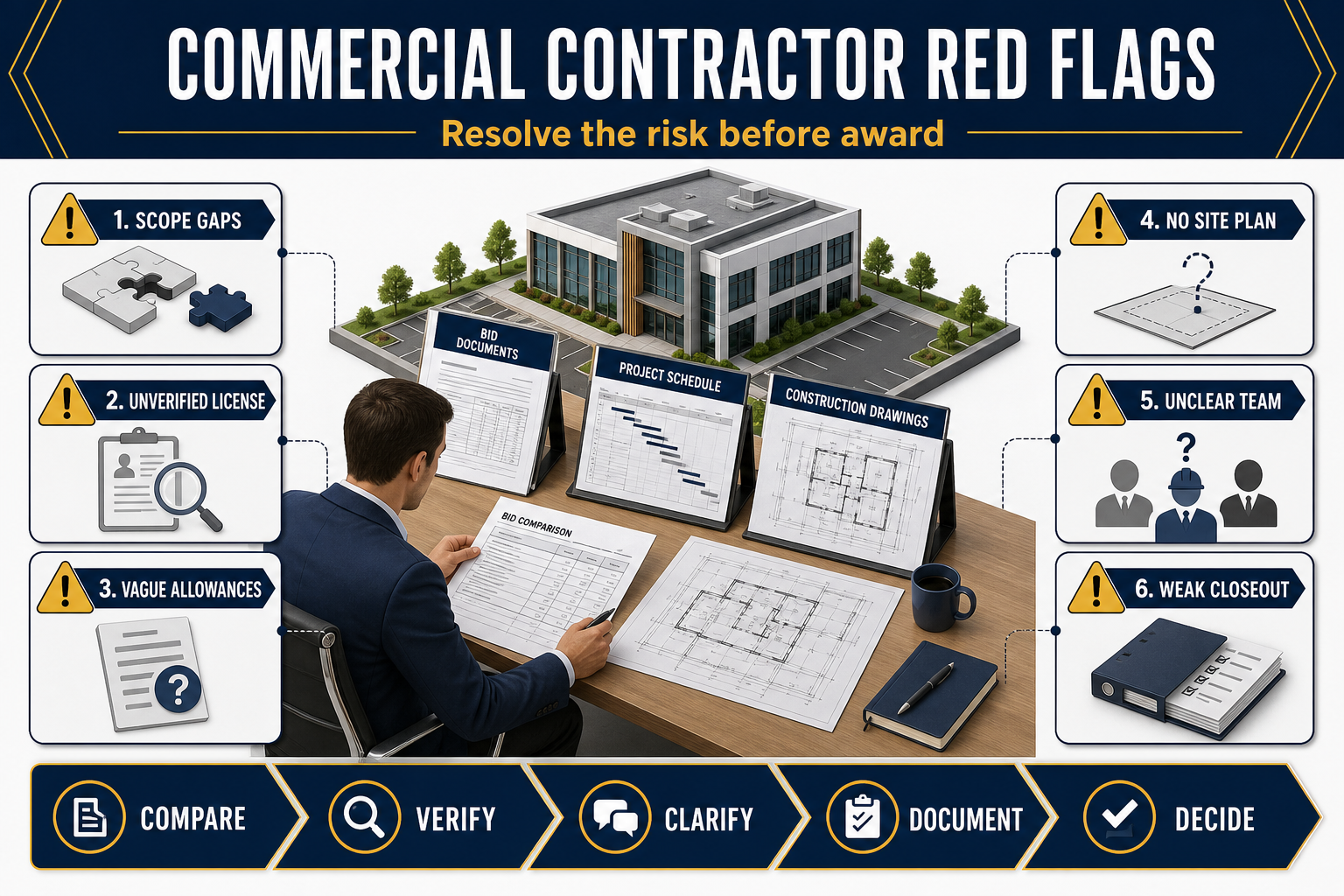
Commercial contractor red flags are not limited to an unusually low price or an expired license. The more common risk is an award decision made before the owner has normalized scope, verified the proposed team, tested the site plan and documented how uncertainty, changes and closeout will be handled.
We recommend treating every warning sign as a question to resolve, not an accusation. A proposal may be incomplete because the issued information was incomplete. A schedule may lack logic because property rules were not provided. The owner’s job is to create a consistent information basis; the contractor’s job is to disclose assumptions and demonstrate an executable approach.
1. The Proposal Cannot Be Tied to a Clear Scope
A proposal should identify the drawings, specifications, addenda and scope narrative it used. If the contractor priced an early plan set while another proposer used a later revision, the totals are not comparable. Ask each team to state inclusions, exclusions, alternates, allowances, owner-furnished items and work by others.
The red flag is not the presence of exclusions. It is a responsibility gap that nobody can explain. Resolve gaps through a common clarification issued to all proposers before award.
2. License Information Cannot Be Verified
Use the California Contractors State License Board’s current license-check service to verify the business name, status and classifications relevant to the offered work. CSLB also displays bond, workers’ compensation and disclosure information. Status can change, so save the verification date as part of the selection record.
Insurance requirements should be established with the owner’s risk and legal advisers. A website badge, proposal statement or old certificate should not replace current verification from the appropriate source.
3. Allowances and Assumptions Are Vague
Allowances can be appropriate when design or selections are incomplete, but each allowance needs a basis: quantity, quality level, unit, labor assumptions and related work. A round number without a basis hides rather than manages uncertainty.
Ask what happens if the final scope differs. Confirm whether taxes, freight, installation, equipment, design, testing and schedule effects are included. The agreement should define how adjustments are handled.
4. The Schedule Is a Date Without Logic
A completion date should connect to design releases, permits, procurement, access, mobilization, inspections, owner decisions and turnover. Ask for the assumptions behind important milestones and identify activities controlled by agencies, utilities, landlords or suppliers.
No qualified contractor can guarantee how every outside party or concealed condition will behave. The useful evidence is a schedule with dependencies, decision dates and a method for updates.
5. There Is No Building-Specific Logistics Plan
Commercial work may affect tenants, customers, patients, employees, neighbors and other employers. A proposal that says only “minimize disruption” does not address access, egress, deliveries, elevators, noise, dust, odor, temporary protection, waste, shutdowns, security or emergency procedures.
OSHA’s recommended practices emphasize communication and coordination when host employers, contractors and other employers share a worksite. Ask who communicates hazards, operational restrictions and changes before work begins and as conditions change.
6. The Proposed Project Team Is Unclear
Company experience and proposed-team experience are not the same. Request the project manager, superintendent and other key roles, along with availability and decision authority. Ask which comparable projects involved those people and whether substitutions require owner review.
A résumé alone does not show how the team will manage submittals, RFIs, changes, schedule reporting and field coordination. Review the actual workflow and sample records where appropriate.
7. References Are Generic or Unverifiable
Ask for references relevant to the property type, scale and constraints. Confirm the contractor’s role and the proposed staff’s participation. Useful questions address communication, scope clarity, response to changed conditions and closeout—not simply whether the reference “liked” the contractor.
First-party project records should state facts that can be checked. Avoid accepting a marketing case study that lacks an identifiable project, role or evidence boundary.
8. Change Control Is Informal
The team should explain how it records a changed condition, obtains design direction, evaluates cost and schedule effects and receives authorization. Informal conversations can help coordination, but they should not become the only record for consequential direction.
Ask who may authorize work and what happens in an urgent condition. The contract and responsible advisers—not this article—determine entitlement and approval requirements.
9. Quality Control Begins Only at Punch List
Quality control should begin with document review and continue through submittals, mockups, first installations, concealed work, testing, inspections and correction. Ask how the contractor verifies requirements before work is covered.
Contractor checks do not replace design-professional review, testing or authority inspections. The proposal should identify the intended coordination path.
10. Closeout Is Defined as “Done”
Define closeout deliverables before award. Depending on the project, they may include correction lists, warranties, manuals, record information, training, keys, attic stock, equipment data and property-management documentation.
Substantial completion, occupancy authorization, owner acceptance and final contract completion can be different milestones. The project documents should use precise terms.
Commercial Contractor Red-Flag Review Matrix
| Area | Evidence to request | Action before award |
|---|---|---|
| Scope | Document list, narrative, inclusions and exclusions | Issue shared clarifications |
| Credentials | Current license and required insurance information | Verify with responsible sources and advisers |
| Price basis | Allowances, quantities, assumptions and alternates | Normalize proposal basis |
| Execution | Schedule logic, logistics and proposed staff | Interview the actual team |
| Controls | RFI, change, quality and reporting workflows | Document responsibilities |
| Closeout | Deliverable and approval matrix | Add requirements to the agreement |
What a Strong Response Looks Like
A strong contractor response is specific about what is known and transparent about what is not. It ties the price and schedule to the same documents, identifies the proposed team, adapts logistics to the building and shows how decisions become records. It does not promise approval, savings or a problem-free project.
For a positive selection framework, see our San Francisco commercial contractor selection guide. For renovation-specific proposal questions, use our commercial renovation contractor interview guide.
Frequently Asked Questions
Is the lowest commercial construction proposal a red flag?
Not by itself. It becomes a concern when the lower total results from missing scope, different documents, unrealistic assumptions or an execution plan that cannot be explained.
Should an owner reject every proposal with exclusions?
No. Exclusions can clarify responsibility. The owner should understand who performs and pays for the excluded work and whether all proposals use the same basis.
How can an owner verify a California contractor?
Use CSLB’s current license-check service and consult the appropriate risk, legal and insurance advisers for project-specific requirements.
Can a scorecard select the contractor automatically?
No. A scorecard organizes evidence; it does not replace judgment, procurement rules, references, interviews or professional advice.
Explore our commercial construction services and preconstruction approach, or share the project information needed for a scope-based conversation.
Primary Sources Reviewed
Constructive Solutions, Inc. is a full-service commercial construction company serving San Francisco and Bay Area.
Whatever your vision, we have the resources, experience, and insight to make your concept a reality, and a space where your business can flourish.
Call Us Now for Estimate









Leave a Reply