

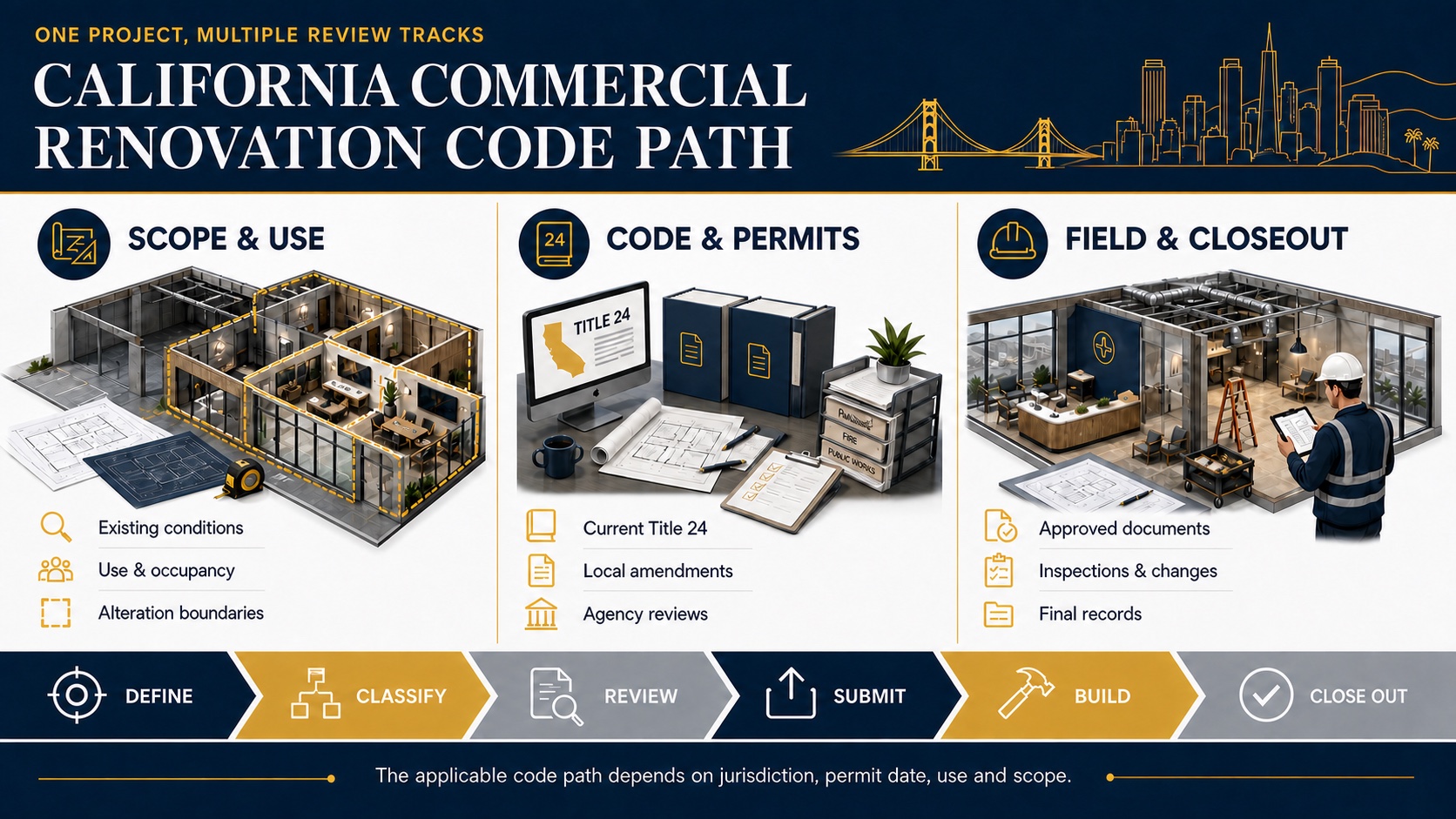
California commercial renovation code compliance begins with four facts: jurisdiction, permit date, existing use and proposed scope. Those facts determine which code edition, local amendments, agency reviews and alteration provisions need project-specific analysis. A renovation can touch building, accessibility, fire/life-safety, structural, electrical, mechanical, plumbing, energy and green-building requirements without every code provision applying in the same way.
This guide is a construction-planning framework, not a code opinion, permit determination or legal guarantee. The owner should engage appropriate licensed design professionals and confirm requirements with the authority having jurisdiction.
Which California building code applies in 2026?
The California Building Standards Commission states that the 2025 California Building Standards Code, Title 24, became effective January 1, 2026. The correct edition for a particular project can depend on the permit application date, jurisdictional process, project type and any applicable exceptions or emergency provisions. Do not update a drawing title block from “2022” to “2025” without confirming the governing basis.
Title 24 is composed of multiple parts. Commercial alterations may implicate the Building Code, Electrical Code, Mechanical Code, Plumbing Code, Energy Code, Existing Building Code, Fire Code, CALGreen and referenced standards, among others. Local jurisdictions may adopt amendments and separate administrative requirements.
Start with a code-path brief
| Input | Questions to document |
|---|---|
| Jurisdiction | Which city, county, state or special agency reviews the work? What local amendments and submittal processes apply? |
| Permit timing | When will the application be filed, and which code edition and forms does the jurisdiction require? |
| Existing and proposed use | What are the legal use, occupancy classification, occupant load and proposed operational changes? |
| Alteration scope | Which walls, systems, fixtures, equipment and exterior/site elements change? What is repair or maintenance versus an alteration? |
| Existing conditions | Which records are available, what has been field verified and what remains concealed or assumed? |
Major commercial renovation review tracks
Use, occupancy and egress
A change in tenant or layout is not automatically a change of occupancy, and a change of occupancy is not determined by informal description alone. The design professional and jurisdiction assess the existing and proposed classifications, occupant load, exits, travel, separation, fire protection and related provisions. Confirm legal use records early.
Accessibility
Commercial alterations can involve federal ADA obligations, California accessibility requirements and local submittal procedures. Review the altered elements and any applicable path-of-travel scope. The 2010 ADA Standards and California Chapter 11B analysis should be performed in the context of the actual facility and work—not reduced to a generic “20 percent of construction cost” statement without its governing details and exceptions.
Structural and seismic
New openings, equipment, rooftop loads, storage, partitions, changes of use or removal of existing construction may need structural evaluation. Seismic requirements can depend on building type, work scope, local programs and triggers. A contractor should not make the engineering determination.
Fire and life safety
Review construction type, occupancy, separations, egress, alarms, sprinklers, fire-resistance, hazardous materials and fire-department access as applicable. Fire review and inspection responsibilities vary by jurisdiction and scope.
Mechanical, electrical and plumbing
Tenant equipment and space changes can affect HVAC loads, ventilation, power, lighting, plumbing fixtures, utility capacity and controls. Existing drawings are a starting point; field verification and engineering analysis may be needed.
Energy and CALGreen
The California Energy Commission states that permit applications submitted on or after January 1, 2026 generally use the 2025 Energy Code. The official 2025 Nonresidential Compliance Manual addresses additions and alterations. Requirements depend on the components altered and selected compliance path; the code does not impose the same package on every renovation.
Permits are scope-specific
Not every action requires the same permit, and permit responsibility should not be assumed. Some work may require building, electrical, mechanical, plumbing, fire, planning, public-works, health or other approvals; limited work may follow a different local path. The owner and design team should confirm the required submissions with the jurisdiction.
| Phase | Control | Record |
|---|---|---|
| Existing-condition review | Separate verified facts from old drawings and assumptions | Document index, survey notes, investigation reports and open questions |
| Design and submittal | Use a responsibility matrix and coordinated design set | Code analysis, permit log, agency comments and approved revisions |
| Construction | Build from current approved documents; elevate conflicts and changed conditions | Submittals, RFIs, change records, inspection requests and test reports |
| Closeout | Complete required inspections, corrections and acceptance items | Final approvals, manuals, warranties, training and record documents required by agreement |
Plan review is not the same as construction coordination
The design team develops and signs professional documents within its scope. Authorities review and inspect within their jurisdiction. The contractor coordinates trade execution and documentation assigned by contract. Owners make business and commercial decisions. Clear boundaries matter because permit approval does not direct every means-and-methods decision, and contractor experience does not replace professional design.
Common code-planning mistakes
- Using an outdated Title 24 edition or form set without checking the permit date.
- Assuming a prior tenant’s approved use or drawings match current conditions.
- Waiting until bid day to identify accessibility, structural, fire or energy questions.
- Treating landlord criteria as a substitute for public-agency requirements—or vice versa.
- Starting work because a permit was filed even though it was not issued.
- Making field changes without determining whether revised design or agency review is needed.
- Assuming inspections occur at one universal percentage of completion.
How preconstruction helps
Commercial preconstruction can organize existing information, constructability questions, logistics, estimate assumptions, schedule dependencies and procurement decisions around the design and permit path. It should not promise approvals. Constructive Solutions’ commercial preconstruction services provide the construction-side framework, while its commercial renovation services support delivery of the approved scope.
Relevant project evidence
The published 2765 16th Street core-and-shell project documents design-build work involving abatement, demolition, concrete and saw cutting, structural steel, waterproofing, roofing, electrical and plumbing. The breadth of that recorded scope illustrates why alteration boundaries and discipline coordination matter. It is not evidence that another project will follow the same code path.
Frequently asked questions
Does every commercial renovation require a building permit?
Permit requirements are jurisdiction- and scope-specific. Building, trade or other approvals may apply even when a full building permit does not. Confirm before work begins.
Is the 2025 California code now effective?
Yes, the statewide 2025 California Building Standards Code became effective January 1, 2026. The governing edition for a particular project still depends on its permit and jurisdictional circumstances.
Does a tenant improvement trigger accessibility work?
It can. The analysis depends on altered elements, areas, use, path-of-travel provisions and applicable federal, state and local requirements. Obtain project-specific review.
Who obtains the permits?
The owner, design professional, contractor or permit expediter may handle different submissions depending on the jurisdiction and agreement. State responsibilities explicitly.
Does passing final inspection guarantee every legal obligation is satisfied?
No blanket guarantee should be inferred. Inspection is an important jurisdictional control, but owners may have contractual, federal, operational or other obligations outside that inspection.
Prepare a California commercial renovation
Before pricing construction, assemble the legal-use records, existing drawings and reports, intended program, alteration scope, landlord criteria, target permit date and open agency questions. Then review Constructive Solutions’ commercial construction services and documented project portfolio to evaluate construction fit.
Constructive Solutions, Inc. is a full-service commercial construction company serving San Francisco and Bay Area.
Whatever your vision, we have the resources, experience, and insight to make your concept a reality, and a space where your business can flourish.
Call Us Now for Estimate









Leave a Reply